Digital transformation for SMEs
Digital transformation for a Dubai SME means fixing one real customer or operating problem with the right tool, not buying expensive software. Most owners get this backwards.
A restaurant owner in Deira spent over AED 50,000 on a point-of-sale (POS) system that nobody on the team could use. Meanwhile, his biggest problem was that customers could not find his menu online. A simple Google Business Profile listing would have helped more than all that technology.
This happens everywhere, and the stakes are rising. The Dubai Economic Agenda (D33) counts on digital transformation to generate new economic value of an average of AED 100 billion a year. A lot of money and attention is moving to technology. The question is whether yours is being spent wisely.
What digital transformation actually means for SMEs
Digital transformation for an SME comes down to three things, not to AI or blockchain or whatever buzzword is trending this week:
- Making it easier for customers to find and buy from you
- Doing boring tasks faster so you can focus on important work
- Understanding your business better through data
Everything else is detail.
You are in good company. SMEs make up around 94% of all businesses in the UAE, and the country added roughly 250,000 companies in 2025. Your competitors are modernising, and so are the businesses you sell to. Our SME solutions page shows how growing businesses add senior support without adding headcount.
Where Dubai SMEs stand today
Dubai's support bodies are backing new businesses at scale. Dubai SME helped launch 3,461 new Emirati businesses in 2024, 524 more than the year before. These businesses are succeeding, but not always because of technology.
The ones that do well understand something important: digital transformation starts with problems, not solutions.
The April 2024 floods showed why. Businesses whose systems lived in the cloud could keep working while their offices were inaccessible. Nobody planned for a flood. They simply wanted to reach their data from anywhere.
Your customers are online, too. The question is whether you are meeting them where they are.
Building your strategy (without the buzzwords)
Forget frameworks and methodologies. Here is how to actually do this.
Start with one problem
Pick your biggest headache. The thing that makes you want to throw your computer out of the window. Maybe it is:
- Customers calling to ask the same questions over and over
- Invoices getting lost in email
- Not knowing which products actually make money
- Staff doing data entry instead of selling
Just pick one. Fix that first.
Set a real goal
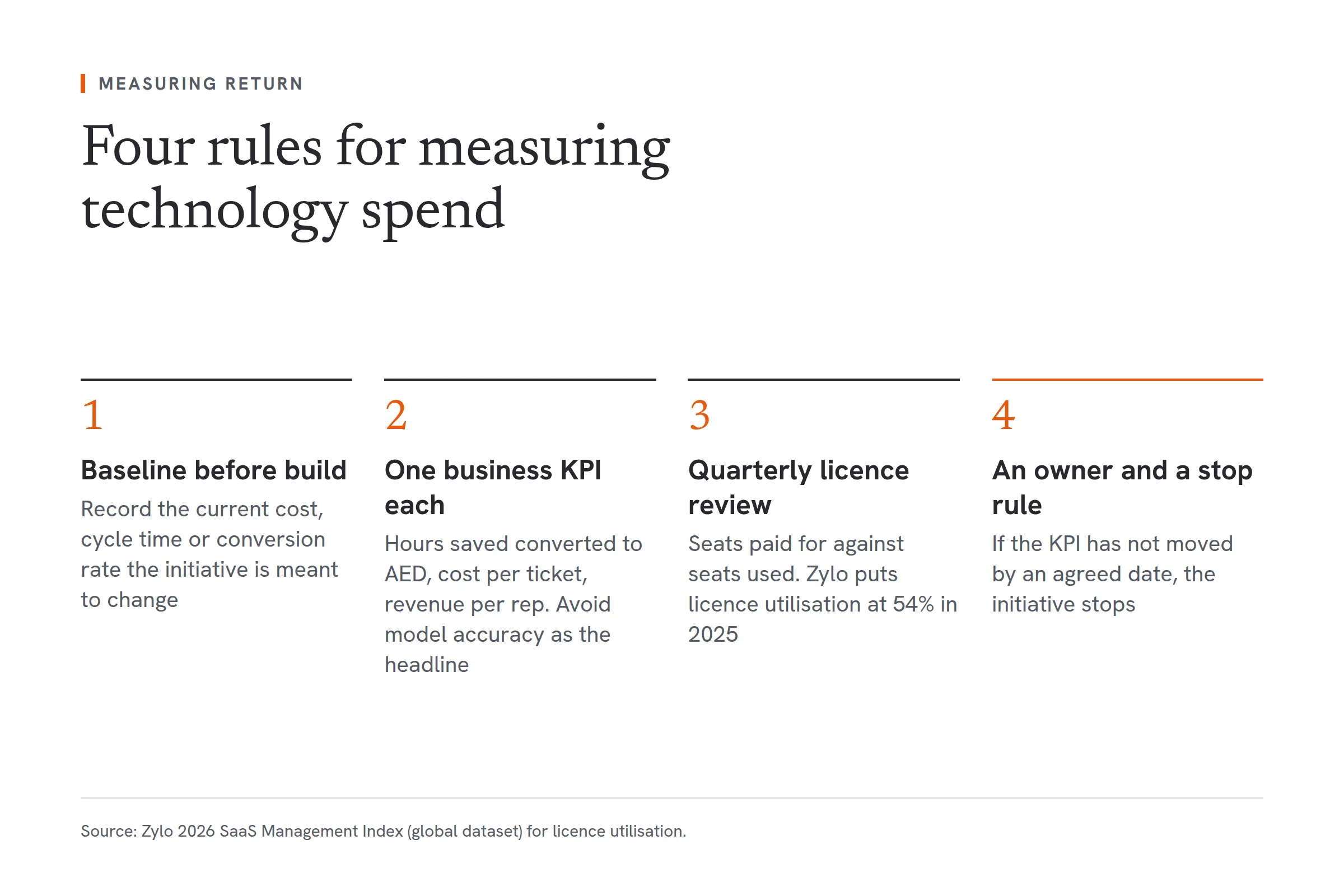
"Digital transformation" is not a goal. "Reduce time spent on invoicing by 80%" is a goal. "Get 50% of orders through our website instead of phone calls" is a goal.
Good goals have numbers and deadlines. Make sure you know exactly what you are buying with your technology budget and which number it should move.
Start small, think big
You do not need to transform everything at once. In fact, you should not. Start with something small that you can finish in a month. Get a win. Then build on it.
The government takes the same approach. The Dubai Chamber of Digital Economy supported 1,210 digital startups in 2024, 120% more than in 2023. It builds momentum step by step rather than changing everything overnight.
The technologies that actually matter
Here is what Dubai SMEs use successfully.
Cloud everything
This is non-negotiable now. Cloud computing lets SMEs put resources precisely where they are needed and avoid paying for capacity they do not use. Start with:
- Google Workspace or Microsoft 365 for documents
- Cloud accounting that can work with the UAE e-invoicing system (see the next section)
- WhatsApp Business (yes, it counts)
Customer relationship management (CRM)
Fancy name, simple concept: remember everything about your customers. Who bought what, when they last visited, and what they complained about. Humans forget. Software does not.
E-commerce that works
Even if you are business to business, your customers expect to browse your catalogue online. Make it easy for them. A fast, simple site that takes enquiries or orders beats an ambitious platform that nobody maintains.
Digital payments
Cards, wallets and payment links are now what customers expect in the UAE. If you are still cash-only, you are leaving money on the table. Literally.
Basic analytics
You do not need AI. You need to know:
- Where customers come from
- What they buy together
- When they stop buying
Google Analytics is free. So is Google Business Profile insights. Start there.
E-invoicing and data protection now shape your tool choices
The UAE is moving to mandatory electronic invoicing, so any accounting or invoicing tool you buy today should be ready for it.
Under Ministerial Decisions 243 and 244 of 2025, the Ministry of Finance set the timetable. A pilot and voluntary adoption began on 1 July 2026. Then:
Business | Appoint an Accredited Service Provider (ASP) | Go live |
|---|---|---|
Revenue of AED 50 million or more | 30 October 2026 (extended from 31 July 2026) | 1 January 2027 |
Revenue below AED 50 million | 31 March 2027 | 1 July 2027 |
Government entities | 31 March 2027 | 1 October 2027 |
The extension of the first deadline to 30 October 2026 did not move the January 2027 go-live date. Business-to-consumer transactions are outside the system until the Minister decides otherwise. Invoices move between suppliers and buyers through an ASP, and tax data is reported to the Federal Tax Authority.
The cost of missing it is real. Cabinet Decision 106 of 2025 sets penalties of up to AED 5,000, including a fine of AED 5,000 for each month a business fails to appoint an ASP or implement the system on time.
What this means for you:
- Ask every accounting, ERP or invoicing vendor how they connect to an accredited provider before you sign
- Clean your customer and supplier data now, because the system needs accurate tax registration details
- Put the dates in your roadmap below, working back from your go-live date
Data protection deserves the same attention. The UAE Personal Data Protection Law (Federal Decree-Law 45 of 2021) has been in force since 2 January 2022. It requires companies to secure personal data, prohibits processing it without the owner's consent except in specific cases, and sets conditions on sending data outside the UAE. Choosing a CRM or cloud platform therefore includes asking where the data sits and who can access it.
Your 12-month roadmap
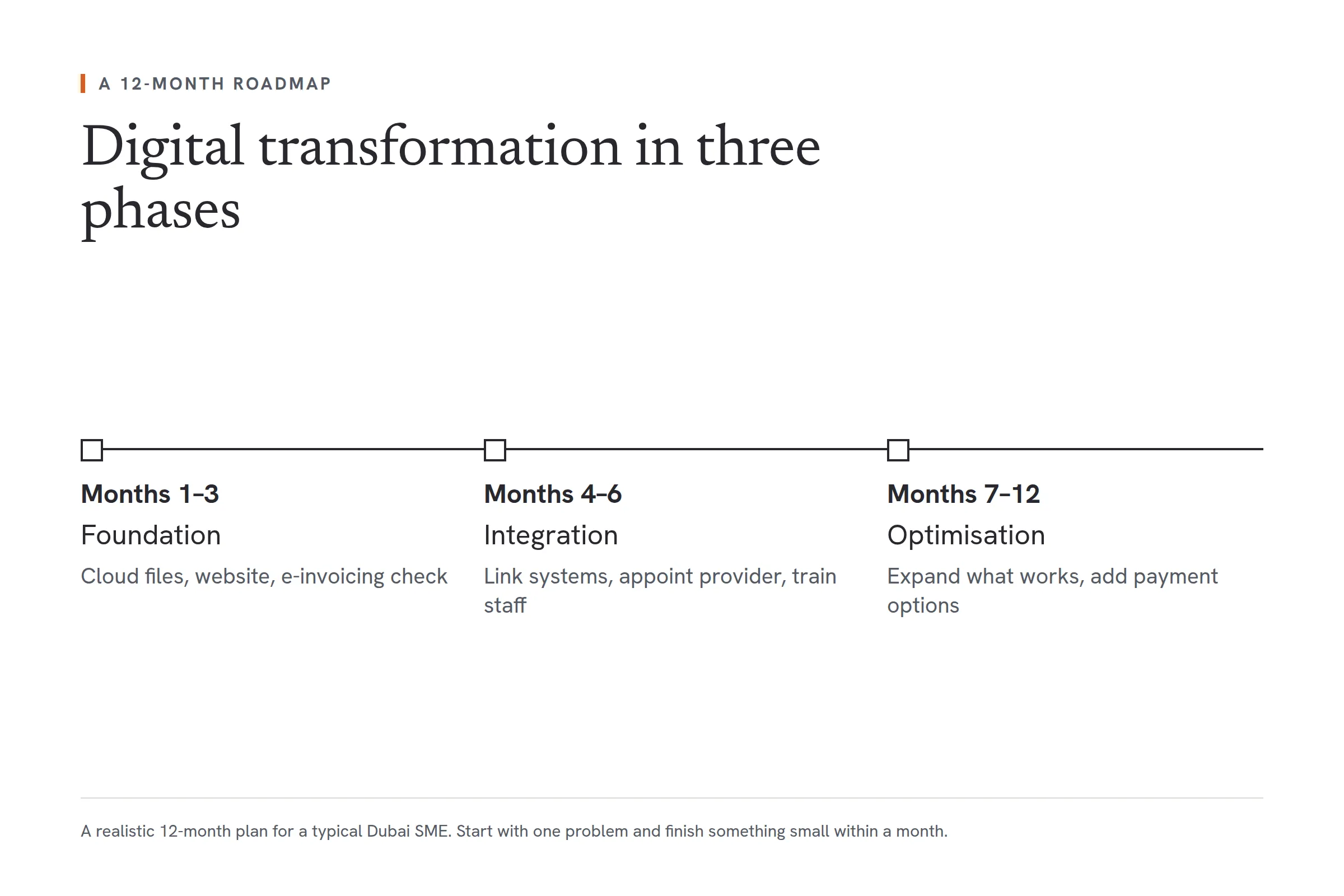
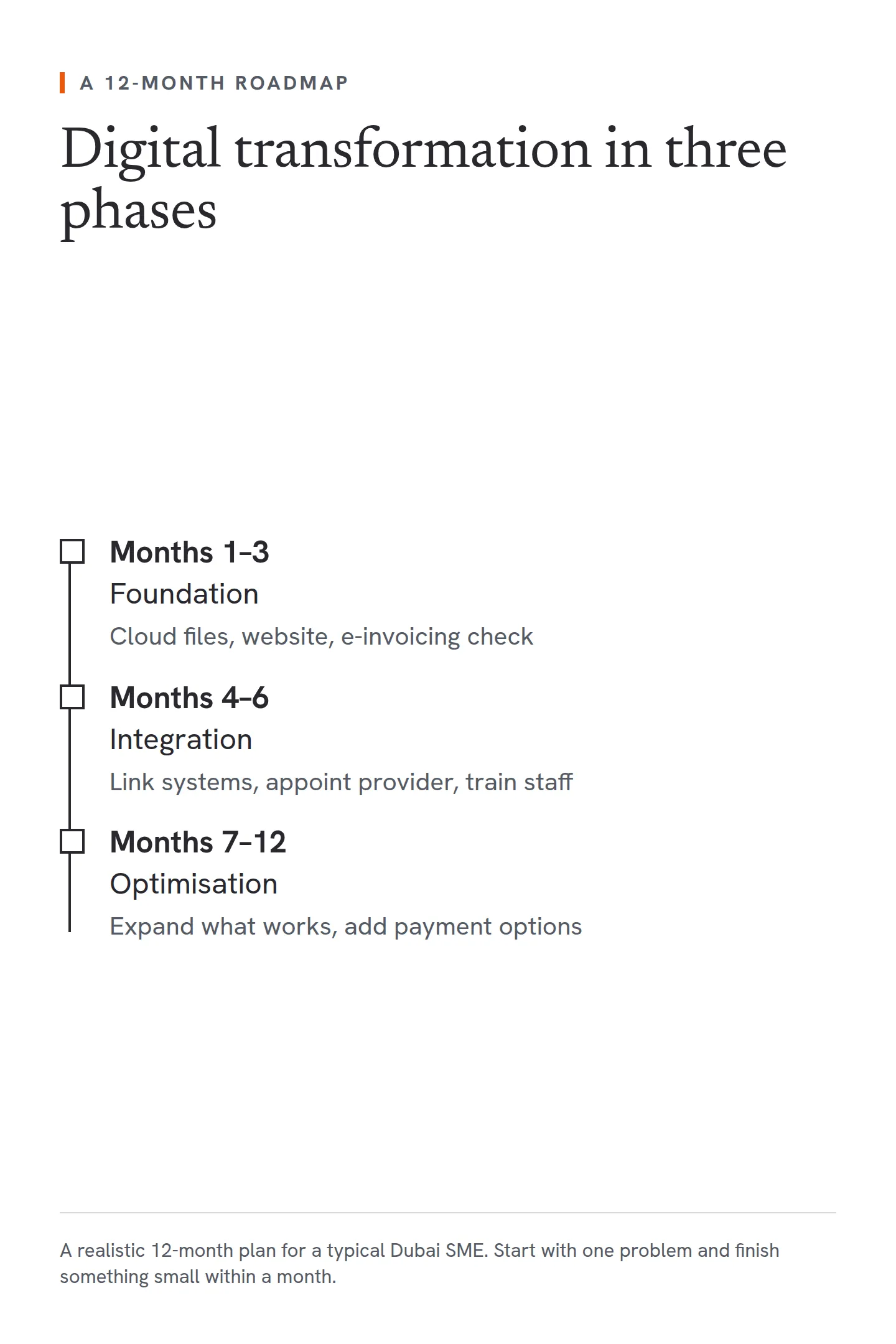
Here is a realistic timeline that works.
Months 1-3: foundation
- Move your files to the cloud
- Set up a proper website (not just Instagram)
- Get your Google Business Profile listing right
- Start collecting customer emails properly, with consent
- Confirm which e-invoicing phase applies to you and shortlist ASPs
Months 4-6: integration
- Connect your systems (accounting to inventory, website to WhatsApp)
- Appoint your ASP and test e-invoices before the go-live date
- Automate one repetitive task
- Train your team properly (this always takes longer than you think)
- Set up basic reporting
Months 7-12: optimisation
- Analyse what is working and what is not
- Add more payment options
- Expand what is successful
- Consider advanced tools only for proven needs
The problems nobody talks about
Here is what will go wrong, so you can plan for it.
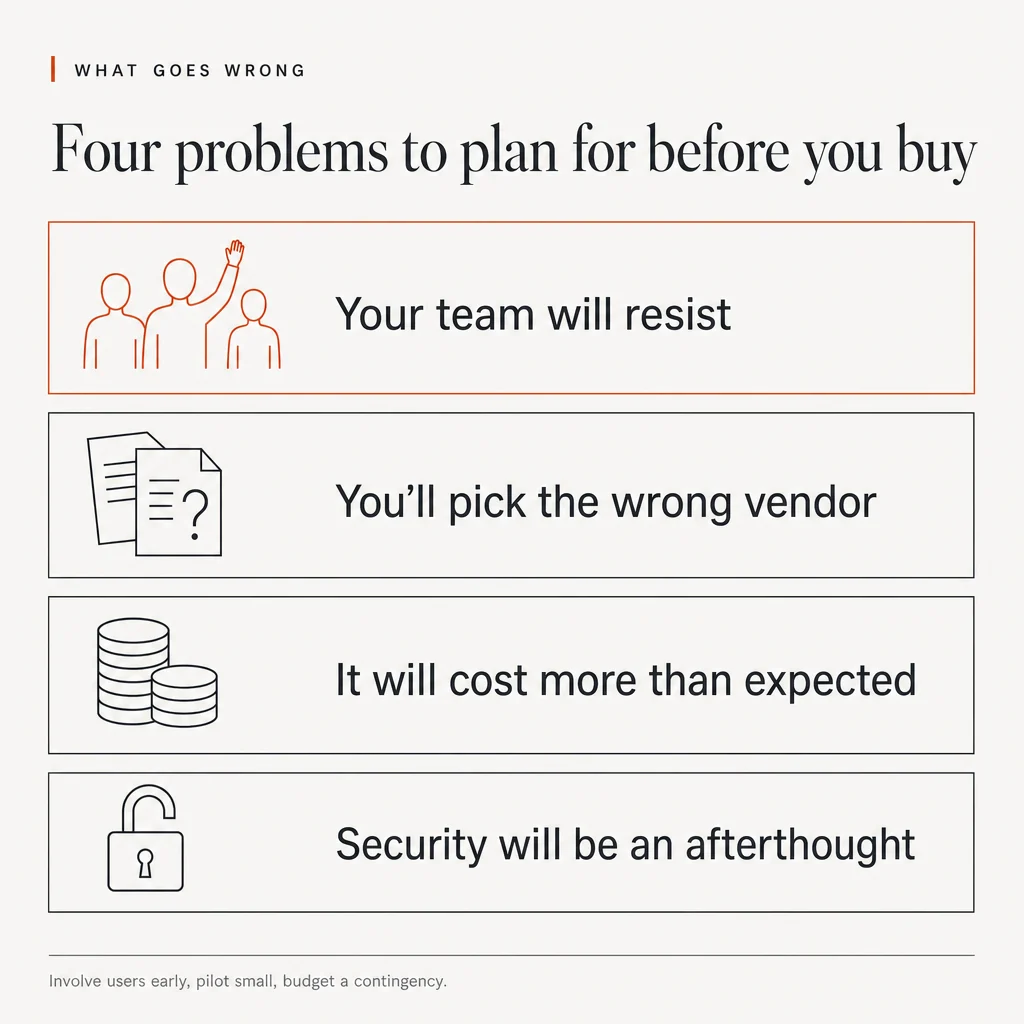
Your team will resist
They always do. Not because they are bad people, but because change is uncomfortable. The fix is to show them how the new tool makes their job easier, not harder, and to involve the people who will use it before you choose it.
You'll pick the wrong vendor
Everyone does at least once. The salesperson will promise everything. The software will do half of it. To avoid this:
- Get references from similar businesses
- Start with a small pilot project
- Never pay everything up front
- Have an exit plan
- Define what successful looks like
It will cost more than expected
Set aside a generous contingency, on top of the licence price, for:
- Training (always underestimated)
- Integration (nothing talks to anything else)
- Customisation (because your business is unique)
- A second consultant to fix what the first one broke
Before buying new tools, check whether technology debt is the real problem. Piling software on top of broken foundations rarely works.
Security will be an afterthought
Mastercard's 2025 survey of small businesses found that 47% of UAE small businesses have experienced a cyberattack. The threat is not only aimed at large organisations. In February 2026 the head of the UAE Cyber Security Council put breach attempts against the country at 90,000 to 200,000 a day, and the Council described ransomware and phishing campaigns among the methods used.
Use two-factor authentication. Back up everything, and test the restore. Train your staff not to click suspicious links. It is not optional any more.
If you hold sensitive customer or financial data, write down who can access it, where it is stored and how you would respond to a breach, then put protections in place that match.
Measuring what matters
You will know it is working when:
- Customers stop asking questions you have already answered online
- Your team spends less time on repetitive tasks
- You can see your business performance in real time
- Revenue per employee increases
Do not measure technology adoption. Measure business outcomes.
What this really means for you
Digital transformation is not about becoming a tech company. It is about using technology to become better at what you already do.
The businesses Dubai's support bodies back are not all tech startups. They are restaurants using online ordering, trading companies with automated inventory, and service businesses with online booking.
The pattern is consistent. They start with their customers' problems, not with technology solutions.
Your next steps
- This week: List your three biggest operational headaches
- Next week: Research simple solutions for the biggest one, and check your e-invoicing date
- This month: Implement one small change
- Next month: Measure whether it actually helped
That is it. No grand strategy needed. Digital transformation is another tool to help you do what you already do well, better.
Need strategic guidance?
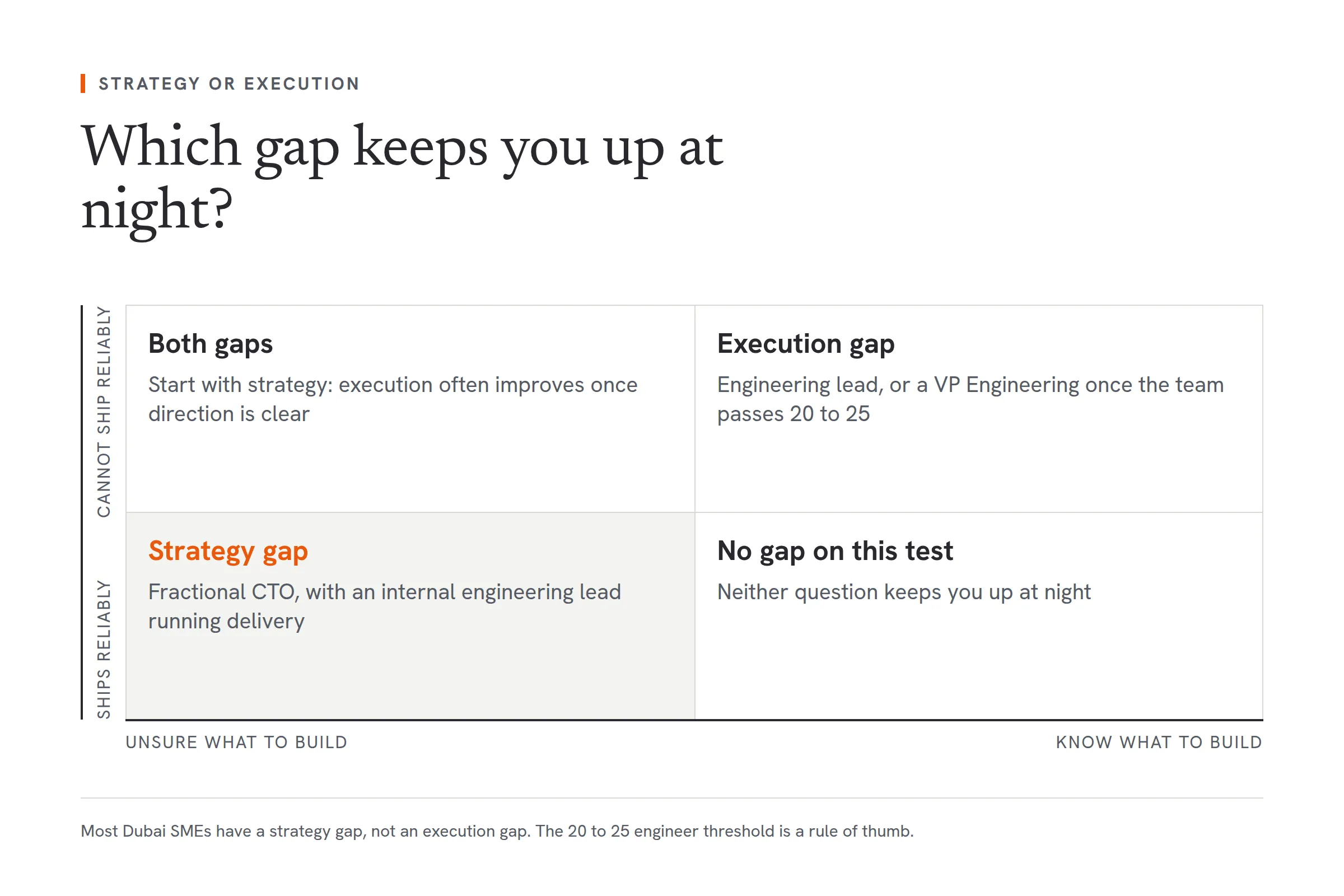
Sometimes you need someone who has done this before, who can spot the pitfalls and shortcuts. That is where a fractional Chief Technology Officer (CTO) can guide your digital transformation without a full-time salary.
An executive from our collective of 350+ curated and vetted executives embeds in your business, works alongside your team and makes sure technology serves the business, not the other way around. They can help you:
- Choose the right technologies without overspending
- Avoid the vendor traps everyone falls into
- Build a realistic roadmap, including the e-invoicing and data-protection dates that apply to you
- Train your team to embrace change instead of fighting it
Engagements are business to business, with one month's notice, and we can typically deploy within weeks. Learn how a fractional CTO can accelerate your digital transformation, explore our fractional CTO service, see how fractional CFO services can help you budget wisely, take our fractional CTO readiness assessment or talk to our team.