Challenges of Dubai expansion
International expansion looks simple from Dubai. It's not. Companies consistently underestimate the complexity, overestimate their readiness, and split focus at precisely the wrong moment. Here's what actually goes wrong.
Let me tell you what nobody mentions at networking events
I spent over a decade building startups in the UK before moving to the Middle East. And here's something I learned the hard way: what works brilliantly in one market can fail spectacularly in another, even when the markets look similar on paper.
The number of confident Dubai founders I've met who say "we're thinking of expanding to Saudi" or "Egypt seems like an obvious next step" is staggering. The number who actually succeed? Considerably smaller.
Not because they're incompetent. Because international expansion is genuinely difficult, and nobody tells you where the landmines are until you've already stepped on a few.
The strategy problem (or lack thereof)
Most expansion decisions happen over coffee. Someone mentions their competitor opened in Kuwait. A big client asks if you operate in Oman. A conference speaker makes Saudi Arabia sound like easy money.
That's not a strategy. That's expensive improvisation. Market entry without operational readiness is how Dubai companies become cautionary tales.
When I rebuilt One Tribe Global's platform to handle multi-region operations, the technical challenge wasn't the hard part. The hard part was understanding how different markets actually operated before we committed resources.
What actually needs to happen before you expand:
Real customer research in the target market. Not surveys. Actual conversations with people who'd potentially buy from you. Their problems might be different than you think.
Regulatory mapping with local legal counsel. What's straightforward in Dubai can be bureaucratic hell elsewhere. Find out before you're committed.
Financial modelling that accounts for delays. Everything takes longer than you think. Sales cycles stretch. Relationship building extends. Budget for reality, not optimism.
Competitive analysis of companies already operating there. Not the competitors you've heard of. The local players you haven't. They know things you don't.
The brutal question: Can you actually afford to operate in two markets simultaneously for 18 months or more before the new one pays its own way? That is our working assumption, not a published benchmark, and it is usually conservative.
Most companies can't. They expand anyway.
The operational complexity that breaks everything
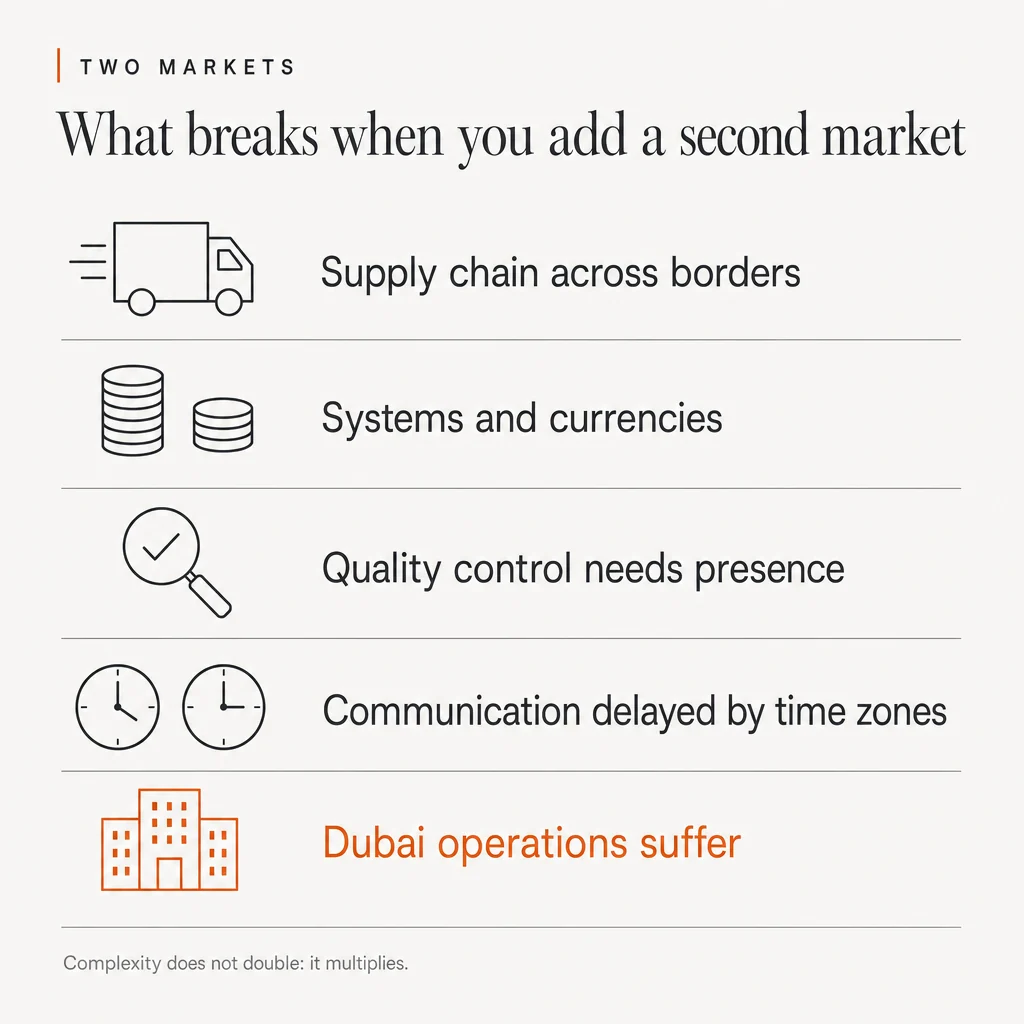
Here's what happens when you go from one country to two: complexity doesn't double. It multiplies geometrically.
I've migrated monolithic systems to serverless architecture. The technical principle is simple: distributed systems are exponentially more complex than centralised ones. The same applies to business operations.
What actually breaks:
Your supply chain becomes unreliable across borders. Your technology systems struggle with multiple currencies and local requirements. Your quality control depends on physical presence, which you no longer have. Your team communication has time zone delays baked in.
And here's the part that kills companies: your Dubai operations suffer while you're distracted building the new market. Your existing clients get less attention. Your team feels abandoned. Strategic decisions get delayed.
The questions worth asking honestly:
Are your processes documented well enough to work without you there?
Can your current systems actually handle multi-country operations, or will you need to rebuild everything?
Do you have a leader who can genuinely run your Dubai operations while you focus on expansion? A fractional Chief Operating Officer (COO) or fractional Chief Financial Officer (CFO) can hold the home market steady. Executive decision paralysis often sets in when founders try to govern two markets from one desk.
Can you maintain quality without being physically present?
If you answered no to more than one, you're not ready. Expand anyway and you're just funding an expensive education.
The cultural intelligence gap
Dubai is remarkably international. Your team speaks multiple languages. You work with diverse clients daily.
This creates a dangerous illusion: you think you understand how to operate across cultures.
You don't. Neither did I when I first moved from London to working with EMEA markets.
What I learned:
Relationship timelines that work in Dubai's fast-paced environment don't exist elsewhere. Your direct communication style can backfire in more traditional markets. Your marketing needs a complete rethinking, not just translation.
Decision-making processes vary wildly. What's a quick founder decision in Dubai might require committee approvals and months of relationship building in your target market.
The companies that succeed? They spend serious time understanding the new market before committing. They hire local advisers who've actually operated there. They test their assumptions early and cheaply.
The companies that fail? They assume Dubai's approach will work everywhere with minor adjustments.
The leadership problem nobody wants to discuss
You cannot run two markets simultaneously as a founder. Full stop.
I've watched this destroy otherwise solid companies. The founder attempts to split time between markets. Dubai operations deteriorate. New market struggles. Both suffer.
At Antler Digital, we learned early that distributed operations require dedicated leadership in each location. Not "I'll fly back and forth." Not "I'll handle both remotely." Actual leadership presence.
Your realistic options:
Hire full-time executives for each market. Expensive. Slow to recruit. High commitment.
Split your own focus. Cheap initially. Devastating long-term. Consistently fails.
Engage fractional leadership who know what they're doing. Flexible, and no full-time commitment. Our engagements typically run 30 to 60% less than a full-time hire. Actually works if you choose right.
Most founders pick option two because it feels cheaper. Then they can burn through more cash than the other two options would have cost.
What is different for UAE founders in 2026
International demand for Dubai-based companies is strong: exports by Dubai Chamber members reached a record AED 356.5 billion in 2025, up 15.1%. That is the opportunity. Two practical changes make the planning more demanding.
Saudi Arabia increasingly expects a local presence. The Kingdom's Regional Headquarters Programme has applied since 1 January 2024 and ties government contracting to having a regional headquarters there. If your target customers include government entities, a sales trip is no longer enough: the legal entity, the people and the leadership have to be in the market.
Longer engagements for senior cover are now normal. Heidrick & Struggles found that 42% of interim engagements now run longer than six months, up from 27% in 2021. Businesses are keeping senior independents for as long as the work takes. Planning for a market-entry leader who stays for the whole build, rather than for a launch week, matches how the model now works. Heidrick's survey draws mainly on North America and Europe, so read it as a direction of travel.
What actually works
The companies that succeed at international expansion share common approaches.
They do extensive market research before committing. They build operational systems that work without founder presence. They invest time in understanding cultural differences. They ensure strong leadership in both locations.
They also accept that expansion takes longer and costs more than initial projections. Always.
The honest self-assessment:
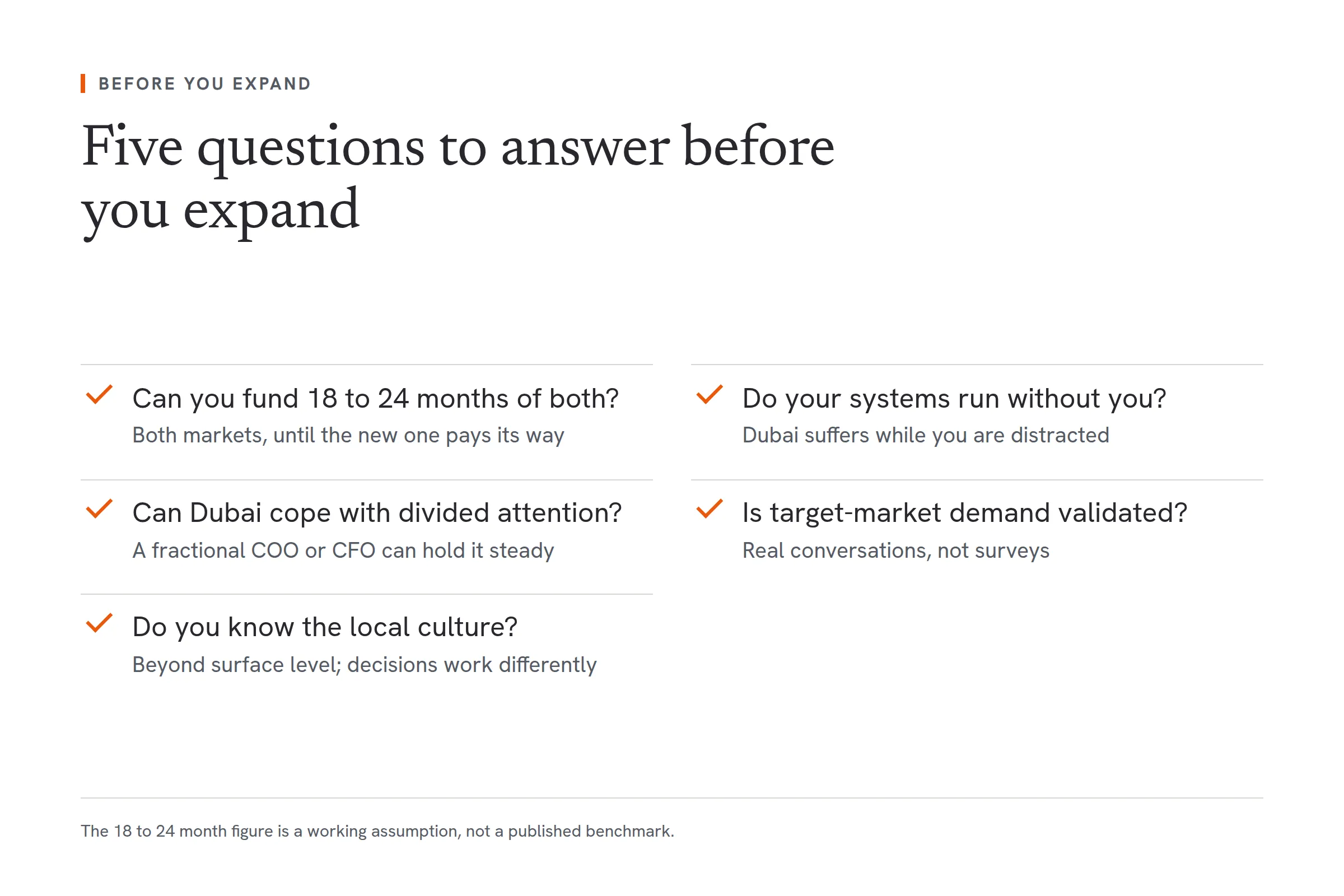
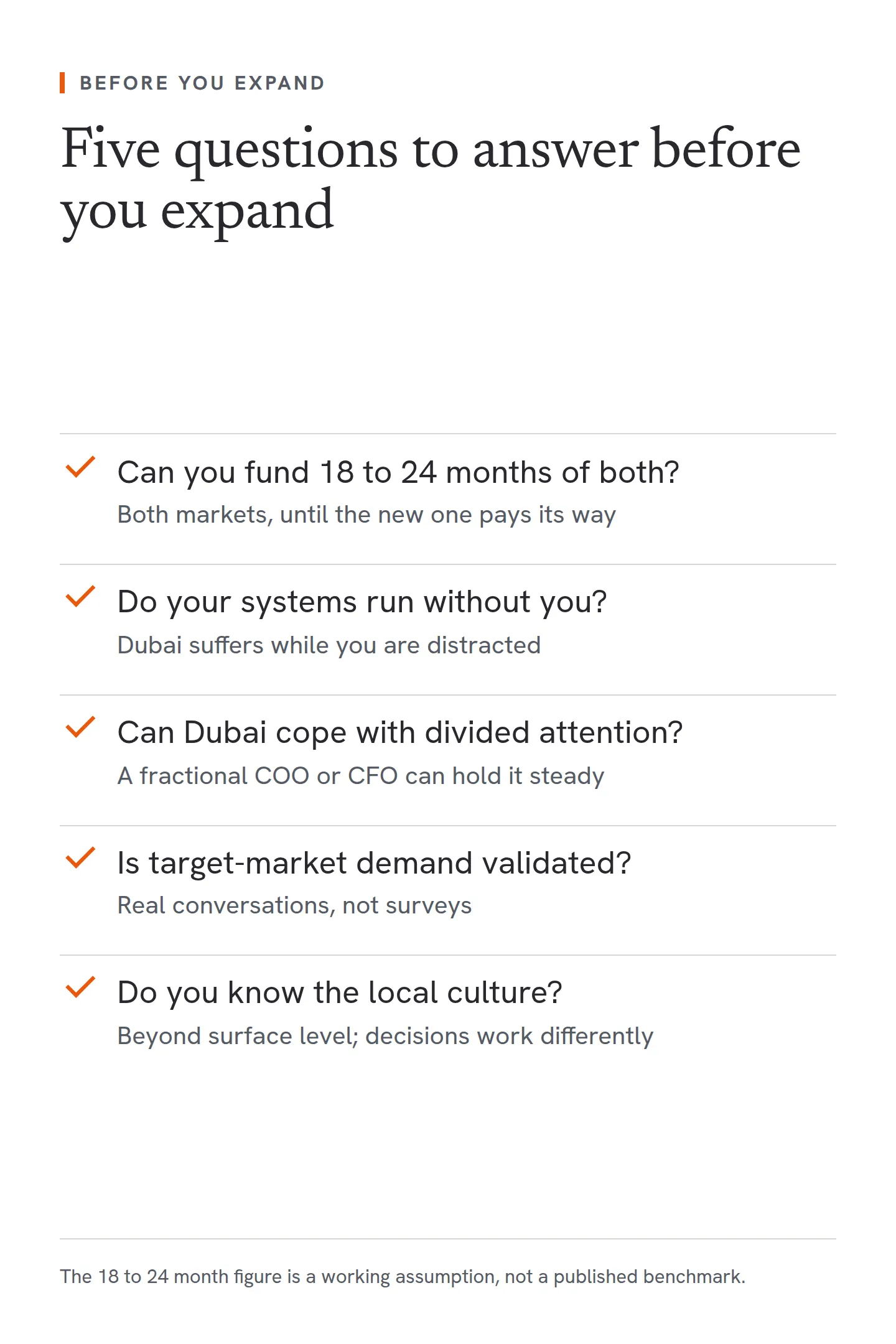
Can you fund 18 to 24 months of running both markets before the new one pays its own way?
Do you have systems and processes that function without you there?
Can you maintain Dubai operations with divided attention?
Have you validated actual customer demand in the target market?
Do you understand local business culture beyond surface level?
If you're hesitating on any of those, you already know the answer.
The real talk
International expansion isn't impossible. But it requires more preparation, more investment, and more patience than most Dubai founders anticipate. Joint ventures and local partnerships add another layer of risk; our guide to partnership disasters in Dubai covers what goes wrong when governance is an afterthought.
The good news? The companies that do it properly gain significant competitive advantages. The bad news? Most don't do it properly.
Before you book that exploratory trip to your target market, answer the hard questions honestly, and take the fractional executive readiness assessment if you want a structured view of where your leadership gaps are. Your bank account will thank you.
Ready to expand internationally without funding an expensive education? Whether you need operational systems built before expansion, strategic guidance on market selection, or leadership to maintain your Dubai operations while you focus on growth, fractional executives who've actually done this before can help you avoid the costly mistakes. Learn more about when your business needs a CXO, explore how fractional COO support can build the operational foundation that makes expansion possible, or contact us to discuss your specific expansion challenges.