A CFO and a financial controller do different jobs: the Chief Financial Officer (CFO) sets financial strategy and capital decisions, while the controller keeps the accounts accurate and the controls sound. Most growing Dubai SMEs get the sequencing wrong, hiring a full-time executive for strategy when what they lack is reliable monthly numbers, or the reverse.
CFO vs controller: what each role owns
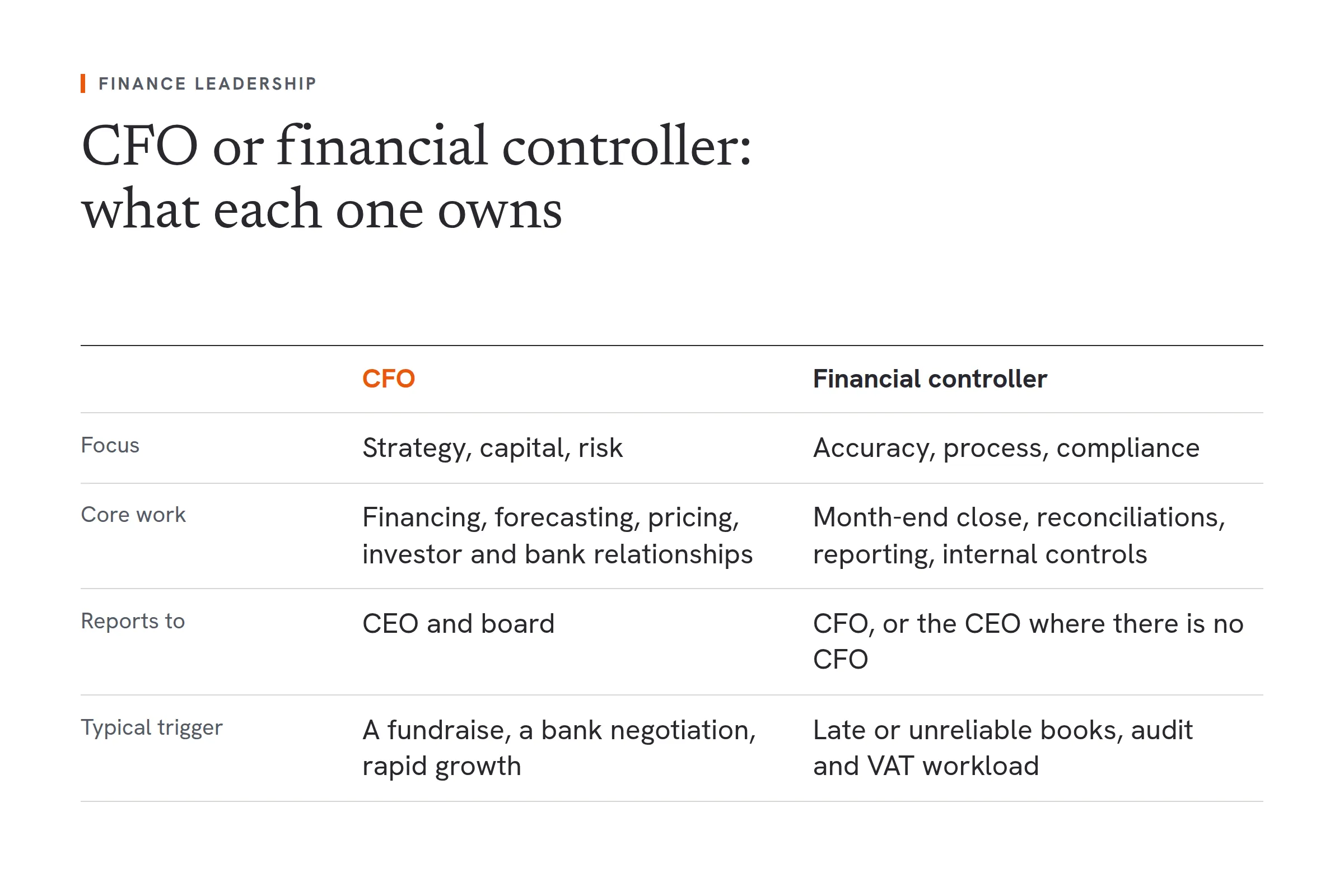
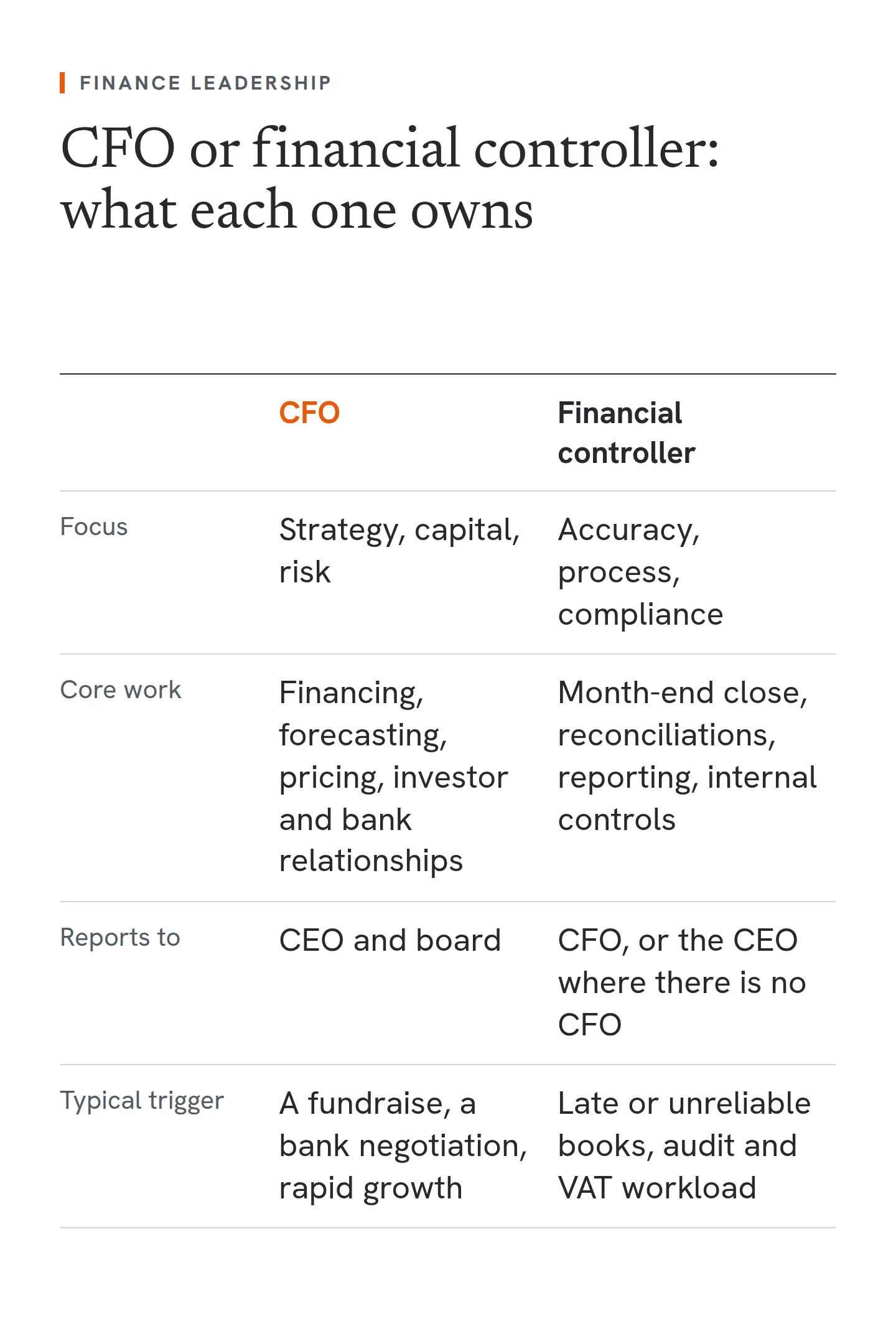
The simplest test is the question each role answers. The controller answers "are our numbers right?" The CFO answers "what should we do with them?"
| CFO | Financial controller |
|---|---|---|
Focus | Strategy, capital, risk | Accuracy, process, compliance |
Core work | Financing, forecasting, pricing, M&A, investor and bank relationships, tax planning | Month-end close, reconciliations, payables and receivables, reporting, internal controls |
Looks | Forward and outward | Backward and inward |
Reports to | CEO and board | CFO, or the CEO where there is no CFO |
Typical trigger | A fundraise, a bank negotiation, an acquisition, rapid growth | Late or unreliable books, audit and VAT workload |
The two overlap on forecasting, budgeting and tax, which is why smaller businesses often blur them. A fractional CFO can cover the strategic layer while a controller or finance manager runs the ledger, which is usually the cleaner split. We cover the layer above in our CFO vs VP Finance comparison.
The real cost of financial leadership
Let's talk money, because choosing between strategic CFO leadership and hands-on controller oversight is a business decision.
Full-time CFO costs
Cooper Fitch's UAE Salary Guide 2025 puts the base salary of a full-time SME CFO at AED 61,000 to 92,000 a month, roughly AED 730,000 to 1.1 million a year. That is only the base. A full-time hire also brings bonus, benefits, a visa to sponsor, end-of-service gratuity and recruitment costs, and carries notice periods that make the role hard to scale down.
A controller is normally a considerably lower-cost hire than a CFO, which is why many SMEs fill that seat first. Pay varies with experience, sector and company size, so check a current salary guide for the profile you need.
Fractional CFO pricing
Fractional CFOs are paid for the time and scope you actually need. Our engagements typically run 30 to 60% less than a full-time hire. They are business to business, on one month's notice, with no employment visa, no end-of-service liability and no insurance burden. A typical engagement is 4 to 24 hours per week, over six to twenty-four months.
The ROI story
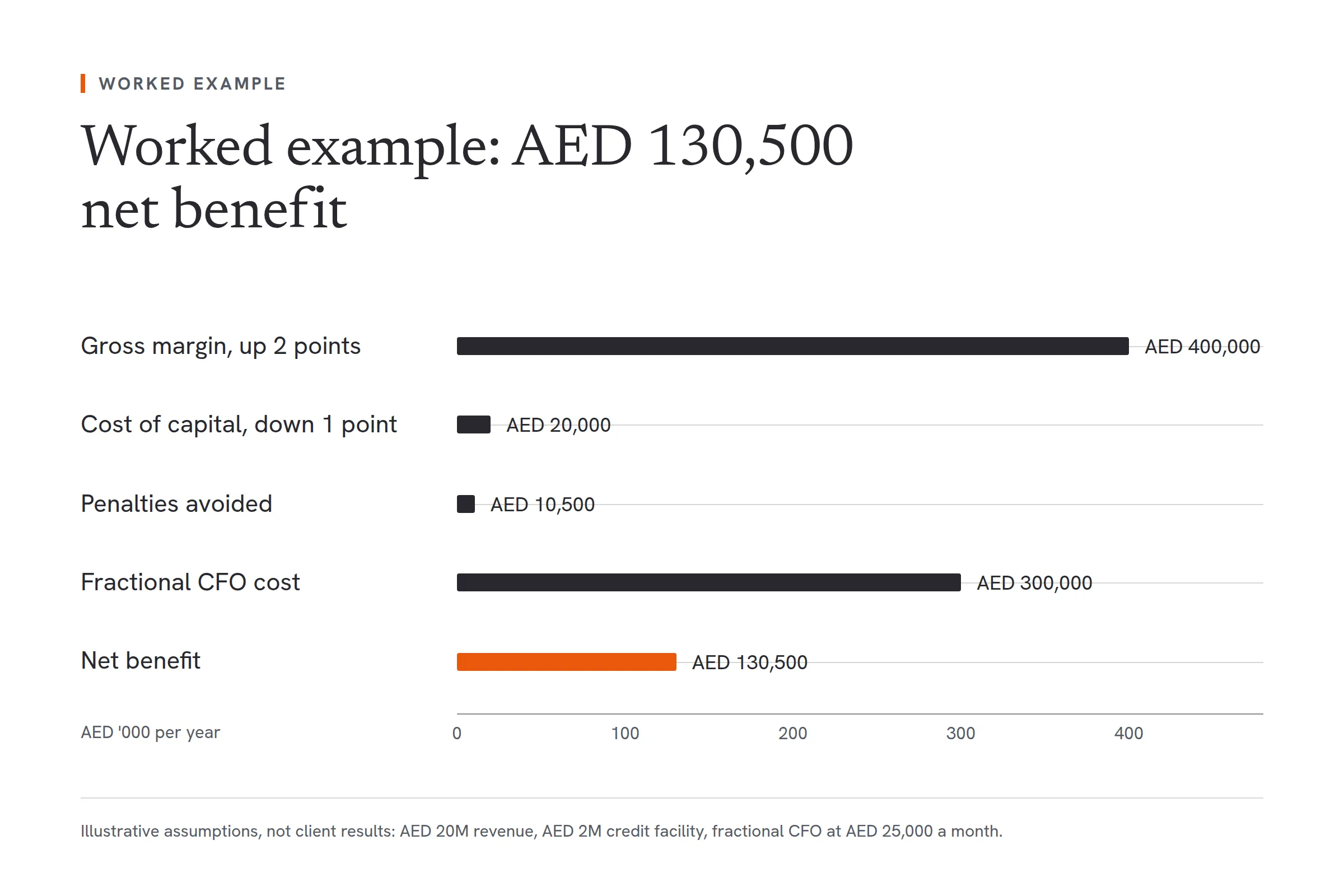
The real return is not only the saving. It is better cash flow management, tighter budgeting and clearer margins. Our CFO ROI calculator shows, with a worked example, how Dubai SMEs can quantify that return.
Technology implementation: getting your systems right
Your financial systems either help you grow or hold you back. For the next twelve months they are also a compliance matter.
E-invoicing is the live systems project
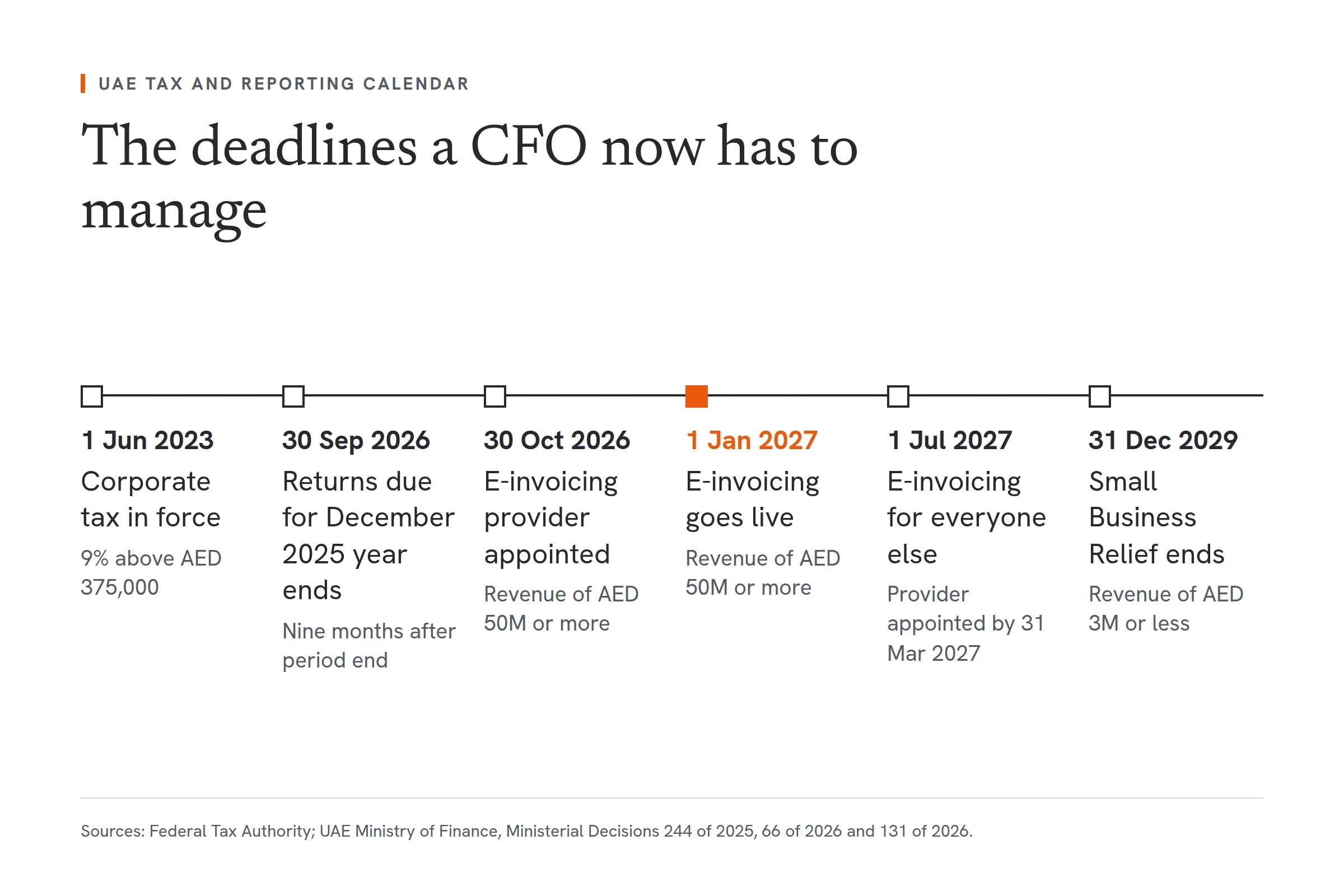
UAE e-invoicing becomes mandatory on 1 January 2027 for businesses with annual revenue of AED 50 million or more, and on 1 July 2027 for all others, with structured invoices exchanged through an Accredited Service Provider. For the larger group, the deadline to appoint that provider has moved to 30 October 2026. This is exactly where the two roles meet. The CFO chooses the provider, sets the budget and sponsors the change. The controller makes sure the accounting system, invoice data and approval workflow actually connect.
ERP implementation leadership
Finance should lead any enterprise resource planning (ERP) implementation where financial accuracy and compliance are top priorities, not IT or operations alone. The CFO brings the whole-business view; the controller brings the knowledge of how transactions really flow.
Cloud-based solutions
Cloud accounting and ERP systems bring real-time data access, automation of routine processes, better collaboration and stronger reporting. The risk is implementation: data migration, integration, testing and training are where projects slip. Get it wrong and you are worse off than before.
Industry-specific benefits: why context matters
Different industries have different financial challenges, and the CFO and controller emphasise different things in each.
- Manufacturing: pricing, supply chain efficiency, production costing and capital investment planning. The controller tracks standard costs and variances; the CFO decides which investments to fund.
- Construction: cash flow timing by project, with monitoring and reporting that keep each job within budget.
- Healthcare: insurance reimbursements, regulatory compliance and equipment financing.
- Technology startups: fundraising, runway management and investor reporting. A fractional CFO who works with several companies brings pattern recognition from how other startups raised and spent capital.
- Real estate: acquisitions, portfolio management and market risk, in a cyclical market where timing matters.
Selecting your fractional CFO partner
This might be the most important finance decision you make this year.
Define your needs first
Assess your cash flow, capital requirements, budgeting and forecasting needs before you hire. Our CFO readiness assessment is a practical starting point if you are unsure whether you need strategic leadership or stronger day-to-day finance first.
Do not hire a CFO to fix problems you have not identified. Understanding whether you are scaling, entering new markets or restructuring defines the scope and the expertise you need.
UAE-specific considerations
The UAE brings its own compliance load. Corporate tax is 9% on taxable income above AED 375,000, per the Federal Tax Authority, with the return and payment due within nine months of the end of the tax period. Small Business Relief now applies to tax periods ending on or before 31 December 2029 for eligible businesses with revenue up to AED 3 million. VAT, free zone rules and cross-border expansion add further layers.
Evaluation criteria
Look for a problem solver with a record of fixing complex financial problems and the ability to explain intricate numbers clearly to non-finance stakeholders.
Quality indicators
We look for a degree in finance, accounting or business administration, professional certifications such as CPA, CFA or CMA, and many years in senior financial roles across different organisations.
Engagement models
Some businesses need weekly check-ins. Others need an intensive three-month sprint. The right model depends on your situation. For a fuller picture of how this works in the UAE, see our complete guide to fractional CFO services.
Why this matters now
Demand for flexible senior leadership keeps rising. Heidrick & Struggles reports that C-suite interim engagements have risen 151% since 2021, and that small and medium companies now account for more than 80% of demand for interim talent.
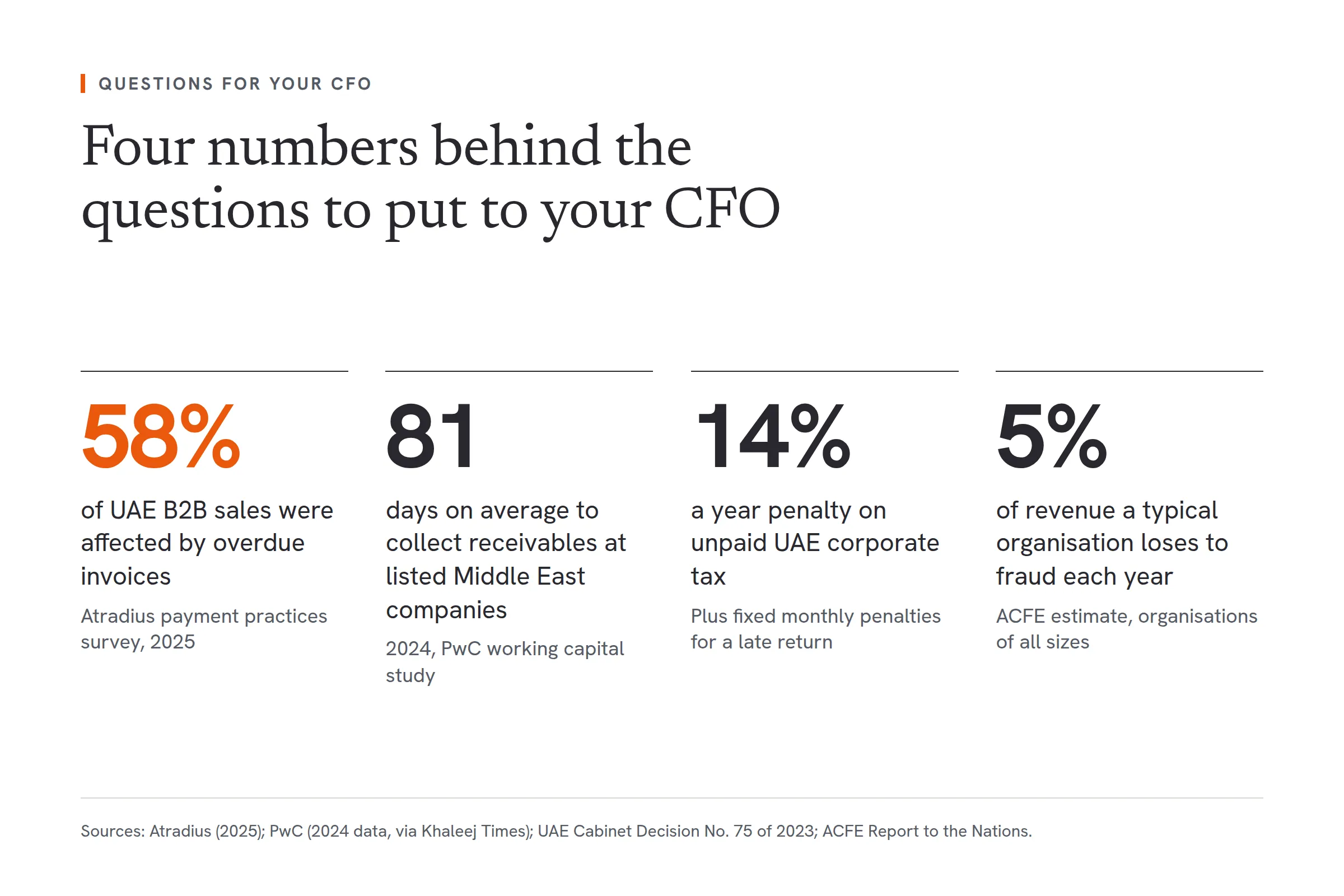
The UAE business base is growing as well. The UAE passed 1.4 million registered companies at the end of 2025, with about 250,000 added during the year, and SMEs account for more than 94% of the UAE's businesses. More businesses means more competition, more compliance and more reasons to get the finance function right.
Getting started
If you have read this far, you probably know you need help. The question is whether you need a controller, a CFO or both, and how to find the right person.
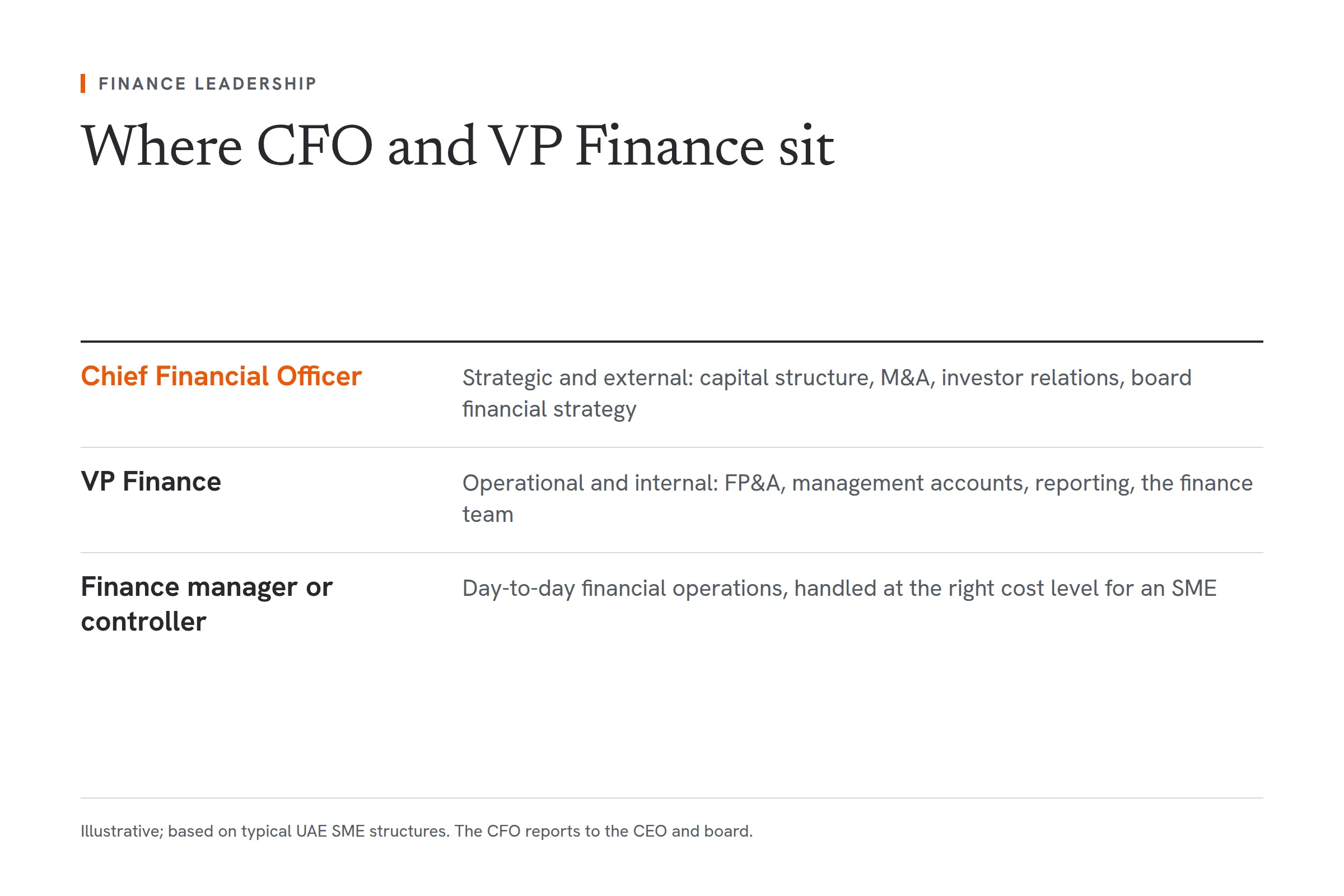
Start by being honest about your current situation. Are the books reliable? What keeps you up at night: cash flow, tax compliance, investor readiness or growth planning? If you are weighing a controller against a VP Finance hire, our CFO vs VP Finance comparison clarifies where each role sits. Once you have senior finance in place, ten questions to ask your CFO will tell you quickly whether the relationship is working.
Then talk to someone who has solved these problems before. A CFO from our collective of 350+ curated and vetted executives can embed within weeks, with the support, structure and governance of Fractional behind the engagement. If you are preparing to raise capital, see our fundraising solutions. To talk it through, book a call.