Fractional CFO guide
A fractional CFO gives a business senior financial leadership for the hours it needs, instead of a full-time salary. Most owners think the choice is a full-time Chief Financial Officer (CFO) or nothing. There is a third option, and it is the one most UAE SMEs should consider first: a fractional CFO who embeds in your leadership team part-time, holds the decisions in the finance domain and is accountable for the outcome.
Demand for this model is rising. Heidrick & Struggles reports a 151% increase in C-suite interim engagements since 2021, and its Talent Lens Survey finds that small and medium companies now account for more than four-fifths of demand. Finance leads the list: interim CFO roles account for 51% of all interim leadership requests, the largest share of any C-suite function.
What a fractional CFO actually is
A fractional CFO is an experienced finance executive who has held a full-time CFO or finance director role and now works part-time with a small number of businesses. They understand financial statements, reporting and the regulatory side of finance, and they bring experience from solving similar problems elsewhere.
They are not an adviser who writes a report and leaves. A fractional executive does not advise from the sidelines: they take the finance function and the decisions inside it, and they are accountable for the result. We provide the support, structure and governance around the engagement; the executive owns the outcomes.
What fractional CFOs do
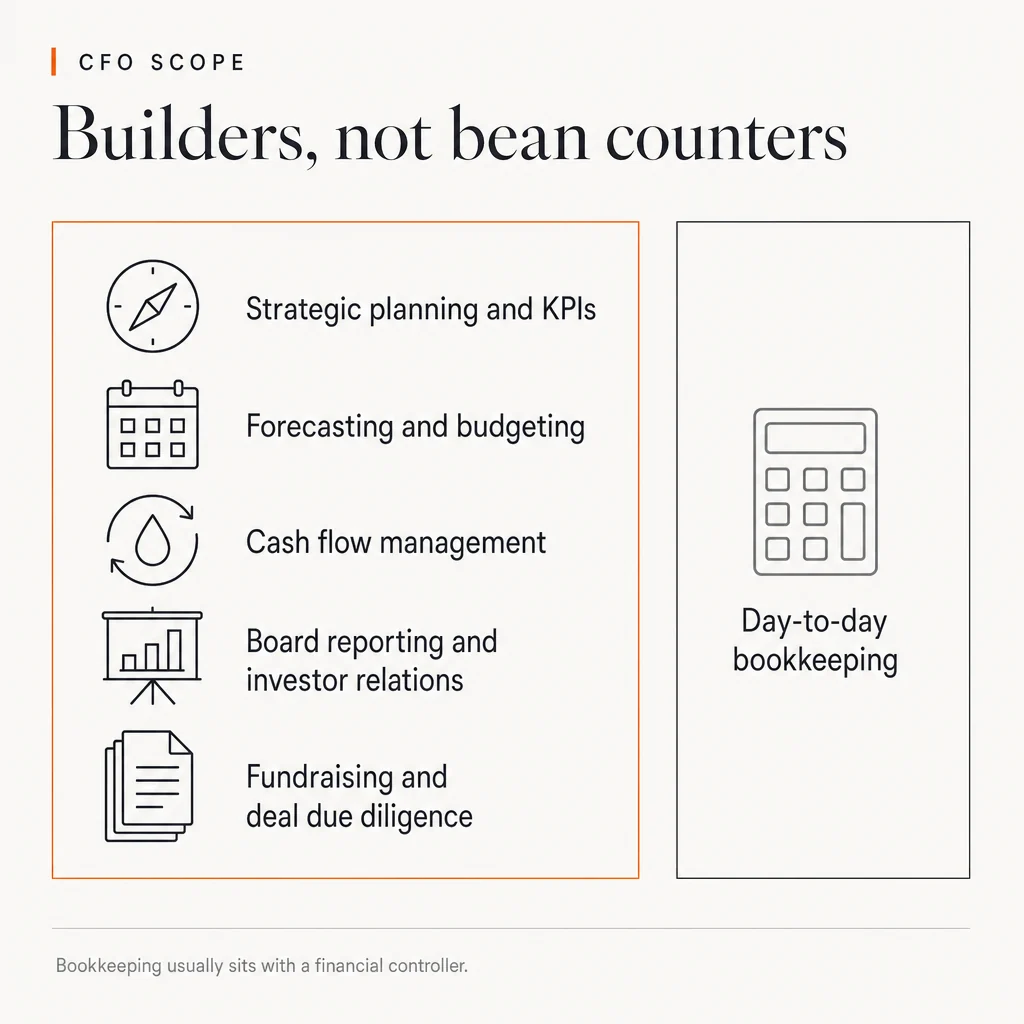
The work covers strategic planning and KPIs, financial modelling and valuation, business plans and pitch decks for fundraising, M&A due diligence and deal-room documents, forecasting and budgeting with variance analysis, cash flow management, banking relationships, financial planning and analysis (FP&A), board reporting and investor relations.
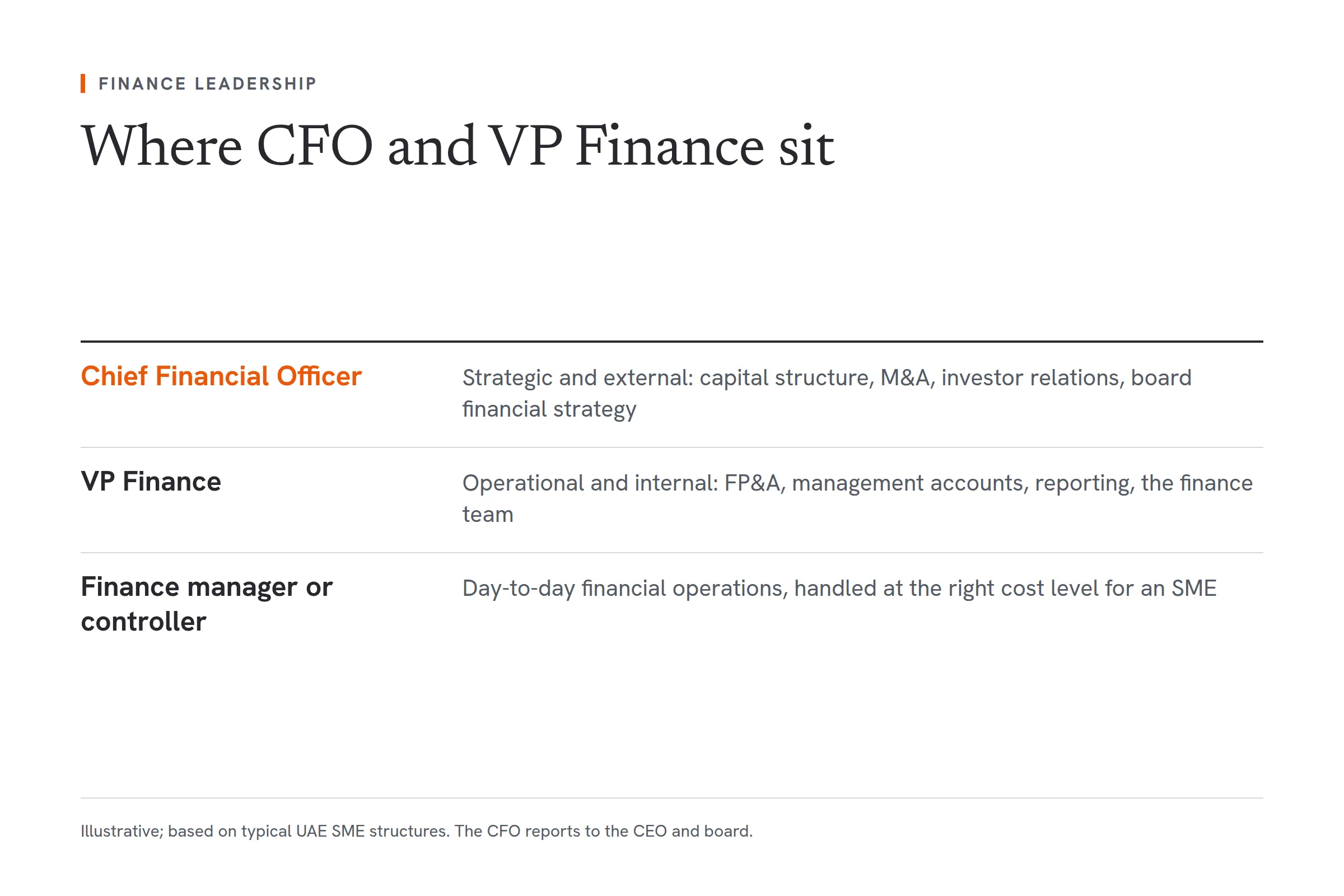
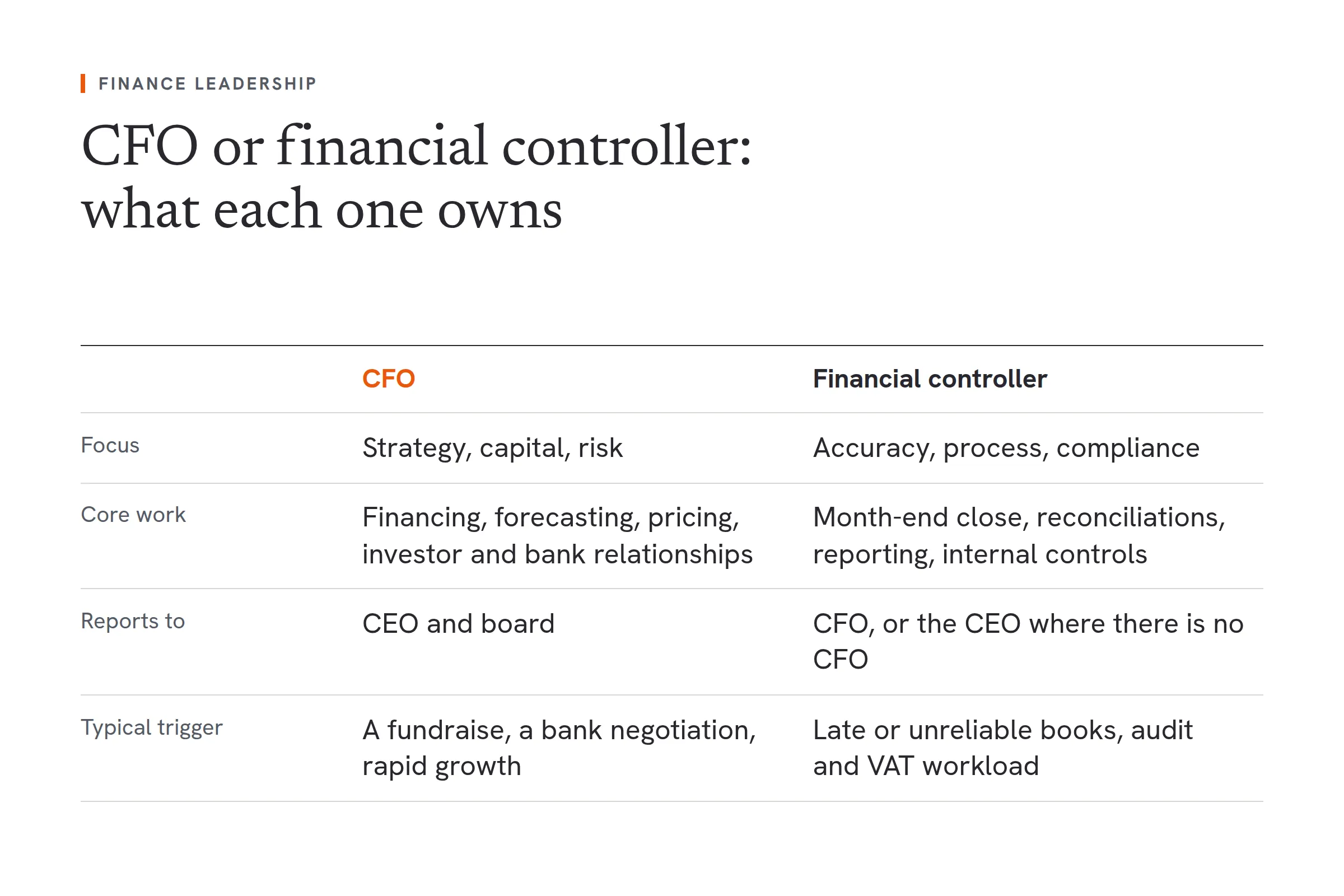
Notice what is missing: day-to-day bookkeeping. That work usually sits with a financial controller, and a fractional CFO sets the standard it is held to. They are builders, not bean counters.
Who needs this service
A fractional CFO fits a business that has outgrown bookkeeping but cannot yet justify, or does not want, a full-time executive salary. The UAE has many of them: the country passed about 1.4 million registered companies at the end of 2025, with around 250,000 added during the year, and SMEs make up around 94% of all businesses in the UAE.
Our clients typically have revenue of 2M to 40M USD. They are owner-operated or investor-backed businesses in services, distribution, manufacturing, construction, healthcare and technology. Sound familiar? That describes most successful Dubai SMEs.
Fractional vs full-time CFO: the real difference
The choice is not only about money, though money matters.
The commitment gap
A full-time CFO is embedded in daily operations and company culture. A fractional CFO works to a defined rhythm: a few hours a week, plus intensive periods around a raise, a close or a deal. The trade-off is depth of daily presence against breadth of experience and independence from internal politics. Politics undermine good financial decisions, and a fractional CFO has no seat in them.
The cost reality
A full-time SME CFO in the UAE commands a base salary of AED 61,000 to 92,000 per month (Cooper Fitch UAE Salary Guide 2025), roughly AED 730,000 to 1.1 million a year. That is base pay only. On top sit bonus, benefits, a residence visa, health insurance, recruitment fees and end-of-service gratuity, which the UAE labour framework adds for every year of service.
Our engagements typically run 30 to 60% less than a full-time hire. The saving comes from the structure: you pay for the hours the business needs, and a fractional engagement is business to business, so there is no employment visa, no end-of-service liability and no insurance burden to carry.
The flexibility factor
The fractional model scales with the business. Need help with a funding round? Engage a CFO through the raise. Preparing an acquisition? Bring one in for due diligence. Our engagements run on one month's notice either way, and a CFO from our collective of 350+ curated and vetted executives can typically be deployed within weeks.
The scope also stays tight. There are no make-work projects to fill an employee's quiet weeks. No busy work, just results.
UAE corporate tax: why you need expert help
Corporate tax is now a standing item on every UAE finance calendar. Most owners are still working out what it means for them.
The tax reality
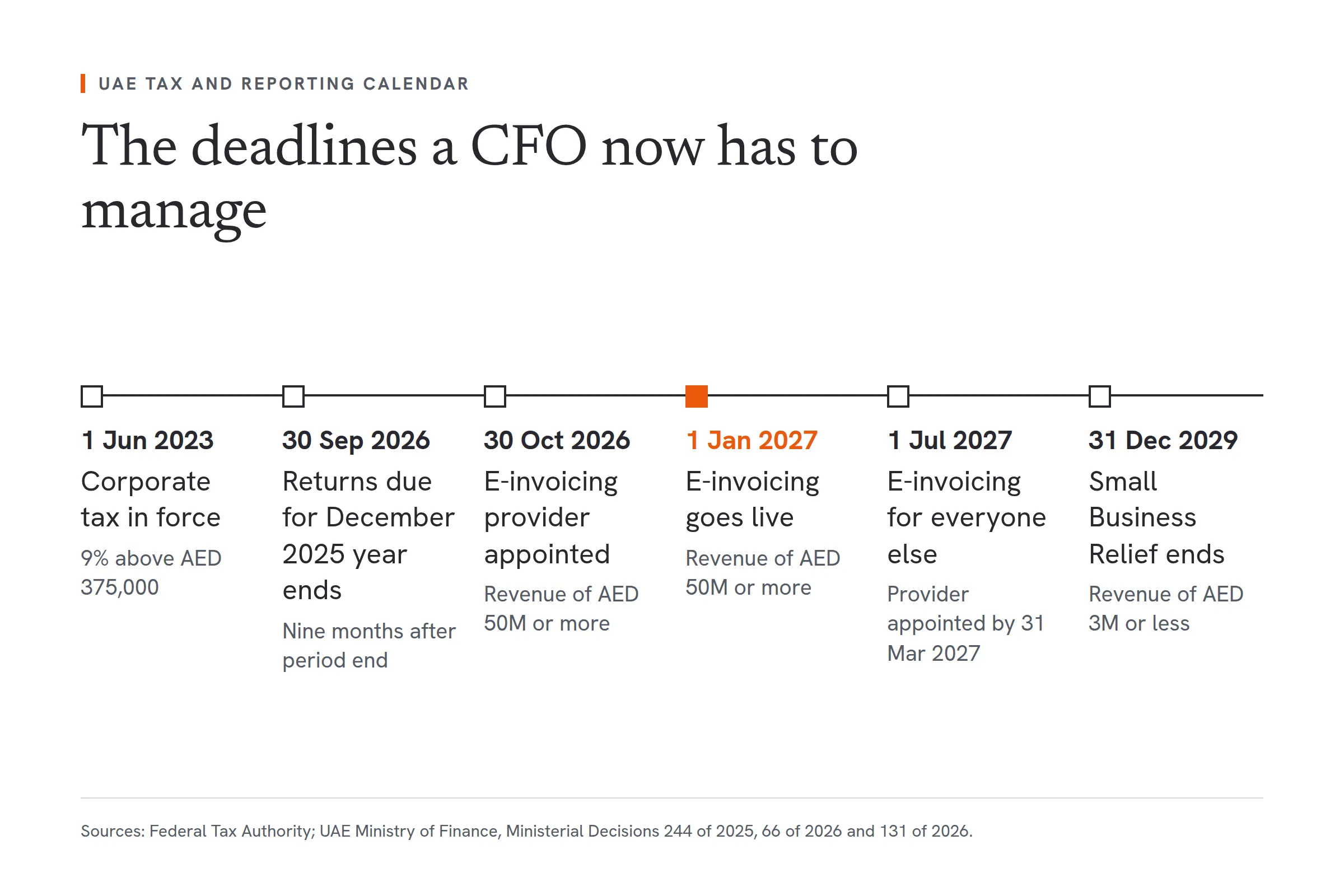
The UAE introduced Corporate Income Tax through Federal Decree-Law No. 47 of 2022, effective for most businesses from financial years beginning on or after 1 June 2023. The rate is 9% on taxable income above AED 375,000, with income up to that level taxed at 0%.
Small Business Relief now runs to 2029
Eligible businesses with revenue of AED 3 million or less can elect Small Business Relief and be treated as having no taxable income. The relief was due to end for tax periods after 31 December 2026, but Ministerial Decision No. 131 of 2026 extends it to tax periods ending on or before 31 December 2029, with the AED 3 million threshold unchanged. Relief is elected in the return, not automatic, and it is not available to Qualifying Free Zone Persons or members of larger multinational groups. A CFO helps you decide whether election is the right call, because it carries trade-offs as well as a nil tax bill.
Pillar Two for larger groups
For multinational groups with global revenue of EUR 750 million or more, the UAE applies a 15% Domestic Minimum Top-up Tax from financial years starting on or after 1 January 2025, aligned with the OECD Pillar Two global minimum tax rules. Most SMEs are outside its scope, but subsidiaries of large groups are not.
Compliance is not optional
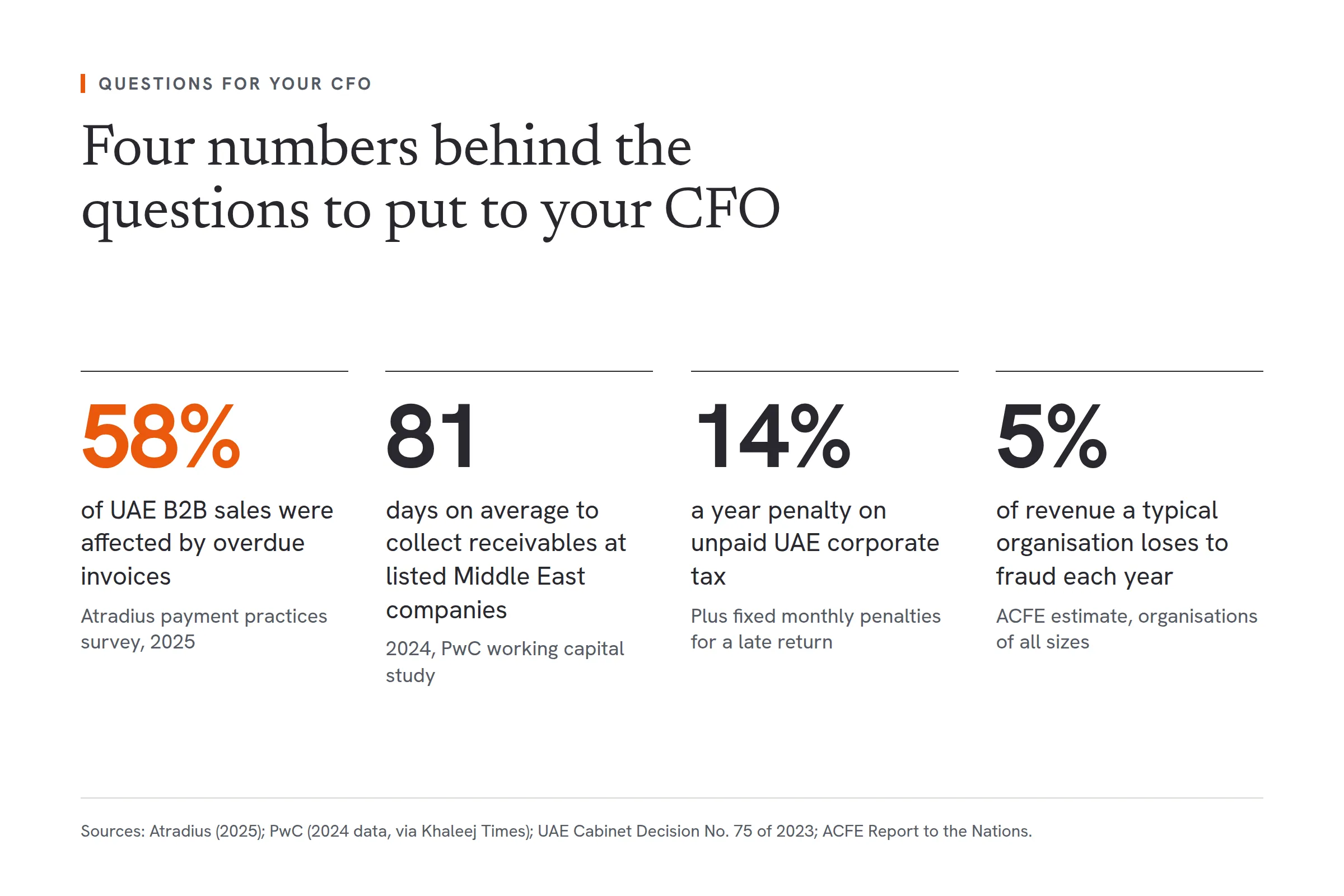
All taxable persons must register for corporate tax with the Federal Tax Authority and file within nine months of the end of the tax period. For companies with a 31 December 2025 year end, that deadline fell on 30 September 2026. Late filing and late payment attract administrative penalties, and the penalty regime changed this year: from 14 April 2026, Cabinet Decision No. 129 of 2025 replaced the compounding late-payment charge with a flat 14% per annum and cut the penalty for an incorrect return.
How fractional CFOs help
This is where a fractional CFO earns their fee. They keep the business registered and filing on time, build tax accruals into the monthly close, assess Small Business Relief and free zone status, and run a risk review of the financial and operational exposures that follow. If you operate from a free zone, our free zone substance and tax service covers the adequate-substance conditions that Qualifying Free Zone Person status depends on.
Smart companies get help before they need it, not in the week the return is due.
Cash flow: the thing that actually kills businesses
Profitable companies run out of cash every day. Not because they do not make money, but because the timing of money in and money out is not managed. The usual UAE pressure points are:
- Long payment cycles in several industries, with customers paying well after delivery
- Seasonal swings in tourism, retail and construction
- VAT and corporate tax payments that land before the related receipts
- Currency exposure from international trade
What good cash flow management looks like
It means monitoring, analysing and optimising the inflow and outflow of cash. The basics are not complicated:
- Track income and expenses daily
- Keep a rolling 13-week cash forecast
- Review cash weekly and fix variances fast
- Adjust plans when assumptions change
Doing it consistently is the hard part, and it is the first thing a fractional CFO puts in place.
Technology makes it easier
Cloud accounting platforms such as Xero and QuickBooks give real-time visibility of cash. Smart companies automate invoice delivery, payment reminders and collections. The less manual work, the fewer mistakes, and the easier the move to e-invoicing described below.
Getting investment-ready: why investors care about your CFO
Investors ask about your financial team before they ask about your product. Fundraising readiness means a data room, a defensible model and reporting they can trust, not just a polished deck.
What investors actually want
Growth-stage businesses need clarity and assurance that valuation, projections and reporting are accurate before they raise. Clarity, assurance and accuracy: these are about competence, not vision.
Financial modelling that works
A financial model is a quantitative representation of a business's financial performance over a period, built on explicit assumptions. A fractional CFO turns the business plan into a clear financial story, with realistic models, the right metrics and a presentation that holds up under questioning.
Due diligence preparation
Due diligence is where deals die, not because the business is bad but because the paperwork is messy. A fractional CFO anticipates investor questions and makes sure the books and documentation are ready before the data room opens.
Private equity and investor expectations
Private equity and institutional investors expect audited-quality numbers and a CFO who can answer for them. For growth-stage companies, a fractional CFO provides that credibility without a full-time salary.
VAT compliance: the details that matter
VAT is a permanent feature of UAE finance. It is better to understand it now than to scramble later.
The UAE VAT framework
The UAE introduced VAT at a standard rate of 5% on 1 January 2018. The mandatory registration threshold for resident businesses is AED 375,000 in annual taxable turnover, and the voluntary threshold is AED 187,500. Non-resident businesses have no turnover threshold.
Filing requirements
VAT returns, with the payment, are due within 28 days after the end of the tax period. Most businesses file quarterly, though the Federal Tax Authority can assign monthly periods. Missing a deadline triggers administrative penalties, and repeat failures cost more.
E-invoicing is the next change
The biggest change on the horizon is mandatory electronic invoicing. Under Ministerial Decisions 243 and 244 of 2025, a pilot began on 1 July 2026, and businesses with revenue of AED 50 million or more must implement e-invoicing from 1 January 2027. Those businesses must appoint an Accredited Service Provider by 30 October 2026. Businesses below AED 50 million follow from 1 July 2027, with an appointment deadline of 31 March 2027. The Ministry of Finance e-invoicing programme page carries the guidelines and the full timeline.
Only structured invoices sent through an accredited provider will count as valid e-invoices, so finance systems, customer master data and approval workflows all need attention. It is a finance project before it is an IT project.
Common mistakes
Many businesses overlook the correct tracking of exempt supplies, which leads to over-recovery of input VAT. Others miss the penalty changes above. These are not small mistakes. They are expensive ones.
The real cost of financial leadership
At the end of the day, this is a business decision, so it is worth setting out the full cost of each route.
Full-time CFO costs
The starting point is the salary benchmark above: AED 61,000 to 92,000 per month in base salary for an SME CFO. Around it you carry recruitment agency fees, a residence visa, health insurance, bonus, benefits and end-of-service gratuity. A full-time hire is also a fixed commitment: if the business changes direction, the cost stays.
Fractional CFO engagements
A fractional CFO is engaged business to business, typically for 4 to 24 hours per week, and the fee scales with the hours and complexity. Our engagements typically run 30 to 60% less than a full-time hire. Because the CFO is not your employee, there is no employment visa, no end-of-service liability and no insurance burden, and either side can end the engagement on one month's notice.
The return on financial leadership
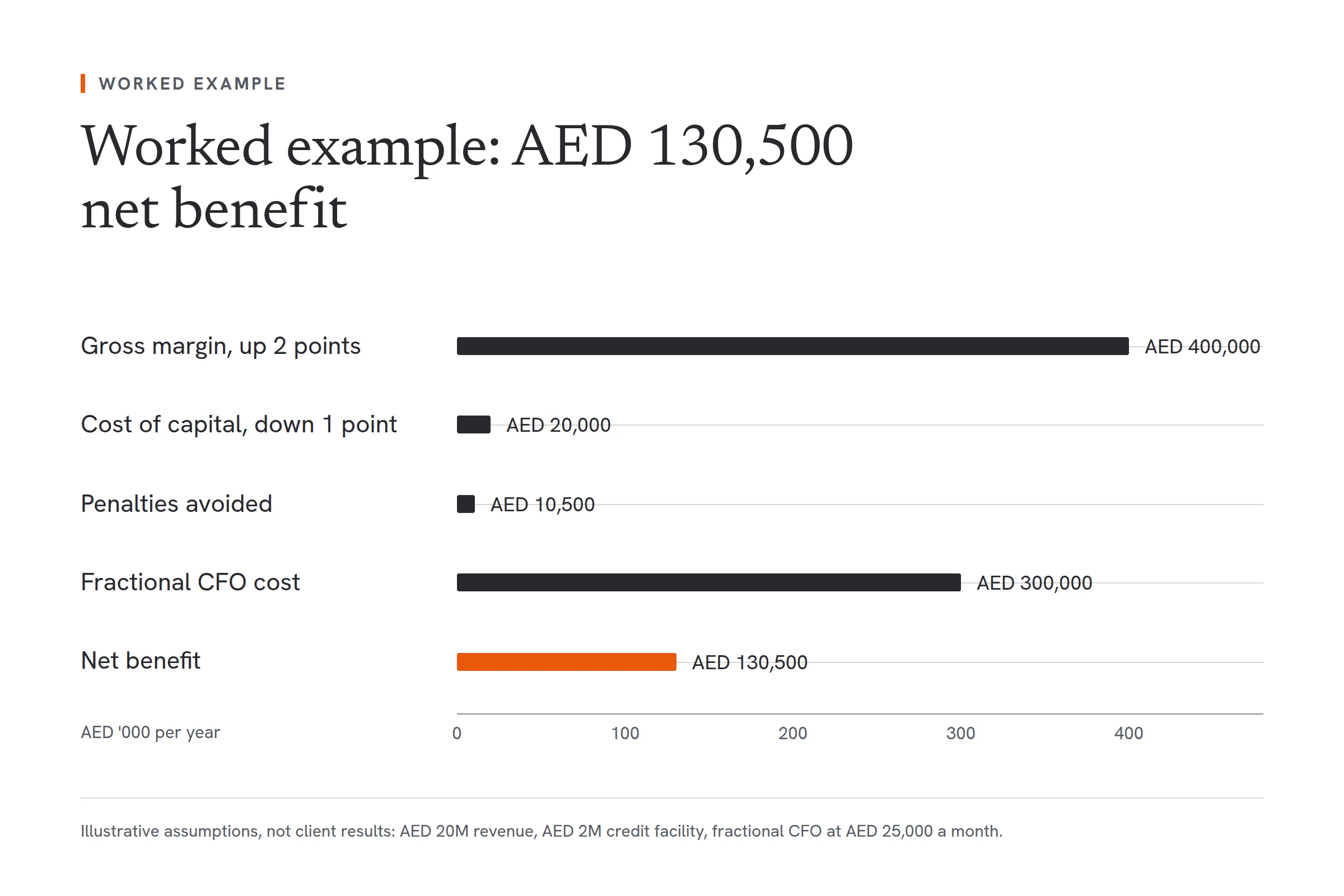
The case does not rest on the saving alone. It rests on better cash flow management, a cleaner budgeting process, earlier warning of problems and a model investors believe. Use our CFO ROI calculator to see what that looks like for your revenue band.
Technology implementation: getting your systems right
Your financial systems either help you grow or hold you back.
ERP implementation leadership
Finance should lead enterprise resource planning (ERP) projects when financial accuracy and compliance are the priority. Not IT alone, and not operations alone. The CFO has the widest view of how the business makes and spends money, so they are best placed to define what the system must do.
Cloud-based solutions
Cloud-based ERP and accounting systems offer real-time data access, automation of routine financial processes, better collaboration, stronger reporting and lower operating costs. They also make the move to e-invoicing simpler, because the invoice data is already structured.
Implementation process
Financial systems implementation covers selection, data migration and integration, testing and quality assurance, and the actual deployment. Get it wrong and you are worse off than before, which is why a CFO who has run one before is worth the fee.
Industry-specific benefits: why context matters
Different industries have different financial challenges, and one size does not fit all.
Manufacturing
CFOs in manufacturing optimise pricing and supply chain efficiency, manage production costs and plan capital investment. By identifying bottlenecks in the cost base, they help reduce costs while protecting quality.
Construction
Construction is all about cash flow timing. Projects run on varying timelines and budgets, and a fractional CFO forecasts cash flow project by project, with monitoring and reporting that keep each one inside its budget.
Healthcare practices
Medicine is getting more financially complex: insurance reimbursements, regulatory compliance and equipment financing all need a plan. A fractional CFO lets clinicians focus on patients.
Technology start-ups
Fractional CFOs work with several companies at once, so they bring knowledge of how other firms raised, ran lean and failed. For start-ups, that cross-pollination is valuable when funds are limited and investors are watching.
Real estate
Real estate relies on CFOs for property acquisitions, portfolio management and market-risk mitigation. The sector is cyclical, and someone who understands market timing can make or break your returns.
Selecting your fractional CFO
This may be the most important finance decision you make, so define the brief first.
Define your needs first
Assess your financial situation: cash flow, capital requirements, budgeting and forecasting. Do not hire a CFO to fix problems you have not identified. Be clear whether the need is scaling operations, entering a new market, raising capital or restructuring, because each calls for different experience.
UAE-specific considerations
The UAE brings its own requirements: VAT, corporate tax, e-invoicing, free zone rules and cross-border planning for businesses that expand internationally. Ask any candidate for recent UAE examples, not general experience.
Evaluation criteria
Look for a problem solver with a track record on complex financial problems, able to think critically and find growth opportunities. Test communication: a good CFO explains intricate financial data clearly to people who are not finance specialists.
Quality indicators
In our view, a strong candidate holds a professional qualification such as ACCA, CPA, CIMA or CMA, has held a CFO or finance director role in a business of similar size, and has direct UAE VAT and corporate tax experience.
Engagement models
The engagement model matters as much as the expertise. Some businesses need weekly check-ins; others need an intensive three-month sprint. Every Fractional engagement is business to business, with support, structure and governance from us so that both the business and the executive can succeed. The right model depends on your situation.
Why this matters now
The UAE tax environment is more complex each year: corporate tax and its penalty rules, Pillar Two for large groups, and e-invoicing from 2027. Investors ask harder questions. Customers expect faster, cleaner invoicing.
Heidrick & Struggles' 2026 Skills Index ranks financial controls, accounting and audit as the most in-demand skills overall. Businesses that invest in senior financial expertise early are better placed than those that react when a deadline or an investor forces the issue.
Getting started
If you have read this far, you probably know you need help. The question is how to find the right CFO.
Start by being honest about your situation. What keeps you up at night: cash flow, tax compliance, investor readiness or growth planning? Take our CFO readiness assessment to pinpoint the gaps, then read ten questions to ask your CFO once you are in conversation. If you are also weighing a VP Finance hire, our CFO vs VP Finance guide explains how the roles differ.
When you are ready, book a 30-minute call and we will match you with a vetted CFO from our collective.
The best time to fix your financial management was three months ago. The second-best time is now.