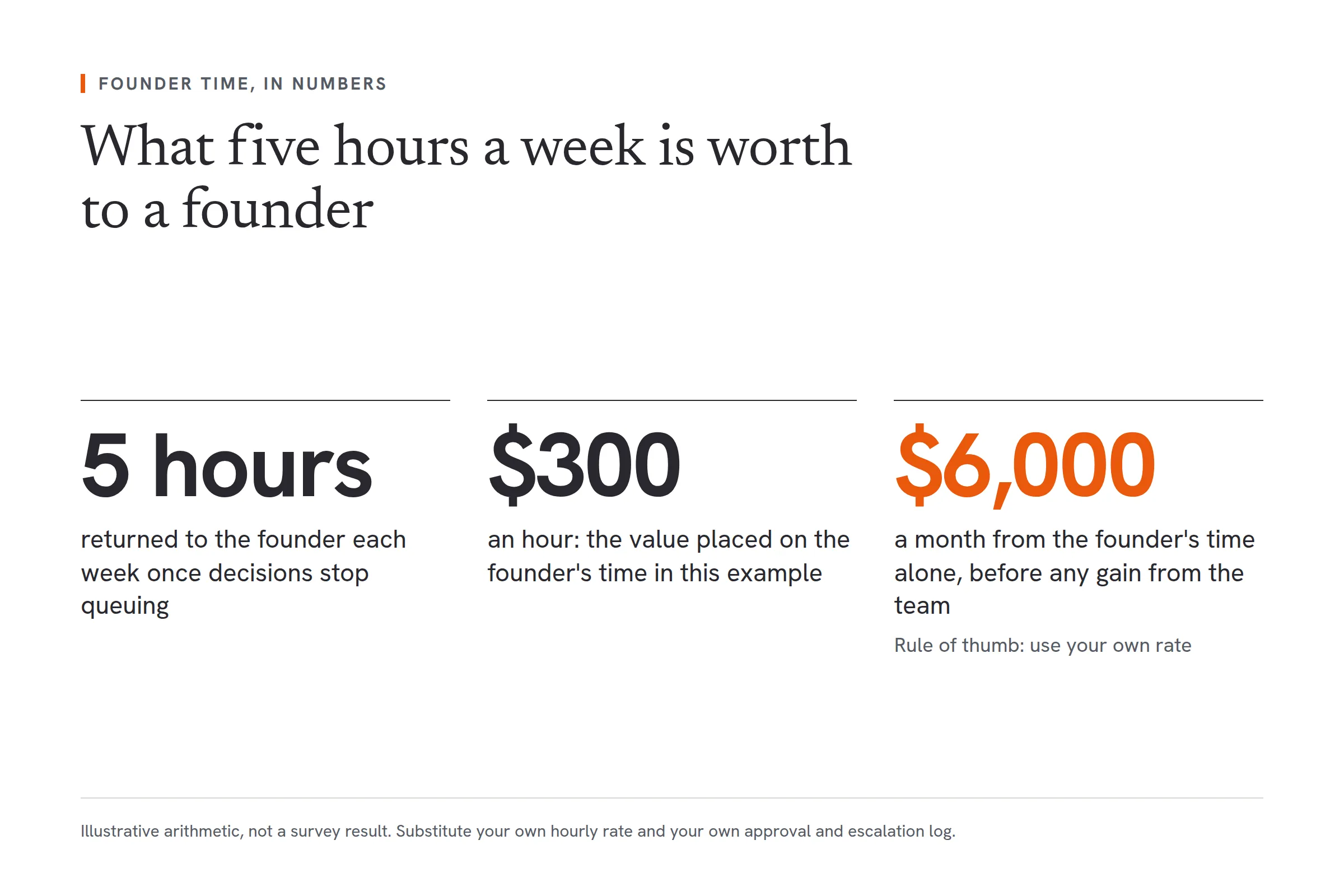
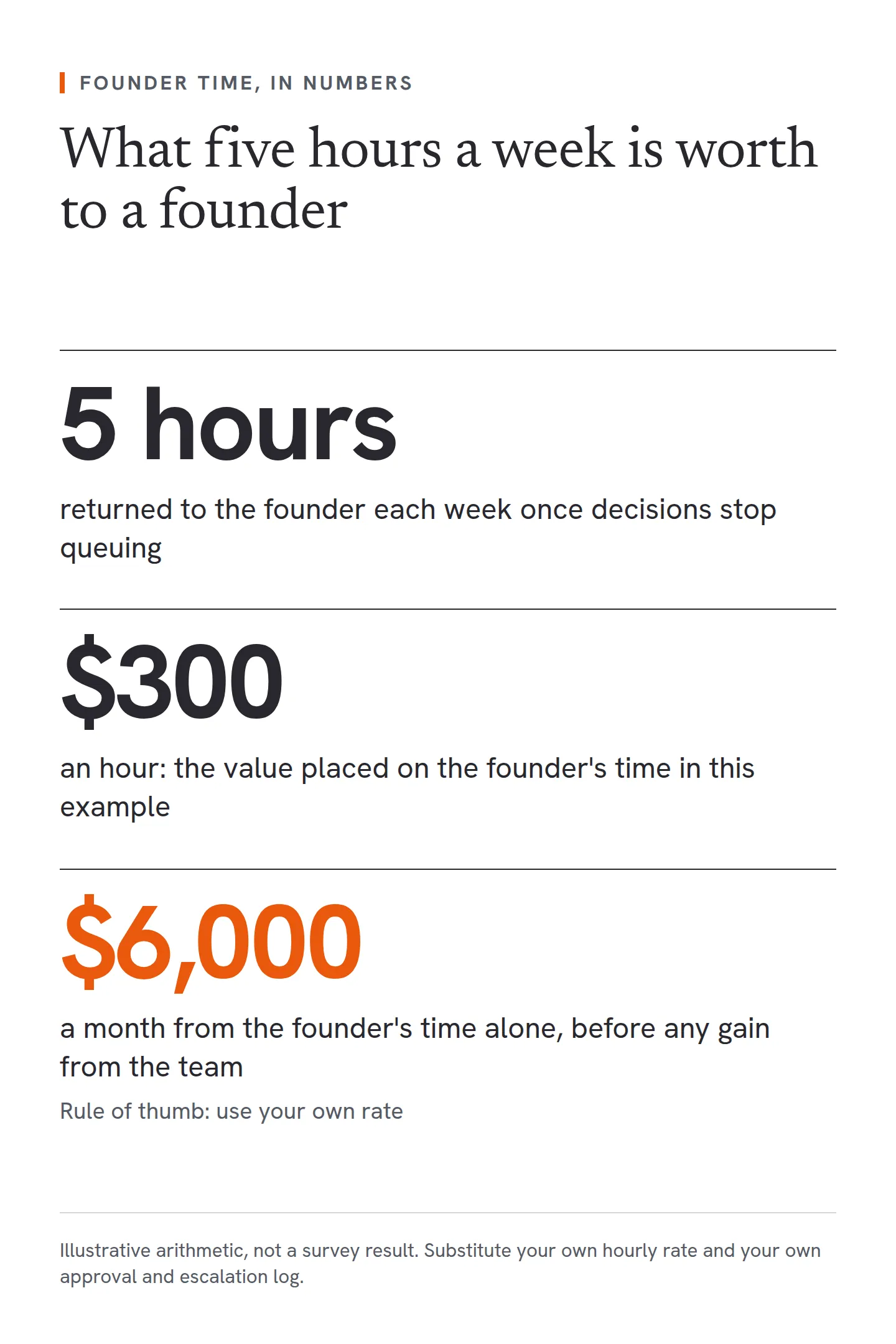
TL;DR: A COO's value shows up first as founder time and decision speed, then as lower process cost and cleaner measurement. The size of the gain depends on your starting point, so baseline first. Every five hours a week returned to a founder whose time is worth $300 an hour is worth roughly $6,000 a month, before any gain from the team.
What actually changes when you hire a COO?
The value of a Chief Operating Officer (COO) is not in what they do. It is in what becomes possible once they do it.
Most founders think a COO will "run operations". That is true, but it misses the point. The real change is simpler: you get your head back.
A good COO gives you something you have not had since you were five employees: the ability to think about next quarter instead of fighting today's fires. Put a number on it for your own business. Every five hours a week returned to a founder whose time is worth $300 an hour is worth roughly $6,000 a month. That is illustrative arithmetic, not a survey result, so use your own rate. And it is only the founder's time.
A sensible engagement follows a 90-day shape. Month one is diagnosis and quick wins. Month two installs routines: meeting cadence, dashboards, escalation paths. Month three hands decisions back to the people who should own them, so you are thinking strategically again instead of approving things.
How much time does a COO actually save?
The honest answer is that the number is specific to your business, and the way to find it is a time audit.
Your team is almost certainly losing time to manual work: data entry, report compilation, checking whether someone else did something. No reliable market-wide figure exists for this, but one published case shows the scale. RedCompass Labs reported saving nearly 19 hours a week, and more than 950 hours a year, by automating expense management. That is one firm's result from a software vendor's case study, in one process. It is not a benchmark, but it shows how much invisible admin sits inside ordinary workflows.
A COO's first job is finding these time sinks, then removing or automating them. Your team does not work harder. They work on things that matter.
This is also what senior interim leaders are hired for. In Heidrick & Struggles' 2026 survey of independent professionals, work centred on strategic and operational planning, process improvement and business transformation. The same survey found that small and medium companies now account for more than four-fifths of demand for high-end interim talent. It is a global sample, with few respondents from the Middle East, so read it as direction of travel rather than a Dubai measurement.
What operational problems get fixed first?
COOs work in a specific order. Not by choice, by necessity.
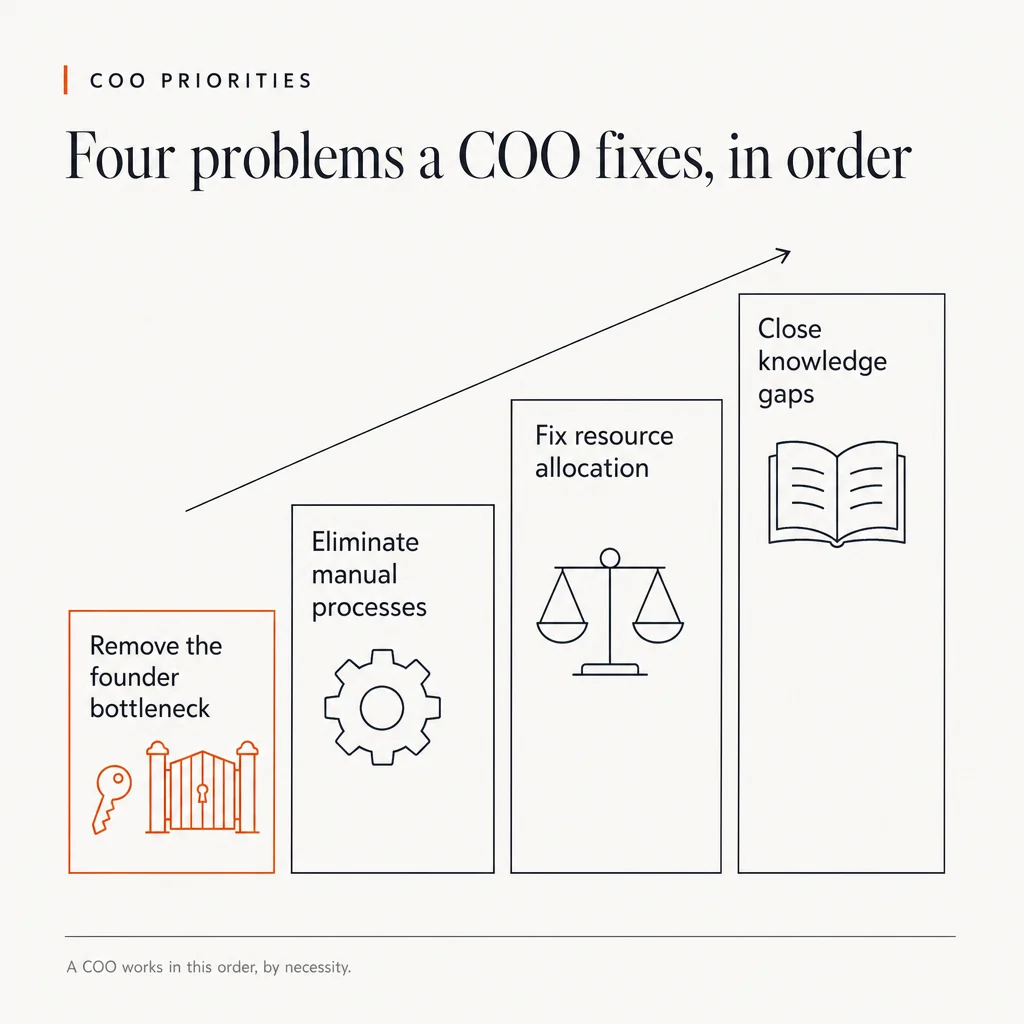
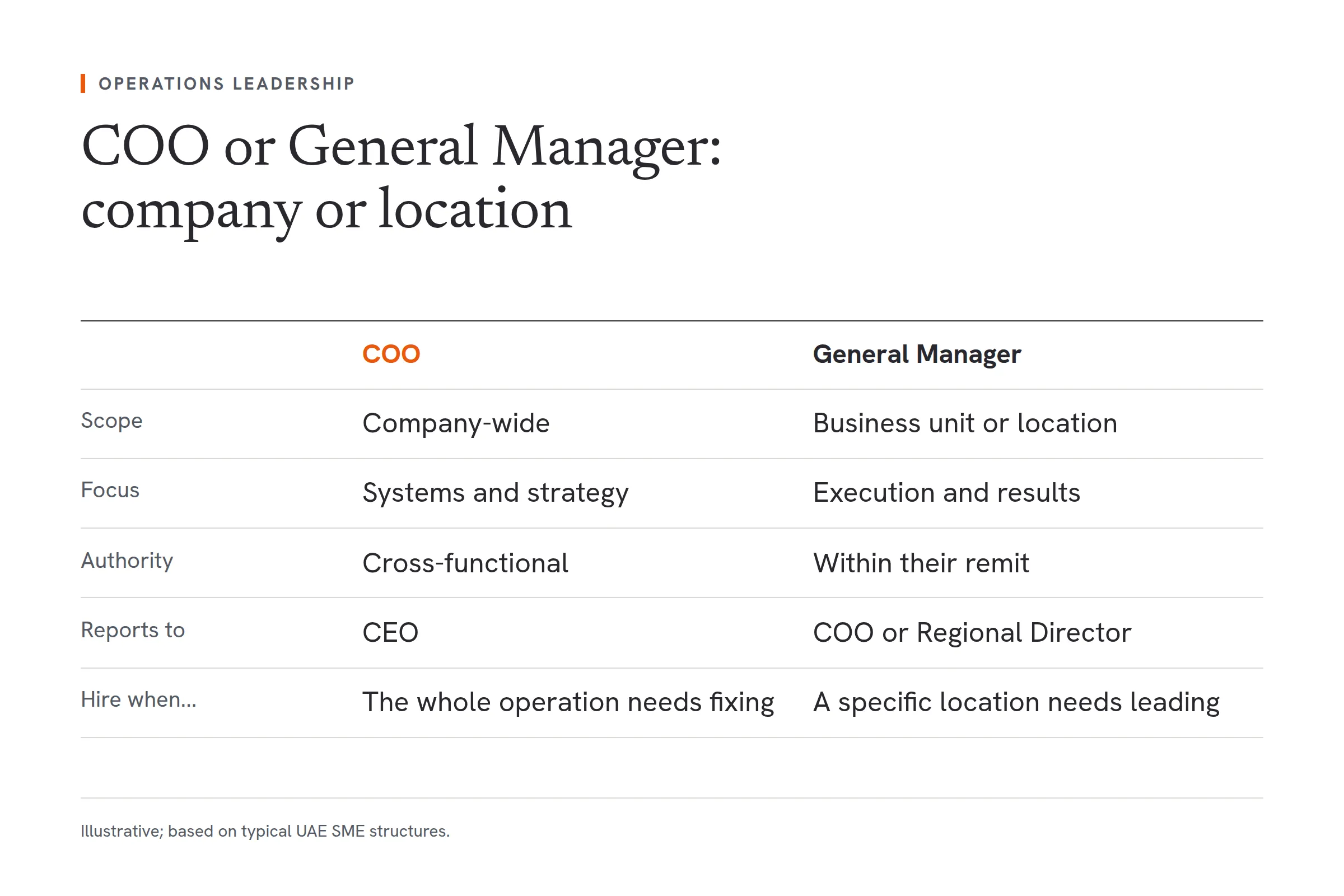
First: remove the founder bottleneck. Growth stalls when every decision flows through one person. A COO creates decision-making frameworks so you stop being the blocker. We unpack that pattern in when the founder becomes the bottleneck.
Second: eliminate manual processes. This is where most of the cost comes out. Not layoffs: documentation, automation and clearer handoffs.
Third: fix resource allocation. Teams are usually structured by accident, not strategy. Fixing that raises output without adding headcount.
Fourth: close knowledge gaps. What happens when your sales manager is sick? If the answer is "chaos", that is a COO problem.
How do you measure COO impact?
Measurement has to start before the COO arrives. You cannot improve what you do not measure, and most SMEs do not track the basics.
The metrics that matter:
- Founder time: hours a week spent on approvals, escalations and exceptions.
- Cycle times: order to delivery, quote to cash, hire to productive.
- Operating efficiency ratio and net profit margin: the financial view of the same improvements.
- Revenue per employee: the simplest test of whether growth is being absorbed or just carried.
- Employee retention: a leading indicator that roles and workloads are workable.
A COO's value starts with establishing this framework. Without a baseline, any claimed gain is a story.
What is the ROI on operations leadership?
Work it out from your own numbers rather than trusting a generic percentage. Return is process cost removed, plus founder time recovered, plus revenue that was previously blocked, minus the cost of the COO.
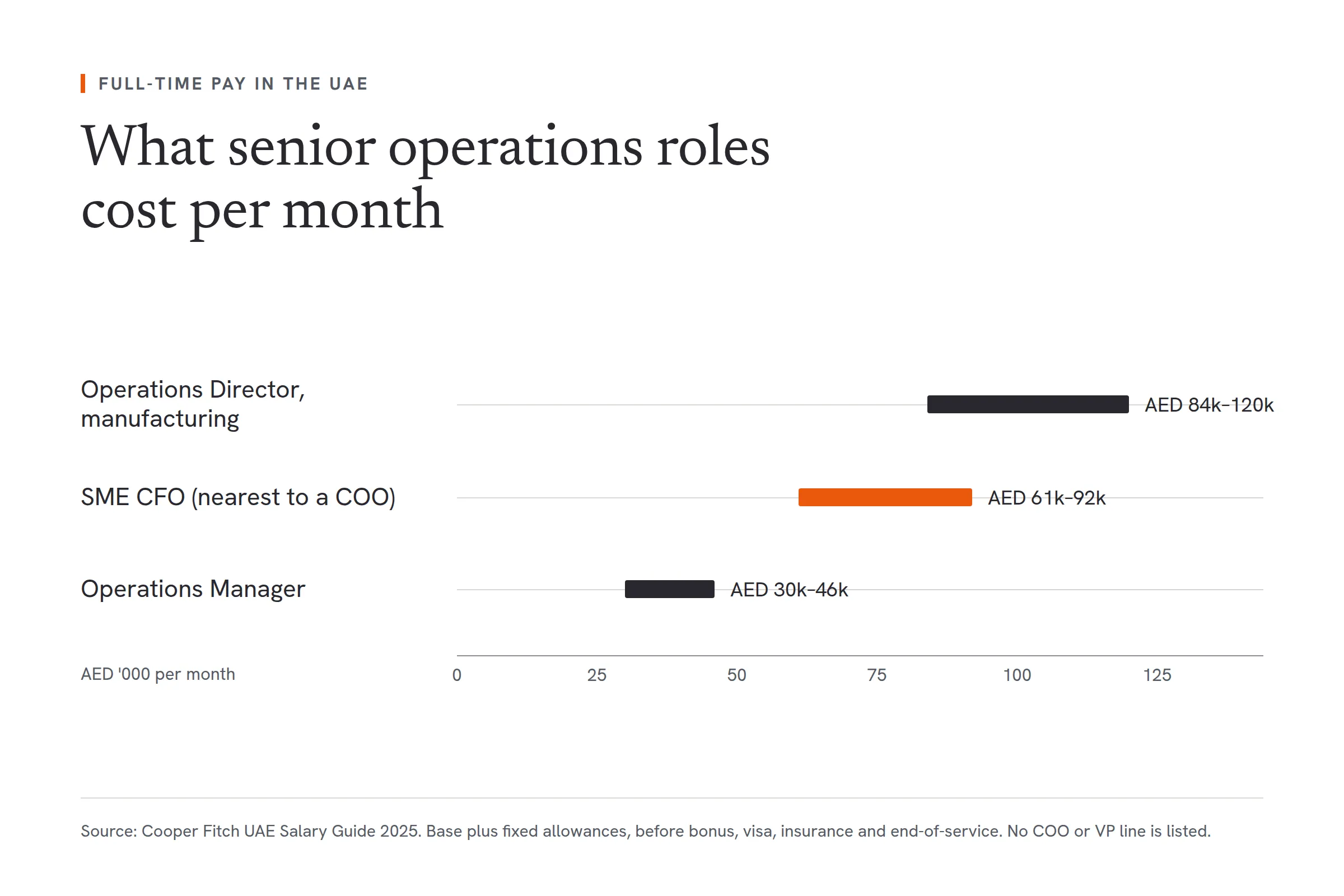
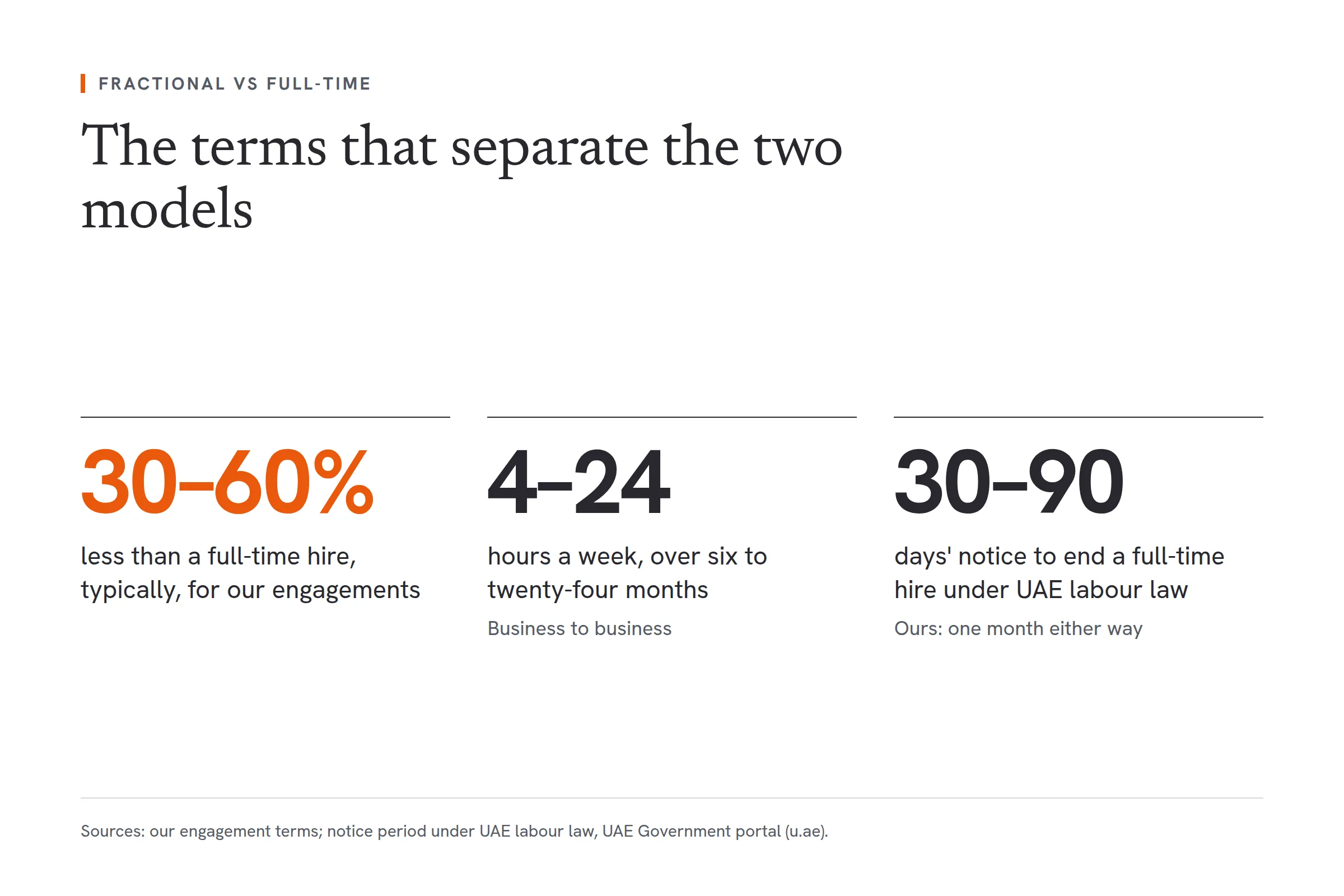
The cost side is easier to benchmark. Cooper Fitch's 2025 UAE salary guide puts an SME Chief Financial Officer at AED 61,000 to 92,000 a month. That is base salary plus fixed allowances, before bonus, visa, insurance and end-of-service. The guide has no standalone COO line, but in our reading a senior operations hire sits in a similar band: it lists an Operations Director in manufacturing at AED 84,000 to 120,000 a month. Our engagements typically run 30 to 60% less than a full-time hire, and carry no employment visa, no end-of-service liability and no insurance burden. Compare that with fractional vs full-time COO economics if you are deciding how to access this leadership.
The benefit side is bigger than the line items. Even a modest margin improvement is not just better profit. It is survival buffer, hiring capacity and strategic optionality, especially in a market that is getting more crowded. The UAE passed 1.4 million registered companies at the end of 2025, with roughly a quarter of a million added during the year, and SMEs account for 94% of all businesses. Competing in that field takes disciplined operations.
Why 2026 and 2027 raise the stakes
Electronic invoicing is the clearest dated example of operations work that cannot wait. Under the Ministry of Finance's rules, a business with revenue of AED 50 million or more must appoint an Accredited Service Provider by 30 October 2026 and implement e-invoicing by 1 January 2027. Below that threshold, the original decision sets an appointment deadline of 31 March 2027 and a go-live of 1 July 2027.
The software is the easy part. Someone has to own the process change: who raises invoices, in what format, how exceptions are handled and how the data reaches finance. That is operations leadership, and it is a good first project for a fractional COO.
Dubai's own ambitions point the same way. The Dubai Economic Agenda D33 aims to double the size of Dubai's economy and consolidate its position among the top three global cities. Businesses that want a share of that growth need operations that can absorb it.
The real question
The question is not whether a COO creates value. The question is whether you are ready to let go.
Most founders know they need operational help. What stops them is fear that nobody will care as much as they do. That is probably true. But caring is not what scales companies. Systems are. A good COO builds systems that work whether you are in the office or on holiday.
If you spend most of your time being reactive, you need operational leadership. If decisions sit waiting for you, you are the bottleneck. If you cannot explain why tasks take as long as they do, you need process documentation. A fractional COO is often the most cost-effective way to install that capability for scaling SMEs. The executive owns the outcomes in their domain; our role is the structure, support and governance around the engagement.
The founder's job is building the future. Everything else is operations.
Ready to fix your operations?
If the bottlenecks, manual work and reactive firefighting sound familiar, take our COO readiness assessment to see where you are losing time and money.
The problems are surprisingly similar across tech, manufacturing, services and retail, and they are exactly what a good fractional COO helps solve. Ready to discuss your situation? Apply for a consultation to get started.
With proper operational systems, founders stop being the bottleneck, teams become self-sufficient and growth becomes sustainable instead of chaotic. Explore our complete guide to fractional COO services to learn more about how it works.