COO vs VP Operations: Which Operations Leader Does Your UAE Business Actually Need?
TL;DR: A COO runs company-wide operations. A VP Operations manages one functional area. Most Dubai SMEs hire the wrong one because they confuse titles with needs. But there's a better question: do you need either full-time.
Business owners love impressive titles. "Chief Operating Officer" sounds important. "VP Operations" sounds like a step down. Neither assumption helps you hire the right person.
Here's what actually matters: do you need the scope of a COO or a VP Operations? And do you need that scope 40 hours a week?
Most companies get both questions wrong.
They hire a COO when they need functional expertise. They hire full-time when they need strategic guidance. They spend AED 40,000-70,000 monthly when they could get better results for a fraction of that.
The fractional model solves this. You get the right scope of expertise at the right intensity. No more paying for unused capacity. No more settling for junior talent because the senior option costs too much.
Let me show you how this actually works.
What a COO Actually Does
Think of a COO as the person who makes the entire company run. Not just one department. Everything.
When your CEO says "we need to scale from 20 to 200 employees this year," the COO figures out how. They don't just optimise one process. They redesign how your entire organisation works.
They're cross-functional leaders. Finance reports to them. Operations reports to them. Sometimes, tech and HR report to them, too. They connect all the pieces that make a business work.
Most importantly, a COO owns P&L responsibility. They're accountable for whether the company makes money.
Here's the thing, though: most companies don't need this 40 hours a week.
A good COO's value comes from strategic decisions, not presence. Choosing the right organisational structure. Building operational systems. Making resource allocation decisions. This is high-leverage work that doesn't require full-time attention.
When we work with Dubai companies needing fractional COO support, they typically need 15-20 hours weekly of focused, strategic work. That's enough to make decisions, guide implementation, and course-correct. The rest would be meetings about meetings.
The fractional model gives you COO-level strategic thinking without paying for capacity you don't need.
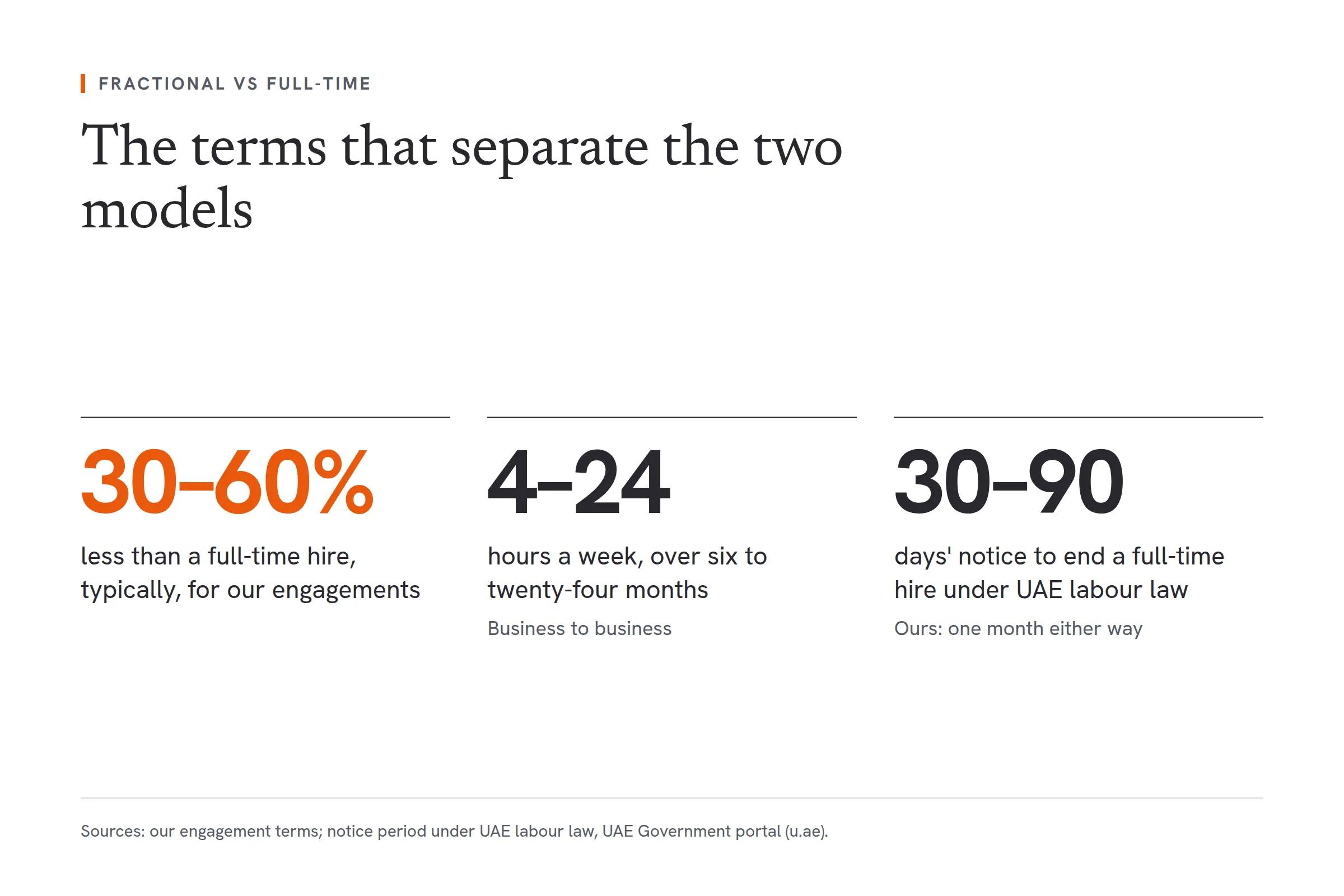
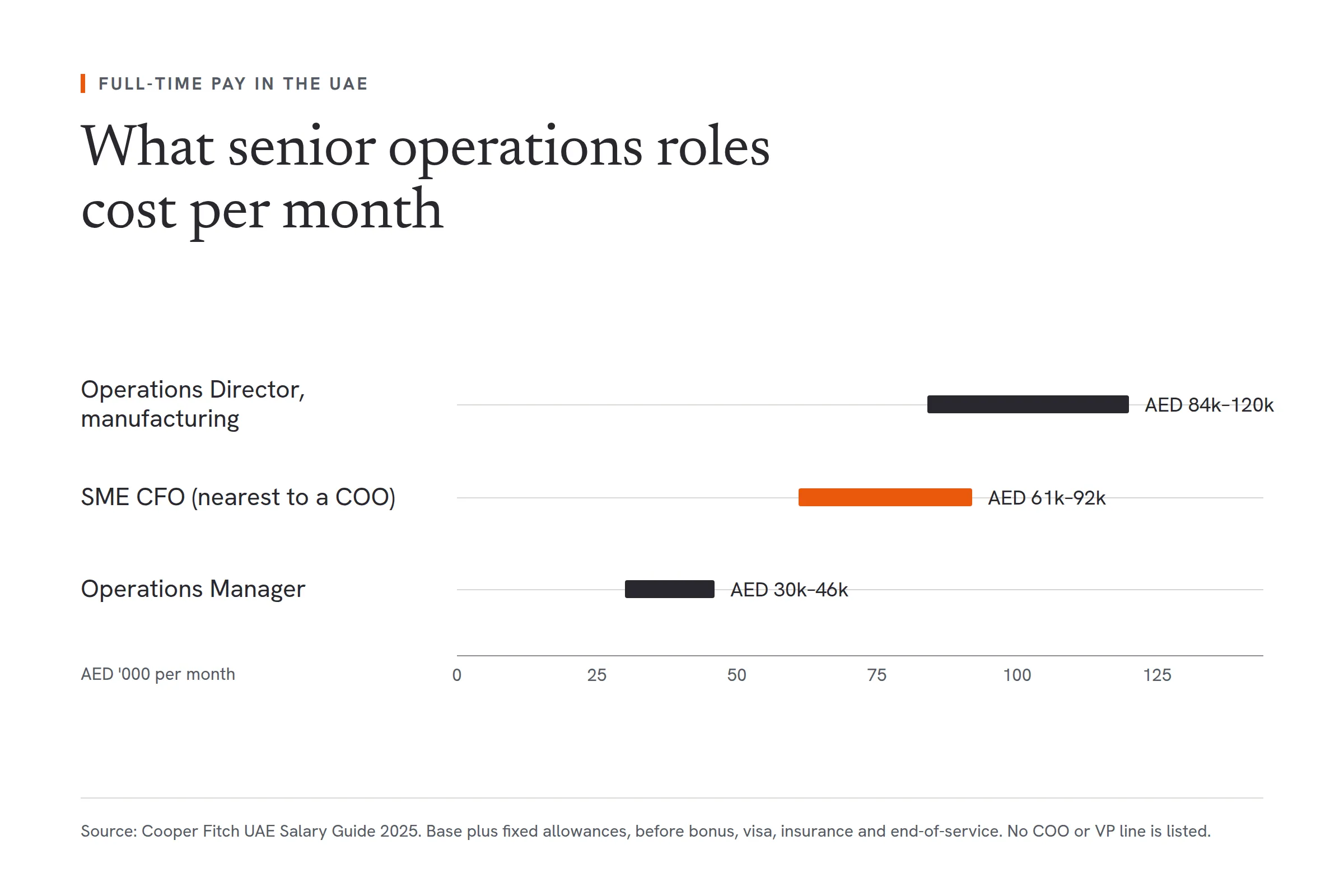
In Dubai's market, a full-time COO costs AED 40,000-70,000 monthly. A fractional COO delivering equivalent strategic value? About 30-40% of that.
What a VP Operations Actually Does
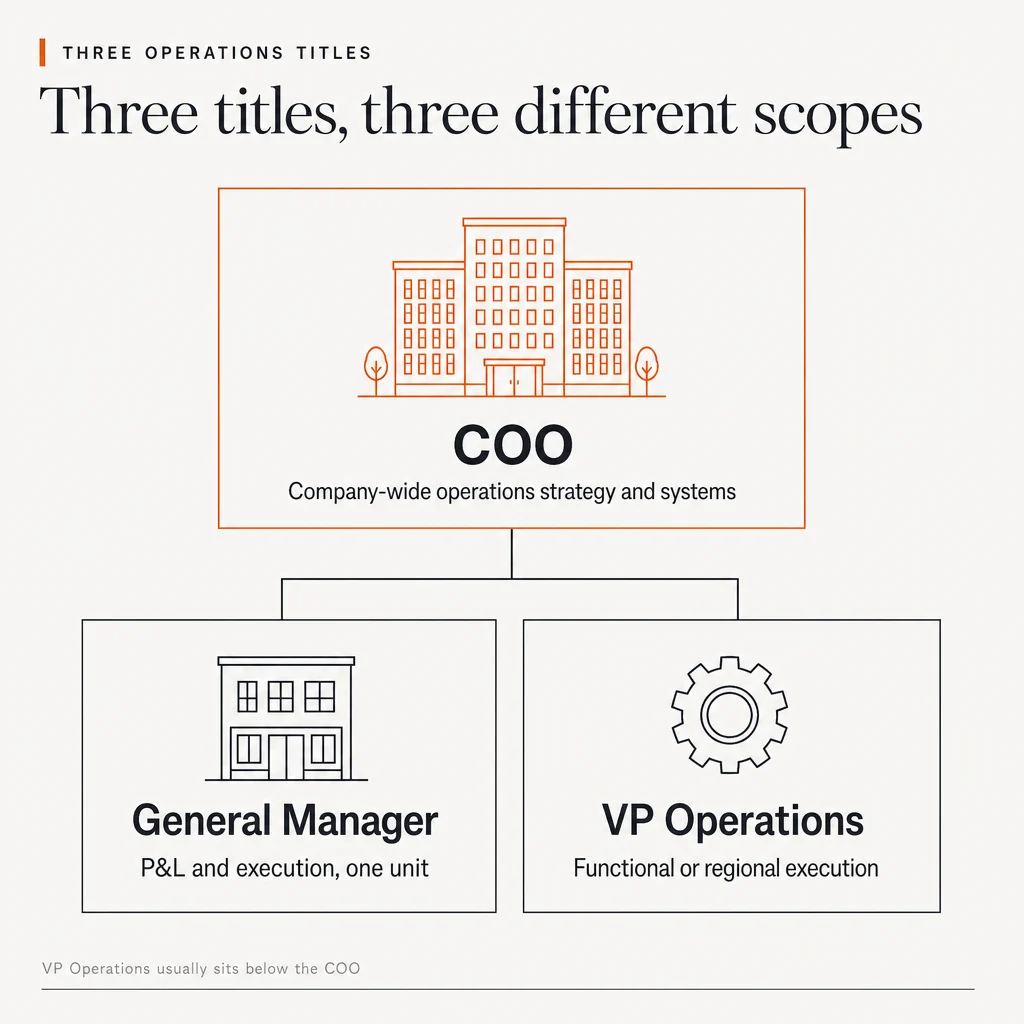
A VP Operations manages one specific part of your operations. Maybe supply chain. Maybe manufacturing. Maybe service delivery. A defined functional area.
They're department-level leaders. They have a team. They have objectives. But they don't run the whole company's operations. They optimise their specific domain.
The scope difference is crucial. A VP Operations improves processes within their area of responsibility. They make their department excellent. A COO makes sure all departments work together to make the whole company excellent.
VP Operations focuses on tactical execution within strategic parameters someone else sets.
And here's where it gets interesting: for most SMEs, you don't need this person full-time either.
You need someone who can:
- Diagnose what's broken in your operational area
- Design better systems
- Train your team to run those systems
- Monitor and adjust as needed
That's not a 40-hour-per-week job. It's project-based work that peaks during design and implementation, then tapers to oversight.
This is perfect for fractional engagement. You get VP-level functional expertise when you need it most. During system design, you might have them 3 days a week. Once systems are running, maybe 1 day a week for optimisation and team development.
In Dubai, a full-time VP Operations costs AED 25,000-45,000 monthly. A fractional VP Operations solving your specific functional problem? You're looking at AED 10,000-18,000 monthly, scaled to your actual needs.
The Real Distinctions (And Why Fractional Solves Both)

Scope
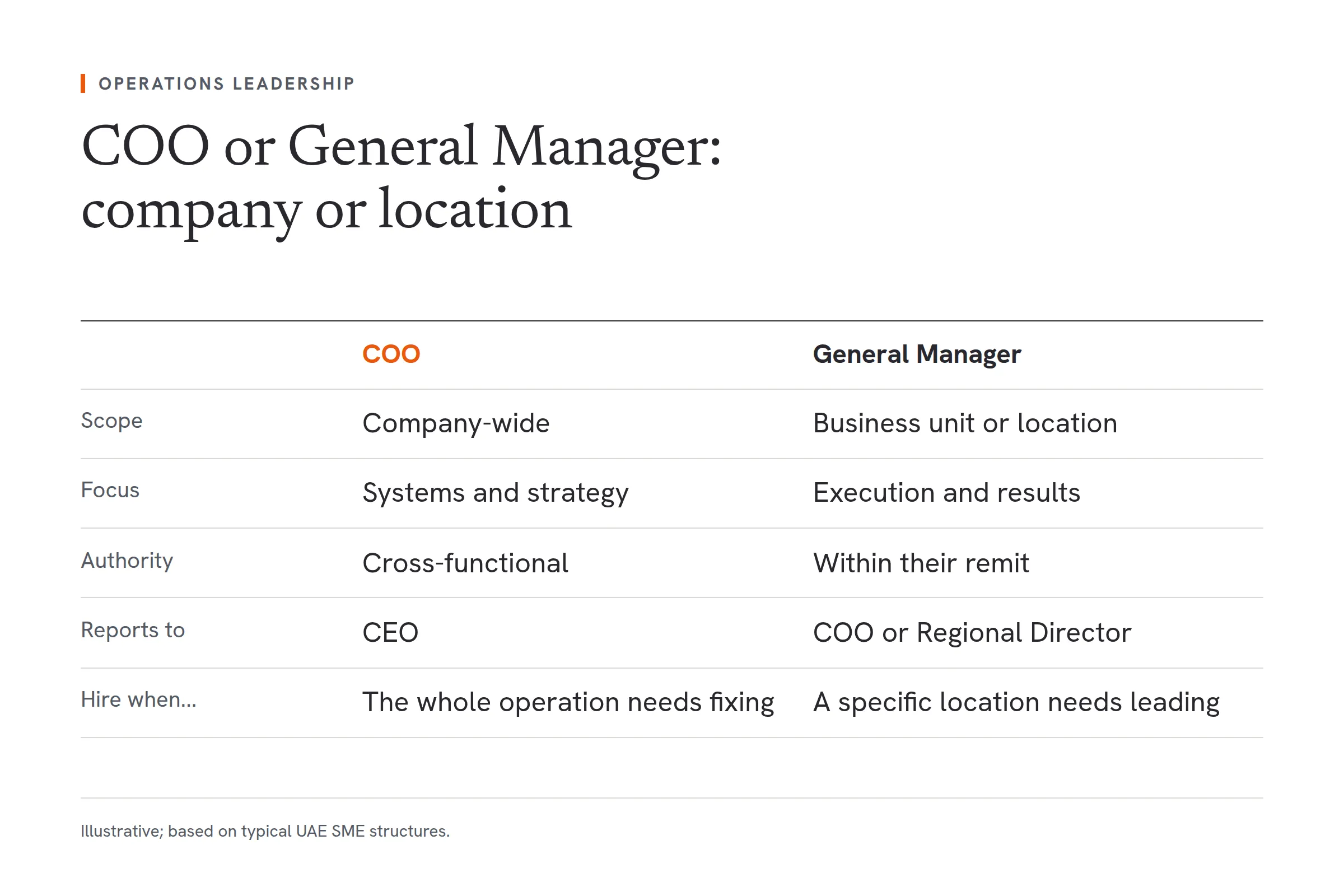
COO: Company-wide operational strategy
VP Operations: Department or functional area
The fractional advantage: You can start with focused VP-level work in your problem area, then expand to COO-level coordination if needed. Or deploy both simultaneously for specific projects. The flexibility lets you match expertise to need, not title to budget.
Strategic vs Tactical
A COO spends most time on strategic questions. How should we structure the organisation as we scale? What operational capabilities do we need for our three-year plan?
A VP Operations spends most of their time on tactical execution. How do we improve warehouse efficiency by 20%? What process changes reduce defect rates?
The fractional advantage: You're not paying COO rates for tactical work or VP rates for routine oversight. You get strategic thinking when you need strategy, tactical expertise when you need execution. The engagement scales with your needs.
Decision Authority
A COO makes company-level decisions affecting every department. They can reorganise teams, reallocate budgets across functions, and change how departments work together.
A VP Operations makes decisions within their domain. They can change processes in their area, hire for their team, and optimise their department's budget.
The fractional advantage: A fractional COO or VP comes without empire-building incentives. They're not fighting for headcount or budget. They're solving your specific problem. This makes their decision-making cleaner and faster.
When Your Dubai Business Needs COO-Level Thinking
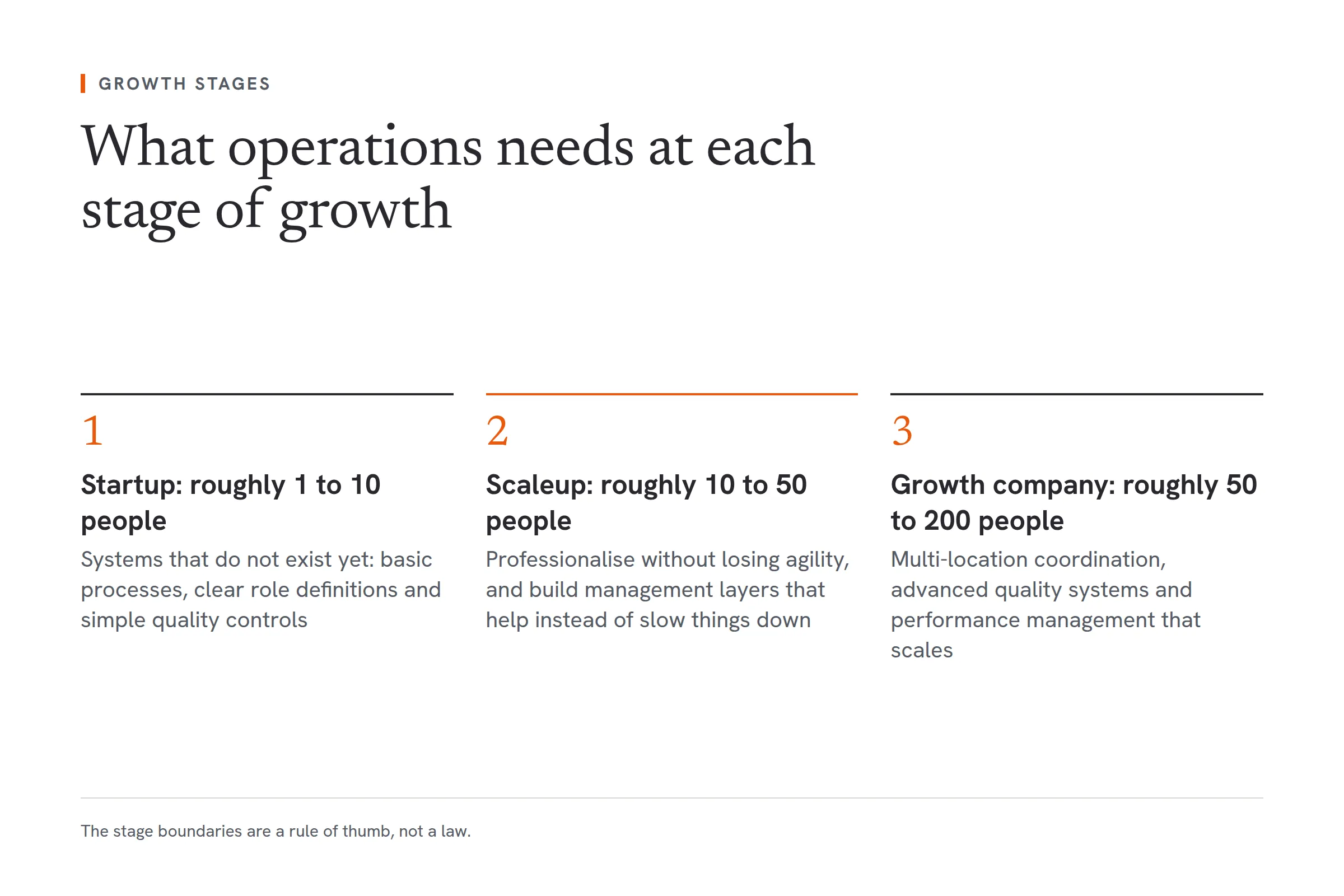
Your CEO has hit capacity. Founders often try to be both CEO and COO. That works when you're 10 people. At 50 people, something breaks.
Fractional solution: Instead of choosing between "promote someone internal who's not ready" or "hire an expensive executive we can't afford," you get a fractional COO who can operate at the needed level immediately. They work 2-3 days per week, which is often enough for strategic operational leadership.
You're scaling across multiple functions simultaneously. When growth requires coordinating technology, operations, finance, and people systems all at once, you need someone who can orchestrate everything.
Fractional solution: This is exactly when fractional makes the most sense. You need COO-level strategic thinking, but you're in a volatile growth phase. Revenue might jump 3x or hit a wall depending on market conditions. Fractional gives you the expertise without the fixed cost risk.
You're preparing for major growth. If you're planning to 3x revenue or expand to new markets, you need someone thinking about system scalability.
Fractional solution: Growth preparation is project-based work with ongoing oversight. Heavy lifting during planning and system design, lighter touch during execution. Perfect for fractional engagement. use fractional COOs specifically for scale preparation - intense 3-month buildout, then lighter ongoing optimisation.
You have complex operational challenges. Multiple locations across emirates. International supply chains. Regulatory compliance across different business units.
Fractional solution: Complex doesn't mean constant. It means you need senior judgment available when decisions need to be made. A fractional COO can handle the strategic decisions while your team executes day-to-day operations.
When Your Dubai Business Needs VP-Level Focus
You have a specific functional problem. Your warehouse operations are chaotic. Your customer service response times are too slow.
Fractional solution: This is the clearest fractional use case. You need expertise to fix a specific problem, then maintain the solution. A fractional VP Operations can dedicate heavy time to the fix (maybe 3 days/week for 2-3 months), then scale down to maintenance oversight (maybe 1 day/week). You pay for what you need when you need it.
You're mid-size and function-focused. At 30-80 employees, you often need strong functional leaders more than you need a COO.
Fractional solution: Here's the real advantage - you can have multiple fractional VPs at the cost of one full-time hire. VP Operations 2 days/week + VP Sales 1 day/week might cost less than one full-time VP, and you get specialised expertise in both areas.
You have a major project in one area. Implementing a new ERP system. Redesigning your supply chain. Optimising manufacturing.
Fractional solution: Project work is literally what fractional roles are designed for. Intense focus during the project, clean handoff afterwards. No awkward "what does this person do now that the project is done" conversations.
The Hidden Third Option (That Often Works Best)
Most companies frame this as: COO vs VP Operations vs nothing.
There's a better option: fractional leadership that gives you the right scope at the right intensity.
Think about what you actually need:
- Strategic operational thinking? 10-15 hours weekly.
- Functional expertise to fix a specific problem? 20 hours weekly during fix, 5 hours weekly for maintenance.
- Cross-functional coordination during growth? 15-20 hours weekly.

None of these requires 40 hours. All of them require senior-level judgment.
The math is compelling. A full-time COO at AED 60,000 monthly gives you 160 hours. If you only need 60 hours of strategic work, you're paying for 100 hours of... what exactly? Meetings? Email? "Executive presence"?
A fractional COO at AED 20,000 monthly gives you 60 hours of focused, strategic work. No filler. No politics. Just the high-leverage decisions that actually move your business forward.
Dubai's Operational Reality (And Why Fractional Fits Perfectly)
Dubai adds specific complexity that actually makes fractional more attractive, not less.
Free zone operations create unique challenges. You might need deep expertise in free zone regulations for 3 months while setting up, then occasional guidance afterwards. Full-time hire? Overkill. Fractional expert who's done this 20 times? Perfect.
Multi-emirate coordination requires strategic thinking, not constant presence. A fractional COO can design your multi-location operational structure in weeks, then provide ongoing oversight at 1-2 days weekly.
Supply chain complexity in the UAE needs senior operational leadership, but most of it is establishing systems and relationships. A fractional VP Operations or COO can set this up, then provide lighter-touch ongoing optimisation.
Labour law compliance affects every department. This is exactly the kind of cross-functional challenge where you want fractional CHRO expertise working alongside your fractional COO. Two specialised executives for less than one full-time hire.
Dubai's business environment is volatile. Regulations change. Market conditions shift. Growth accelerates or stalls based on factors outside your control.
Fractional leadership matches this reality. When you're growing fast, scale up engagement. When you hit a cash crunch, scale down. When the problem is solved, end it. The flexibility is the point.
Making the Right Choice (Probably Not the One You Think)
Here's how to actually decide:
First, assess your actual problem. Write down specifically what's not working. Is it one area or everything? Is it tactical or strategic?
Second, estimate the required time. How many hours per week of senior strategic thinking do you actually need? Be honest. Most companies overestimate this by 2-3x.
Third, consider your growth volatility. If your revenue could double or halve in the next 12 months (and in Dubai, it could), fixed executive costs are dangerous.
Fourth, think about expertise gaps. Do you need one generalist or multiple specialists? Fractional lets you have both a COO for strategic coordination and a VP Operations for your specific functional challenge, often for less than one full-time hire.
Most Dubai SMEs we talk to initially think they need a full-time COO. After proper assessment, here's what actually happens:
- 30% realize they need focused VP-level expertise in one area, delivered fractionally
- 40% realize they need COO-level strategic thinking, but only 15-20 hours weekly
- 20% realize they need both COO coordination and VP functional expertise, deployed fractionally
- 10% actually need full-time senior operational leadership
That means 90% of companies get better results with fractional engagement than traditional full-time hiring.
The Real Cost Comparison (That Nobody Shows You)
Let's be specific about costs in Dubai's market:
Full-Time COO:
- Salary: AED 50,000-80,000/month
- Benefits, visa, insurance: +30%
- Recruitment fees: 2-3 months salary
- Ramp-up time: 3-6 months before full productivity
- Risk: If it doesn't work out, you're looking at 6-12 months and AED 300,000-500,000 lost
Full-Time VP Operations:
- Salary: AED 40,000-60,000/month
- Benefits, visa, insurance: +30%
- Recruitment fees: 2-3 months salary
- Ramp-up time: 2-4 months
- Risk: Similar to COO, just smaller numbers
Fractional COO (15-20 hours/week):
- Monthly fee: AED 18,000-30,000
- No benefits overhead
- No recruitment fees
- Immediate productivity from day one
- Risk: If it doesn't work out, you end next month. Clean exit.
The fractional model isn't just cheaper. It's better aligned with how operational expertise actually creates value.
The Question You Should Actually Be Asking
It's not "Do I need a COO or VP Operations?"
It's: "What operational expertise do I need, at what intensity, and for how long?"
Once you frame it that way, fractional becomes obvious.
You need COO-level strategic thinking? Great. How many hours weekly? Probably not 40.
You need VP-level functional expertise? Perfect. For how long? Probably intense during the fix, light afterwards.
You need both? Even better. Fractional lets you deploy both for less than one full-time hire.
The title matters less than getting the scope and intensity right. Fractional lets you match both precisely to your needs.
Getting Started
If you're not sure what you actually need, take our assessment. It clarifies whether your challenges require company-wide or function-specific operational leadership - and whether you need that full-time or fractionally.
Most companies discover they need less than they thought, but better quality than they could afford full-time.
That's exactly what fractional solves.
Want to discuss your specific operational challenges? Talk to us. We'll assess what you actually need and show you how fractional engagement can deliver better results than traditional hiring.
Frequently Asked Questions
Can one person be both VP Operations and COO?
Not really in terms of scope. But here's what's interesting: a fractional executive can operate at different scope levels for different companies. They might work as your VP Operations (functional focus) while serving as COO (company-wide focus) for another smaller company. That cross-pollination of experience makes them more valuable to you.
Should a COO have been a VP Operations first?
Not necessarily. Some of the best COOs come from consulting, general management, or CEO roles at smaller companies. What matters is strategic thinking and cross-functional leadership. With fractional, you're not hiring someone's career path - you're hiring their expertise for your specific problem.
How much does each role cost in Dubai?
Full-time COO: AED 50,000-80,000 monthly plus benefits. VP Operations: AED 40,000-60,000 monthly plus benefits. Fractional COO (15-20 hrs/week): AED 20,000-30,000 monthly, no benefits or overhead. The fractional rates give you equivalent strategic value at 30-40% of full-time cost.
When should we upgrade from VP Operations to COO?
When operational complexity exceeds what one functional leader can handle. When your CEO can't manage all operational functions anymore. Or when you're preparing to scale significantly. But consider: could a fractional COO provide that strategic coordination at 15-20 hours weekly, letting you keep your strong functional leaders in place?
Can a fractional executive work as COO or VP Operations?
Both. Actually, fractional works especially well for COO-level strategic work because most companies don't need 40 hours of executive strategic thinking weekly. They need 15-20 hours of focused, high-leverage decision-making. Same with VP Operations - fixing a functional area is project-based work that doesn't require constant full-time presence.
What if our needs keep changing as we grow?
This is exactly when fractional makes most sense. You might need heavy VP Operations support this quarter (3 days/week to fix operations), COO-level strategic thinking next quarter (2 days/week for scale planning), then both running the quarter simultaneously after. Fractional adapts as your needs evolve. Full-time hiring can't do that.
How do we know if fractional is right for us?
If you answer yes to any of these, fractional probably makes more sense than full-time:
- Your revenue fluctuates more than 20% quarter-to-quarter
- You have specific operational problems to solve rather than ongoing management needs
- You can't afford full-time senior operational leadership at market rates
- You need multiple types of expertise (operations + technology + finance)
- You're pre-revenue/early-growth and operational needs will change rapidly
Most Dubai SMEs fall into at least two of these categories.
The bottom line: The COO vs VP Operations question misses the point. The real question is: what scope of operational expertise do you need, at what intensity, and can you afford to get it wrong with a full-time hire?
Fractional gives you the right expertise at the right intensity without the risk. For most Dubai SMEs, that's not just cheaper - it's smarter.
Assess your needs or talk to us to see how fractional operational leadership could work for your specific situation.