CTO vs CIO in one answer
A Chief Technology Officer (CTO) decides which technology the business builds or buys in order to grow, while a Chief Information Officer (CIO) runs the internal systems, data and security the business already depends on. For most non-tech UAE companies the gap is strategic technology leadership, and a fractional CTO fills it at a fraction of the full-time cost. Our guide to CTO as a service for non-tech companies explains how traditional businesses access that leadership.
What is the difference between a CTO and a CIO?
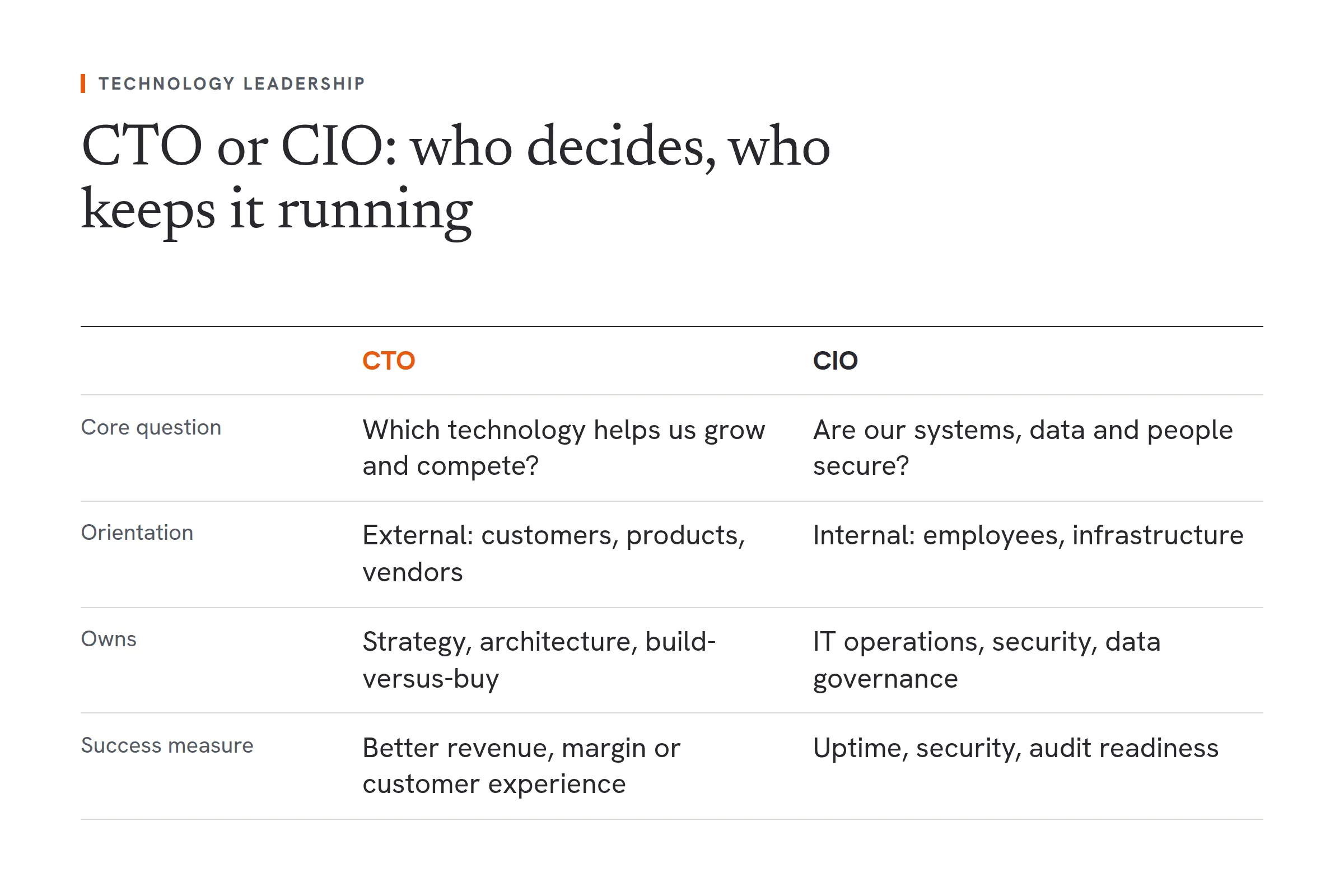
The CTO is outward-facing and the CIO is inward-facing, and the two roles overlap most in smaller businesses.
| CTO | CIO |
|---|---|---|
Core question | Which technology helps us grow and compete? | Are our systems, data and people secure and reliable? |
Orientation | External: customers, products, platforms, vendors | Internal: employees, infrastructure, processes |
Typical ownership | Technology strategy, architecture, build-versus-buy, digital products | IT operations, security, data governance, compliance, internal systems |
Success measure | Technology that improves revenue, margin or customer experience | Uptime, security, cost control, audit readiness |
Time horizon | Two to five years | Current operations and the next budget cycle |
In large enterprises both roles exist. In a founder-led SME, one senior person is often asked to cover both, or neither exists and decisions default to whoever signs the invoice. If your challenge is delivery speed inside an existing engineering team rather than direction, see our comparison of CTO versus VP Engineering roles.
Which does a non-tech UAE company need first?
Most non-tech companies need CTO-style leadership first, because the costly decisions are about direction: which ERP, which payment stack, which e-commerce platform, which vendor. These decisions are expensive to reverse and rarely have an internal owner.
A CIO-style role becomes necessary when the business holds large volumes of customer or employee data, runs many internal systems across sites, or operates in a regulated sector. Even then, a part-time senior leader plus a capable IT manager or managed service provider often covers the need until the scale justifies a full-time hire.
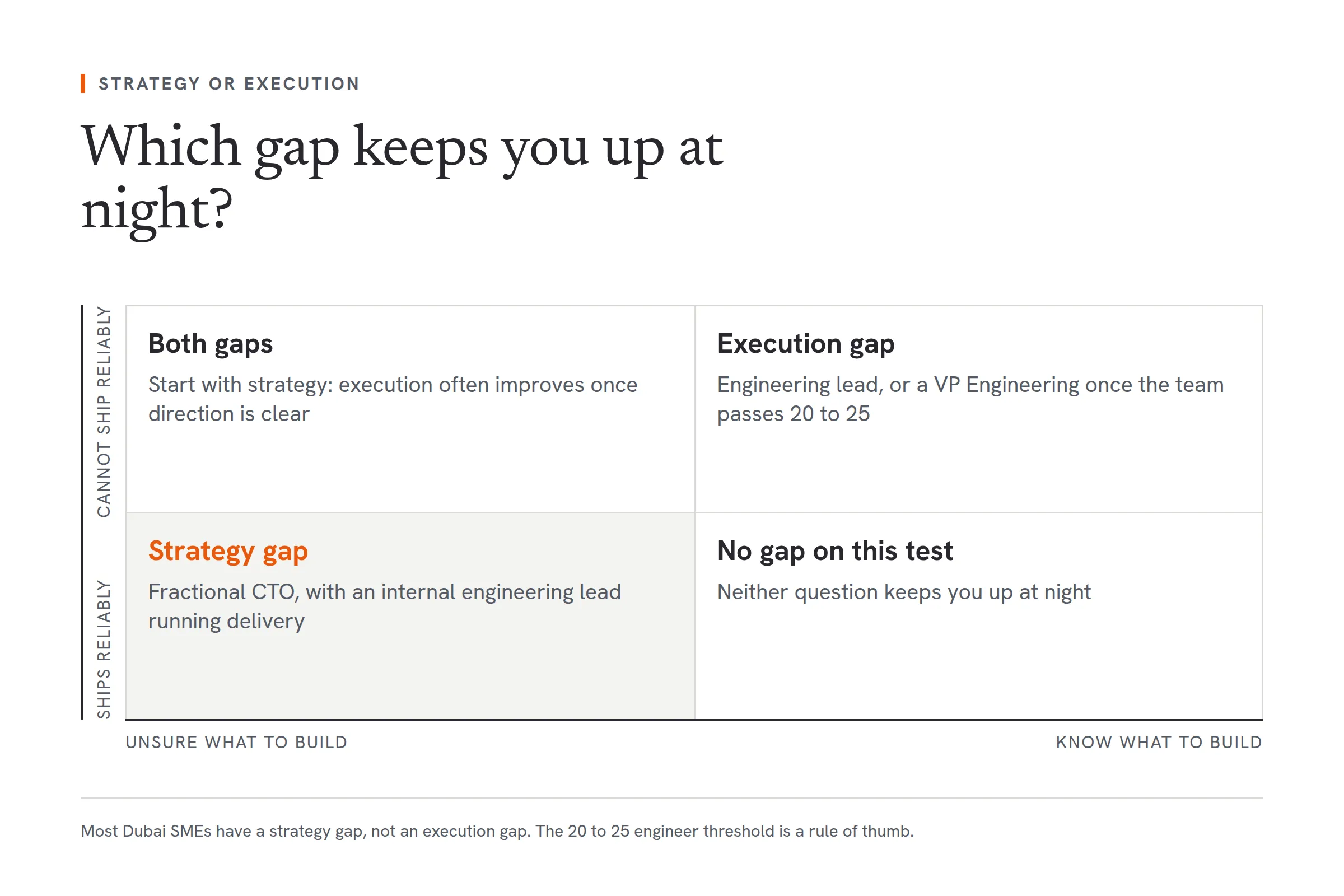
A simple test: if you are unsure what to buy or build next, you need a CTO. If you know what you run but cannot be sure it is secure, compliant and stable, you need CIO-style governance. Many UAE SMEs need both, which is why a fractional CTO who also sets IT governance is often the right first step. Our guide to when your business needs a C-suite executive helps frame the decision.
Who owns UAE regulatory technology decisions?
Four UAE changes land on technology leadership, and they straddle the CTO and CIO remits.
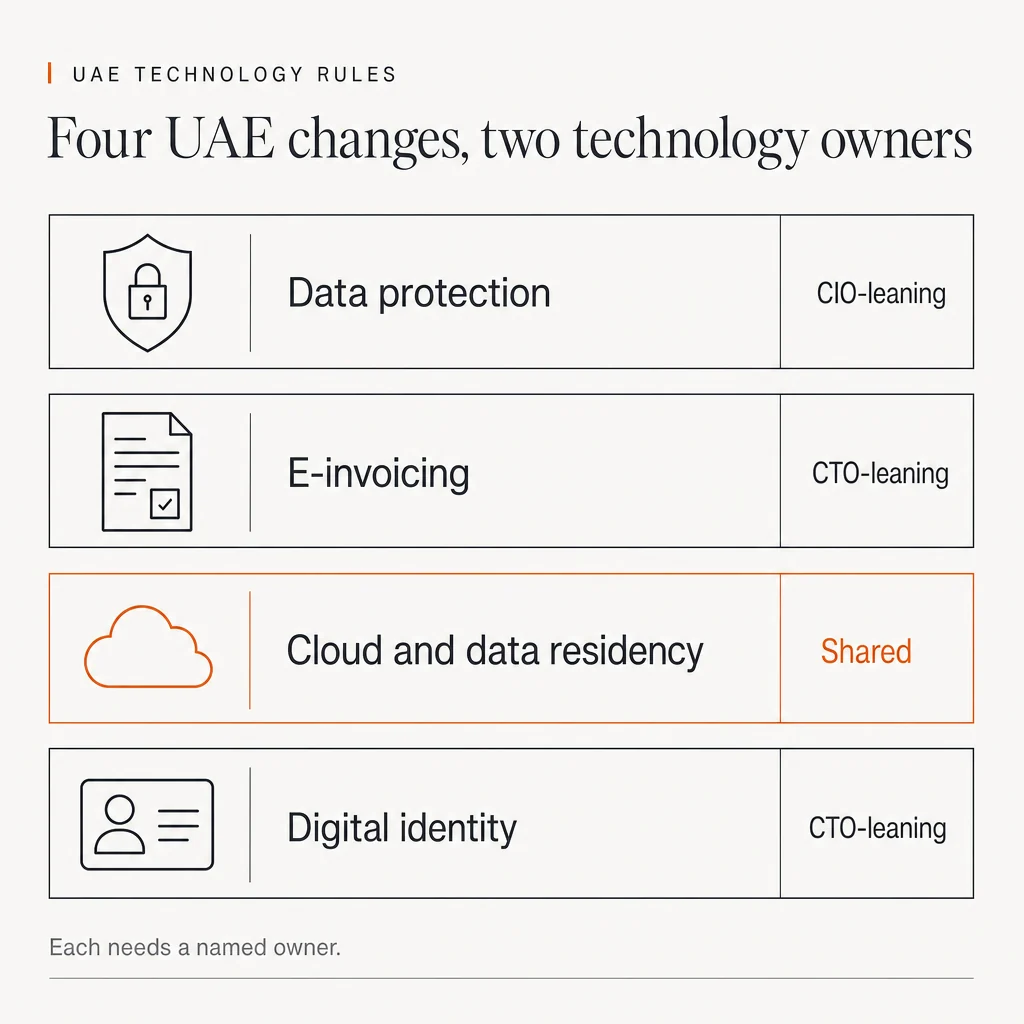
Data protection (CIO-leaning). The PDPL (Federal Decree-Law No. 45 of 2021) has applied since 2 January 2022, with consent and cross-border transfer requirements. Law-firm commentary in July 2026 notes that its executive regulations remain pending, while on 14 June 2026 the government created a federal Artificial Intelligence and Data Authority that absorbs the UAE Data Office. Someone must own consent records, access requests and breach handling now.
E-invoicing (CTO-leaning, because it is a systems choice). The Ministry of Finance phases the UAE e-invoicing programme by revenue. Businesses with annual revenue of AED 50 million or more must go live on 1 January 2027, with the deadline to appoint an accredited service provider extended to 30 October 2026. Other in-scope businesses must appoint a provider by 31 March 2027 and go live on 1 July 2027.
Cloud and data residency (shared). Where data is hosted is both an architecture decision and a compliance one. Sector laws such as Federal Law No. 2 of 2019 on ICT in healthcare add conditions to the PDPL's transfer rules, so confirm requirements for your sector before choosing a cloud region or vendor.
Digital identity (CTO-leaning). UAE PASS offers authentication and digital signature services to government entities and private organisations. It is worth evaluating for onboarding and signing, but it is an option rather than a blanket requirement.
What does fractional technology leadership cover?
Fractional CTO leadership provides senior technology guidance to a company on a part-time basis. Rather than hiring a full-time executive, the business engages an experienced technology leader who is accountable for outcomes in their domain, supported by our structure and governance.
Key service areas
- Technology strategy, assessment and roadmap
- Vendor selection and management
- System integration oversight
- Cybersecurity strategy and IT governance
- Regulatory technology readiness (PDPL, e-invoicing, data residency)
- Digital transformation planning
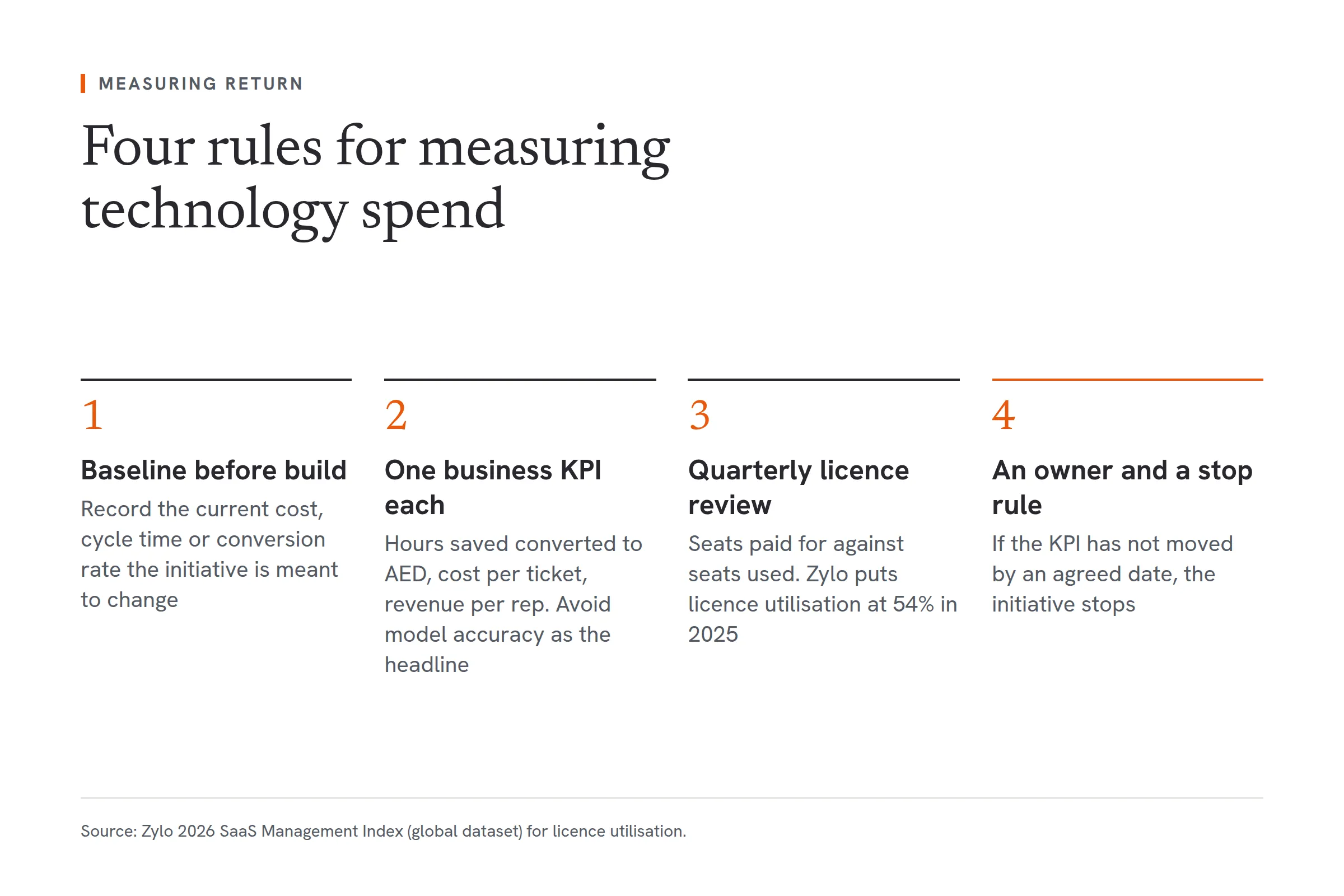
This approach suits traditional businesses that need strategic technology decisions without full-time executive overhead. Our guide to measuring technology investment ROI covers how to judge whether it is working.
How does strategic technology leadership work?
Strategic technology leadership follows a structured approach focused on business outcomes rather than technical features.
1. Business-technology alignment assessment
Review current systems against business goals. Identify gaps between technology capabilities and operational requirements. Document integration points and failure risks.
2. Prioritised implementation roadmap
Create a phased plan aligning technology investments with revenue impact. Put fixed dates, such as the e-invoicing go-live, at the front. Focus on quick wins, building towards strategic improvements.
3. Vendor selection and management
Handle technical negotiations and contract review. Evaluate solutions on business fit, not feature lists. Manage implementation timelines and quality standards.
4. Ongoing strategic guidance
Provide monthly technology leadership without a permanent salary commitment. Monitor industry trends and adjust strategy as the business grows. This is the kind of strategic technology decision-making that supports business growth rather than reactive problem-solving.
How much does technology leadership cost?
Our engagements typically run 30 to 60% less than a full-time hire, and the saving goes beyond salary.
Full-time CTO or CIO
- Base salary, benchmarked in UAE salary guides from Cooper Fitch, Michael Page and Hays (the detailed technology tables sit behind a download, so check the current edition for your seniority level)
- Bonus, housing and other allowances
- Employment visa sponsorship and medical insurance
- End-of-service gratuity
Fractional CTO
- A business-to-business monthly retainer scaled to scope, with one month's notice
- Typically 4 to 24 hours per week over six to twenty-four months
- No employment visa, no end-of-service liability, no insurance burden
- Project implementation: variable based on scope
Demand for senior interim and fractional leaders is rising: 42% of interim engagements now last longer than six months, up from 27% in 2021, according to Heidrick & Struggles.
How to choose the right technology leadership
Selecting appropriate technology leadership means evaluating a few criteria.
Essential qualifications
- Proven experience in your industry sector
- UAE market knowledge and regulatory understanding
- Track record of strategic technology implementations
- Business outcome focus rather than technical feature emphasis
- Integration experience with local systems (VAT, e-invoicing, banking, UAE PASS)
Service delivery approach
- Clear communication in business terms, not technical jargon
- Structured methodology for assessment and implementation
- Vendor-agnostic recommendations based on business fit
- Measurable outcomes with timeline commitments
Engagement model flexibility
- Part-time strategic guidance and project-based implementation support
- Scalable involvement as the business grows
- Access to a collective of 350+ curated and vetted executives when you need wider expertise
Consider taking the fractional CTO readiness assessment to evaluate your technology leadership needs.
When should your UAE business act?
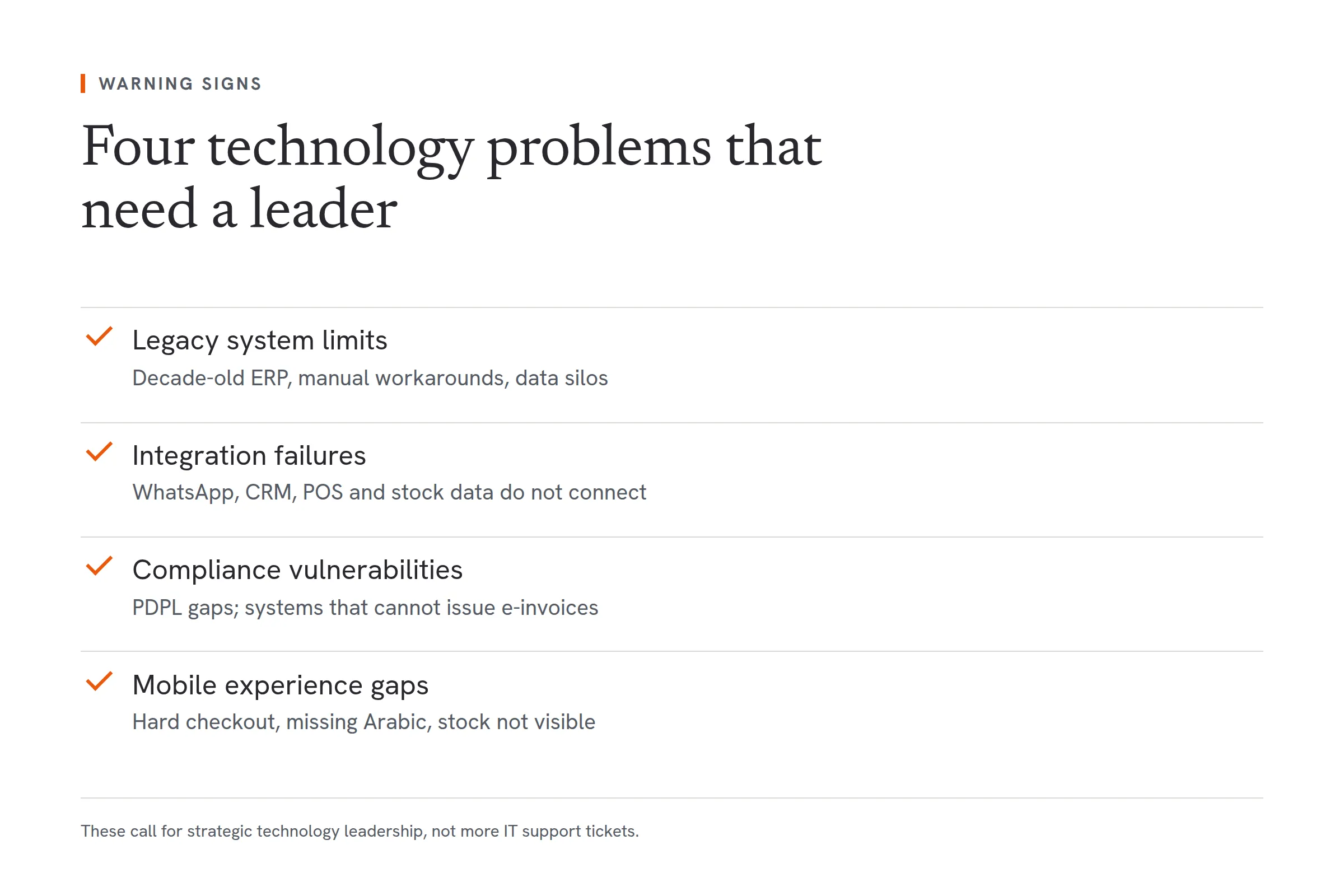
Three warning signs indicate an immediate need for strategic technology leadership.
Technology decision paralysis
You are making technology choices based on vendor sales presentations rather than business requirements. Your team asks for guidance on technology investments but lacks internal expertise to evaluate them.
Operational technology friction
Your staff spends more time working around technology limitations than using technology for productivity. Manual workarounds replace automated processes because systems do not integrate.
Missed business opportunities
You are postponing growth initiatives because current technology cannot support them. Meanwhile, regulatory dates such as e-invoicing go-live are approaching with no named owner.
Understanding what fractional leadership actually means helps identify when strategic guidance becomes essential. For a wider view of digital planning, see our digital transformation strategy guide.
Key takeaways
- Two different jobs: the CTO sets technology direction; the CIO keeps internal systems, data and security running
- Start with strategy: most non-tech UAE SMEs need CTO-style leadership first, with IT governance alongside
- Cost-effective expertise: our engagements typically run 30 to 60% less than a full-time hire
- Dated obligations: UAE e-invoicing goes live for businesses with revenue of AED 50 million or more on 1 January 2027, and for other in-scope businesses on 1 July 2027
- Scalable engagement: business to business with one month's notice, so cover grows with the business
Next steps
Book a strategic technology assessment with one of our Fractional CTOs. We will map your business goals to technology requirements and show you how strategic technology leadership works for your industry.
Not sure if you are ready? Take our Fractional Executive Readiness Assessment.