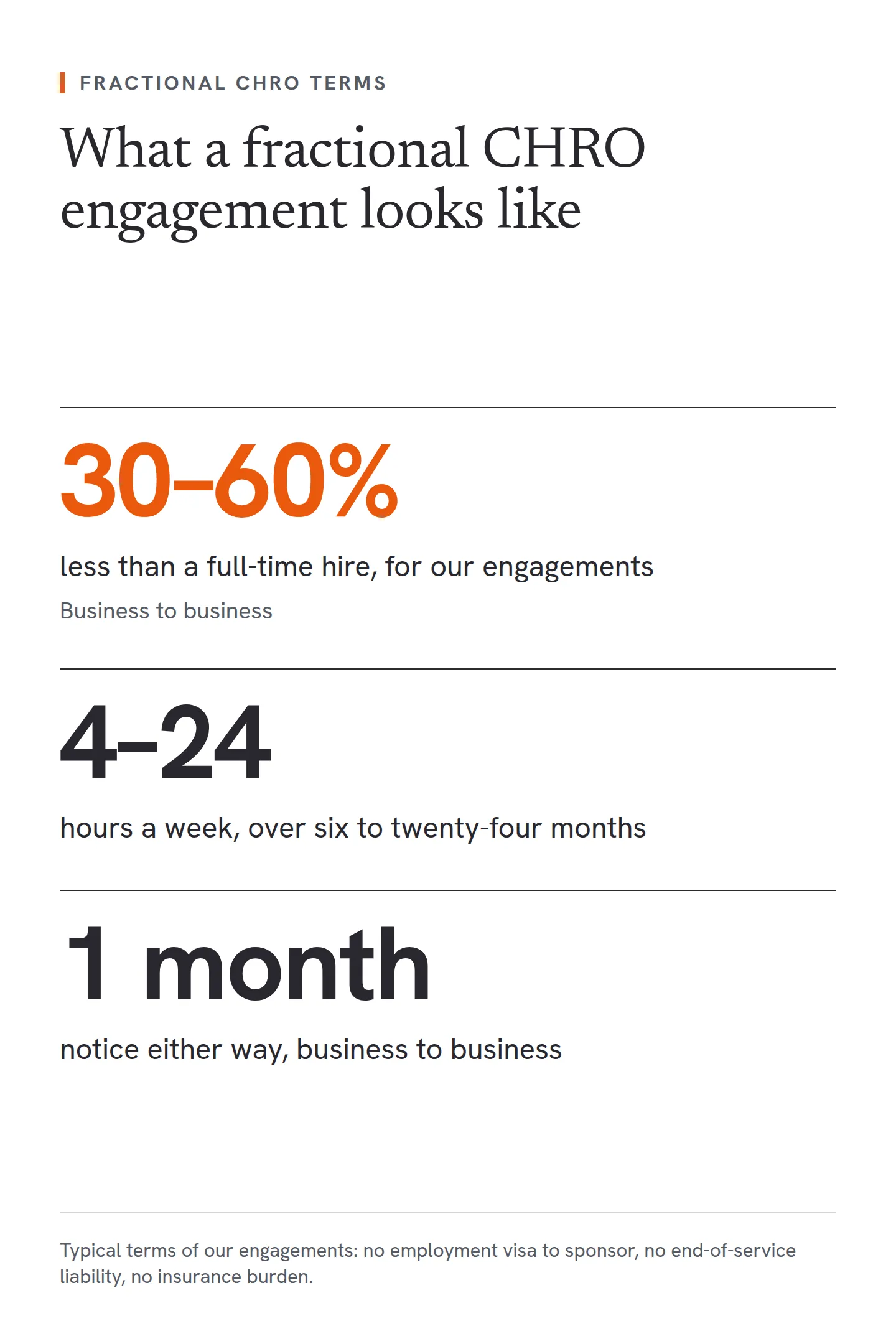
A fractional CHRO gives a Dubai business senior people leadership (workforce planning, Emiratisation strategy, culture and labour law oversight) at a fraction of the cost of a full-time hire. Our engagements typically run 30 to 60% less than a full-time hire, business to business, with one month's notice.
This guide explains what a fractional CHRO does, how fractional leadership works in the UAE, what the 2026 labour and Emiratisation rules mean for your people function, and when your business is ready.
The leadership crisis nobody talks about
Most growing businesses in the UAE make the same expensive mistake. They hire full-time executives they do not need yet, or they try to grow without proper leadership because they think they cannot afford it.
We have watched this play out many times. A startup raises funding, grows fast and suddenly needs a Chief Financial Officer (CFO). The founders interview candidates who expect a full senior package. A full-time SME CFO in the UAE commands a base salary of AED 61,000 to 92,000 per month, roughly AED 730,000 to 1.1 million a year, before bonus, benefits, visa and end-of-service. The maths does not work, so they either make a hire they cannot afford or muddle through without the expertise they need.
There is a third option: fractional leadership.
The UAE's business base keeps expanding. The country passed 1.4 million registered companies at the end of 2025, with about 250,000 added in that year alone. Growth at that pace puts pressure on people leadership: hiring, onboarding, compliance and culture all scale faster than the HR function behind them.
Fractional leadership solves this by bringing in an experienced leader part time. Someone who has already done the job, embedded in your team for the hours and months your business needs.
What fractional leadership actually means
A fractional executive is a seasoned leader who works part time with a business, embedded in its leadership team. Think of it as senior capability on a flexible footing: the expertise of a full-time executive without the full-time cost or commitment.
Demand is rising on a documented basis. Heidrick & Struggles reports a 151% increase in C-suite engagements since 2021 in high-end independent talent, and its 2026 survey found that 42% of interim projects now last longer than six months, up from 27% in 2021. The same survey shows that small and medium-sized companies now account for more than four-fifths of demand.
Fractional executives differ from consultants: they do not advise from the sidelines. They hold the decisions in their domain, join your meetings, lead your people and are accountable for the outcome. The executives in our collective are curated and vetted, with experience that typically spans senior roles at established companies.
How fractional leadership actually works
The mechanics are simpler than most people expect. There are three main models.
Time-based arrangements are the most common. The executive dedicates set days or hours to your business each week or month. Our engagements typically run 4 to 24 hours per week over six to twenty-four months.
Project-based engagements focus on specific deliverables, such as leading a fundraising round, an organisational redesign or a digital transformation. The executive comes in, delivers and moves on.
Retainer models provide ongoing strategic support with a defined monthly commitment. This works when you need consistent access to expertise but not full-time attention.
Duration varies, and the direction of travel is longer, in line with the Heidrick finding above. Some relationships last years, with bursts of more time and focus when the business needs it.
Cost is a fraction of the alternative. Our engagements typically run 30 to 60% less than a full-time hire. For a fractional CHRO, monthly fees typically sit between AED 18,000 and AED 60,000 depending on scope and time commitment. With a full-time hire you also carry the visa, health and unemployment insurance, and end-of-service gratuity that accrues every year of service. We deploy within weeks, and the engagement is business to business: no employment visa, no end-of-service liability, no insurance burden.
The full spectrum of fractional roles
The model now reaches well beyond the traditional C-suite. A summary of the main roles:
Fractional Chief Executive Officers (CEOs) provide strategic vision and leadership without the full-time overhead. They suit founder-led companies that need experienced business leadership during growth phases.
Fractional CFOs are a natural first step for many businesses: every growing business needs financial expertise, but not every business needs a full-time CFO from day one. UAE startups benefit particularly for investor reporting, fundraising preparation and regulatory requirements including corporate tax and VAT. See fractional CFO services.
Fractional Chief Technology Officers (CTOs) guide technology strategy and digital transformation, from architecture choices to security and vendor decisions. See fractional CTO services.
Fractional Chief Operating Officers (COOs) focus on operations, process and scaling. They are the bridge between strategy and execution. See fractional COO services.
Fractional Chief Marketing Officers (CMOs) handle marketing strategy and execution, from positioning to the commercial engine behind it. See fractional CMO services.
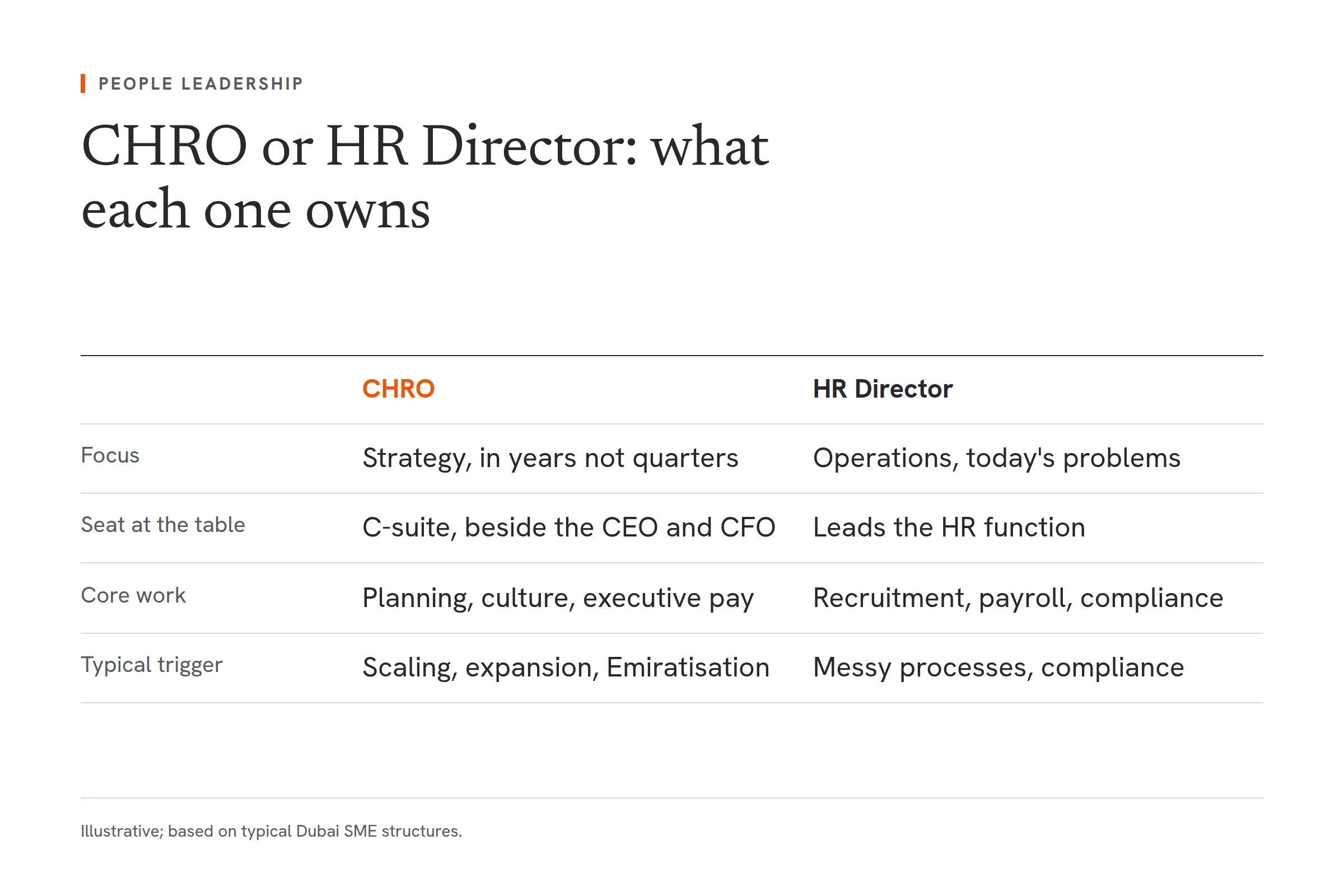
Fractional CHROs address talent acquisition, organisational development and compliance. Our CHRO vs HR Director guide explains when strategic CHRO thinking beats operational HR leadership. In the UAE, where Emiratisation rules and labour law keep tightening, a fractional CHRO is often the most direct way to get that expertise (see the next section).
The model also covers specialist roles such as Chief Revenue Officers and Chief Information Security Officers.
What a fractional CHRO covers in the UAE
The UAE people function is unusually regulated, which is why the CHRO seat is one of the strongest cases for fractional leadership. In 2026 a fractional CHRO typically works across these areas:
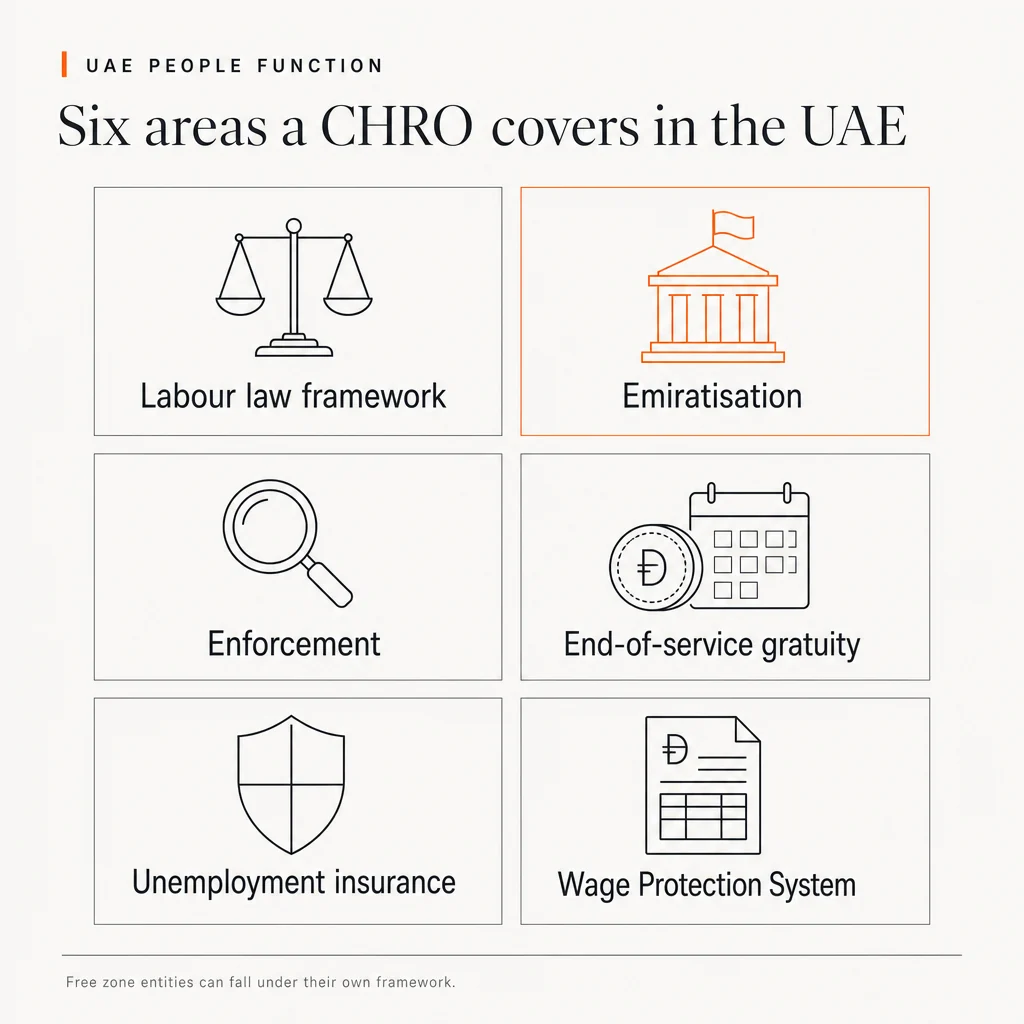
Area | What the current rule or position is | Why it matters |
|---|---|---|
Labour law framework | Employment is governed by Federal Decree-Law 33 of 2021, in force since 2 February 2022 and amended by Decree-Law 20 of 2023. Decree-Law 9 of 2024, effective 31 August 2024, raised employer fines to AED 100,000 to 1 million for serious breaches and lets MoHRE decide claims up to AED 50,000. | Contracts, permits and disputes need to follow the current text, not the 2022 one. |
Emiratisation | Companies with 50 or more employees must raise the Emirati share of skilled roles by 2% a year, to reach 10% by 2026. MoHRE announced contributions of AED 10,000 a month (AED 120,000 a year) per unfilled position from 1 July 2026. | This is a workforce strategy decision with a direct cost, not only a filing. |
Enforcement | MoHRE detected 377 fake Emiratisation cases at 266 private companies in the first half of 2026. | Genuine roles and progression paths protect the company and the hire. |
End-of-service gratuity | 21 days of basic salary per year for the first five years, then 30 days per year, capped at two years' wage, settled within 14 days of termination. | A hidden cost of every full-time hire and every departure. |
Unemployment insurance | Mandatory for private sector employees: a premium of AED 5 or AED 10 a month plus VAT depending on basic salary, with benefits of up to three months. | Easy to miss in onboarding and renewals. |
Wage Protection System (WPS) | Salaries are paid through the MoHRE-monitored payroll system. | Late or mis-recorded payroll creates compliance exposure. |
Two further notes. Free zone entities, the DIFC for example, can fall under their own employment framework rather than the mainland law, so a fractional CHRO should confirm which regime applies to each entity before designing policy. And on residency, the Golden Visa criteria for executive directors were tightened on 18 February 2025, which is worth checking if you plan to use residency as part of a senior package.
Why this model works
Cost-effectiveness. Our engagements typically run 30 to 60% less than a full-time hire. The comparison is not only salary. A full-time C-suite hire brings a residence visa, insurance, a bonus structure and gratuity liability that continues for as long as they are employed.
Access to senior expertise. Fractional executives bring cross-industry knowledge and a record of having solved similar problems. A full-time executive search can take months; we deploy within weeks.
Flexibility and scalability. Organisations can adjust leadership capacity as needs change, with one month's notice either way, rather than carrying fixed leadership cost through uncertainty.
Lower commitment risk. You can test the fit of an executive and the value of the role before committing to a permanent hire. That reduces the cost of a wrong appointment.
Fresh perspective. External executives provide an unbiased view that challenges assumptions and reduces internal politics. They bring experience from other businesses and often spot inefficiencies internal teams overlook.
Speed. Experienced leaders need minimal onboarding and focus on high-impact work, so you see movement in weeks rather than quarters.
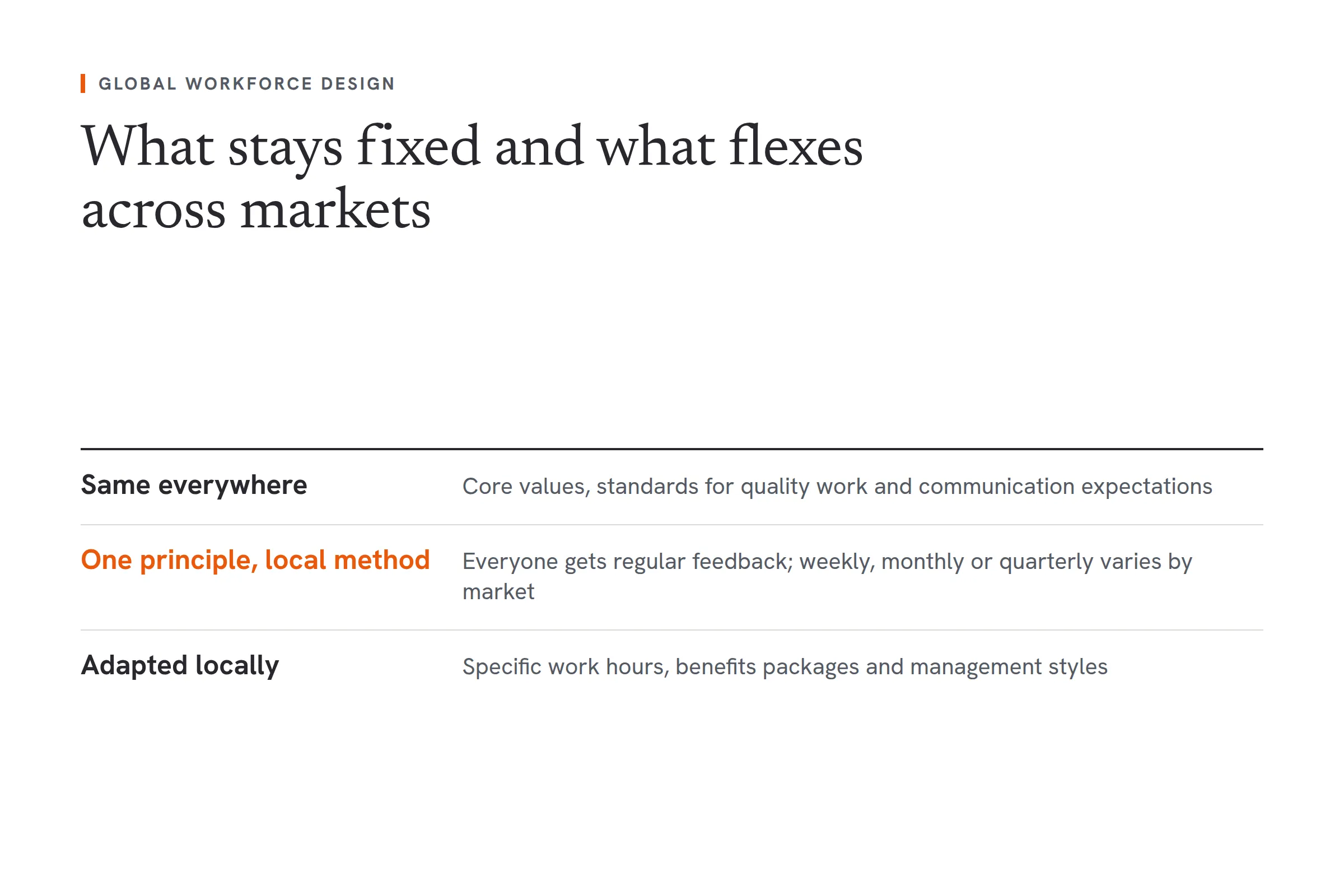
In the UAE's international business environment, fractional executives who combine regional experience with global practice are particularly valuable, especially on cultural and employment questions where local nuance matters.
When your business actually needs this
Most companies wait too long to bring in senior leadership. They struggle with problems experienced executives could solve quickly, burning time and money in the process.
Startup growth phases create ideal conditions for fractional executives. Many early-stage startups need executive expertise but lack the budget for full-time C-suite positions. A fractional executive provides strategic guidance during funding rounds, market validation and early scaling.
Scale-up challenges demand specialised expertise. Growing businesses face operational complexity during expansion, from first people-management layers to systems and policy. For scale-ups, a common trigger for a fractional CHRO is the point where headcount passes 50, Emiratisation targets start to apply and informal HR no longer holds.
Crisis management requires immediate expertise. Fractional executives provide rapid response during restructuring, turnaround scenarios or unexpected leadership departures.
Digital transformation projects often exceed internal capability. Fractional CTOs help businesses navigate infrastructure upgrades, security and innovation strategy.
Market expansion benefits from proven experience. Businesses entering new markets benefit from fractional executives who have run similar launches elsewhere. See market entry.
Temporary leadership gaps create immediate needs. Unexpected departures, sabbaticals or role transitions need interim cover, while giving you time to evaluate a permanent replacement.
Specific project requirements such as mergers and acquisitions, fundraising, regulatory compliance or a strategic pivot call for targeted expertise for a defined period.
The pattern is clear: fractional leadership works best when you need senior expertise for a defined period, project or scaling challenge, but cannot justify a full-time commitment. For people-specific triggers, read when your business needs a CXO and consultancy vs fractional executive leadership.
How to actually get started
If this sounds relevant, here is how to evaluate whether fractional leadership suits your business.
Assessment process starts with an honest evaluation. What specific leadership gaps are slowing us down? Do we need ongoing strategic guidance or specialised project expertise? What is our budget for leadership, and what outcomes would justify the investment?
Consider your timeline. If you need someone to start and contribute quickly, a fractional executive offers a significant advantage over a traditional hiring process.
Evaluate integration. Fractional executives work best when treated as team members rather than external consultants. Do you have the systems and access that allow an external leader to contribute?
Finding the right fractional executive requires knowing where to look. Fractional Dubai provides a collective of 350+ curated and vetted executives. Explore fractional CHRO services if people strategy is the gap, or contact us to discuss which role fits your stage.
Consider industry-specific experience, cultural fit and a proven record in similar organisational contexts. The UAE's diverse business environment requires executives who understand both local nuance and international practice.
Setting up engagement terms requires clarity up front. Agree time commitment, duration, scope of responsibilities and success metrics. Define communication, reporting lines and decision rights so the executive can integrate effectively. Our engagements are business to business with one month's notice either way. For a fractional CHRO, monthly fees typically sit between AED 18,000 and AED 60,000 depending on scope and time commitment.
Managing the relationship means treating the executive as part of the leadership team, with appropriate authority and resources. Set regular communication, provide access to the information they need and agree clear performance expectations.
Balance fractional input with internal talent development. The best fractional executives build internal capability that reduces long-term dependence on external leadership.
Success metrics should focus on measurable outcomes: financial indicators, operational efficiency, strategic milestones and timeline adherence. For a CHRO these often include retention, time to hire, Emiratisation progress and compliance findings. Review them regularly so the engagement tracks the business.
Common questions about fractional leadership
Q: What is the typical cost of a fractional CHRO in the UAE?
For a fractional CHRO, monthly fees typically range from AED 18,000 to AED 60,000 depending on scope and time commitment. Our engagements typically run 30 to 60% less than a full-time hire. A full-time hire also brings visa, insurance and gratuity costs that a business-to-business engagement does not.
Q: How long do fractional engagements typically last?
Our engagements typically run 4 to 24 hours per week over six to twenty-four months, with one month's notice either way. Heidrick & Struggles reports that 42% of interim engagements now last longer than six months, up from 27% in 2021, so longer engagements are becoming normal.
Q: What is the difference between fractional executives and consultants?
Fractional executives take responsibility for decisions in their domain and integrate into the leadership team, while consultants provide advisory services without operational accountability. Fractional executives become part of your team; consultants remain external advisers.
Q: Which industries use fractional leadership?
Demand is broad, from technology and financial services to healthcare, real estate and professional services. In the UAE we see steady interest from fintech, healthcare and real estate businesses.
Q: How quickly can fractional executives start contributing?
We deploy within weeks, and an experienced executive needs far less onboarding than a permanent hire, so contribution starts quickly.
Q: What visa requirements apply for fractional executives in the UAE?
Because our engagements are business to business, there is no employment visa to sponsor, no end-of-service liability and no insurance burden for your company. If you are hiring a full-time executive instead, you will need a work permit and the associated insurance. For senior residency options, note that Golden Visa criteria for executive directors were tightened on 18 February 2025.
Q: Can fractional arrangements transition to full-time positions?
Sometimes. Many engagements start as a lower-risk way to see how an executive performs, and some businesses go on to hire. It works like an extended working interview that benefits both sides.
Q: What return can companies expect from fractional executives?
Return depends on the mandate and the baseline. For a CHRO, measure it through retention, hiring speed, compliance outcomes and Emiratisation progress rather than a headline multiple. We do not quote a generic return figure because no reliable independent benchmark exists.
The future is already here
Fractional leadership is a fundamental shift in how businesses access senior talent, and the data now supports it. Heidrick & Struggles' latest research shows C-suite interim engagements up 151% since 2021, with small and medium-sized companies driving more than four-fifths of demand.
The UAE's position as a business hub suits the model. The concentration of experienced executives, the international business environment and the pace of company formation create ideal conditions for fractional leadership.
Companies that adopt it early access senior talent at lower cost, reduce hiring risk and keep flexibility during uncertain times. Most importantly, they can focus resources on growth rather than overhead.
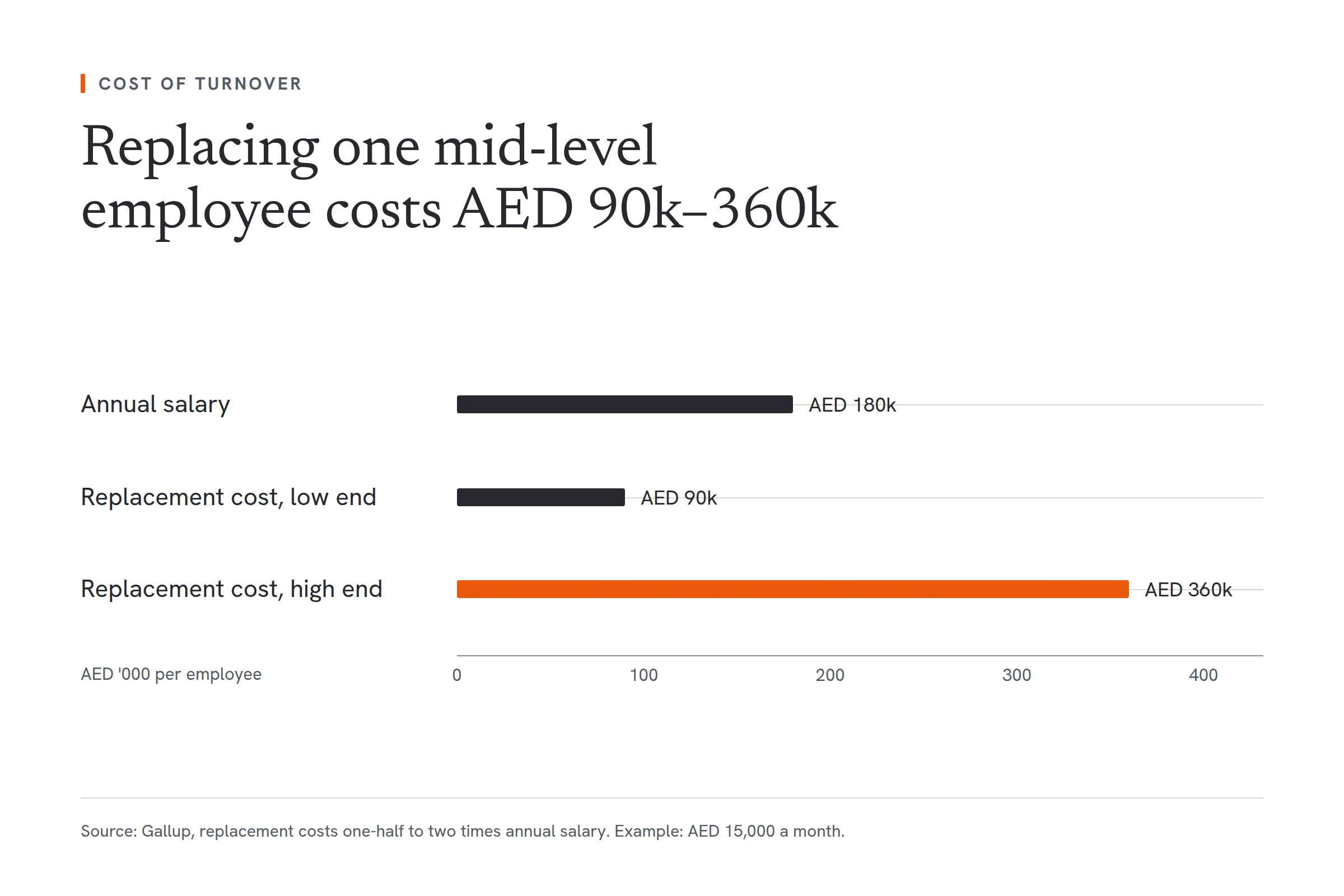
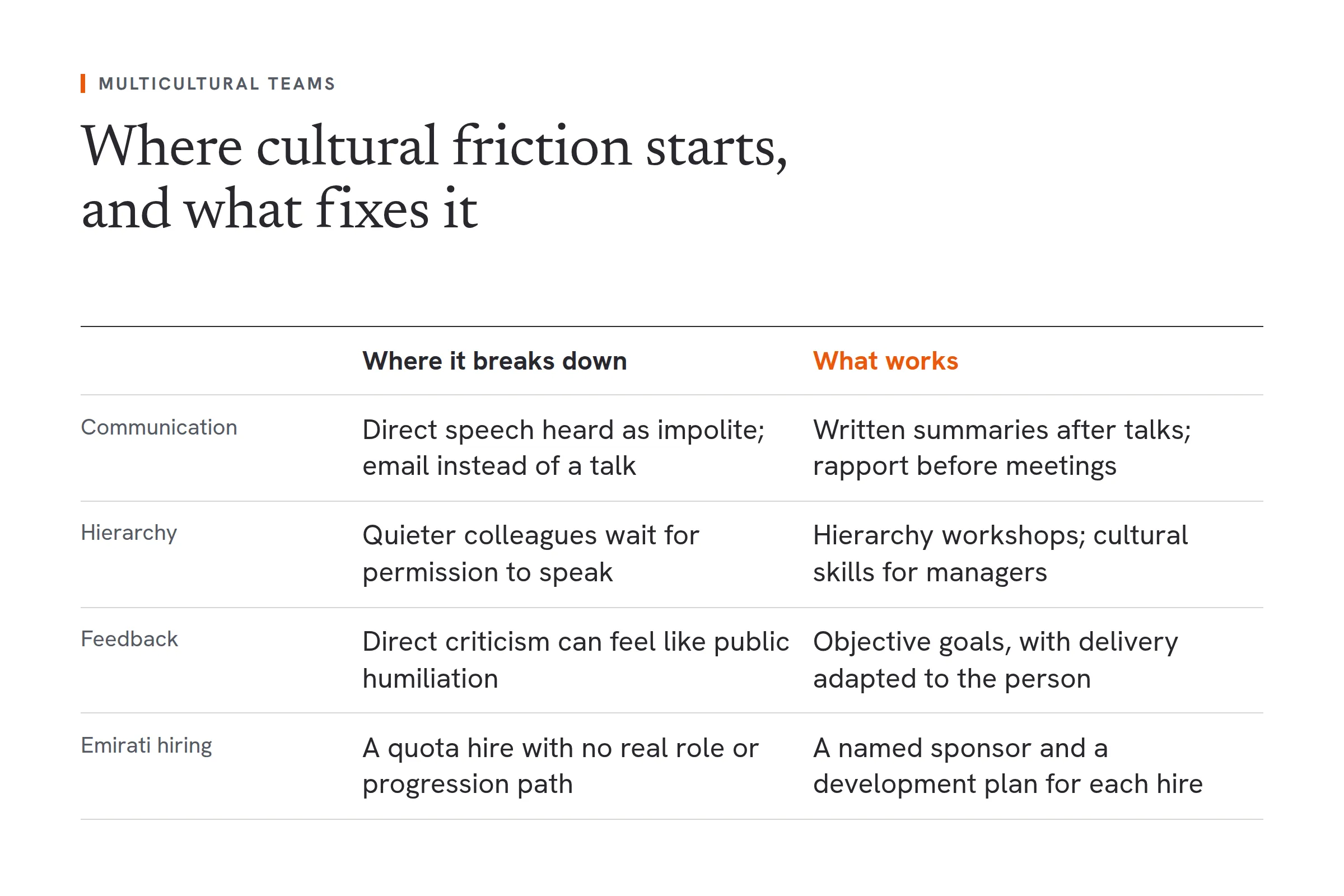
If you are running a growing business in the UAE with a leadership gap, fractional executives are a practical answer. On the people side, cultural integration and turnover costs are often the first signals that CHRO-level help is overdue. You get the expertise you need without the commitment you cannot carry, and you can test the fit before making permanent decisions.
Explore fractional CHRO services for Dubai SMEs, take the CHRO Readiness Assessment, or contact us to discuss your people strategy gaps.