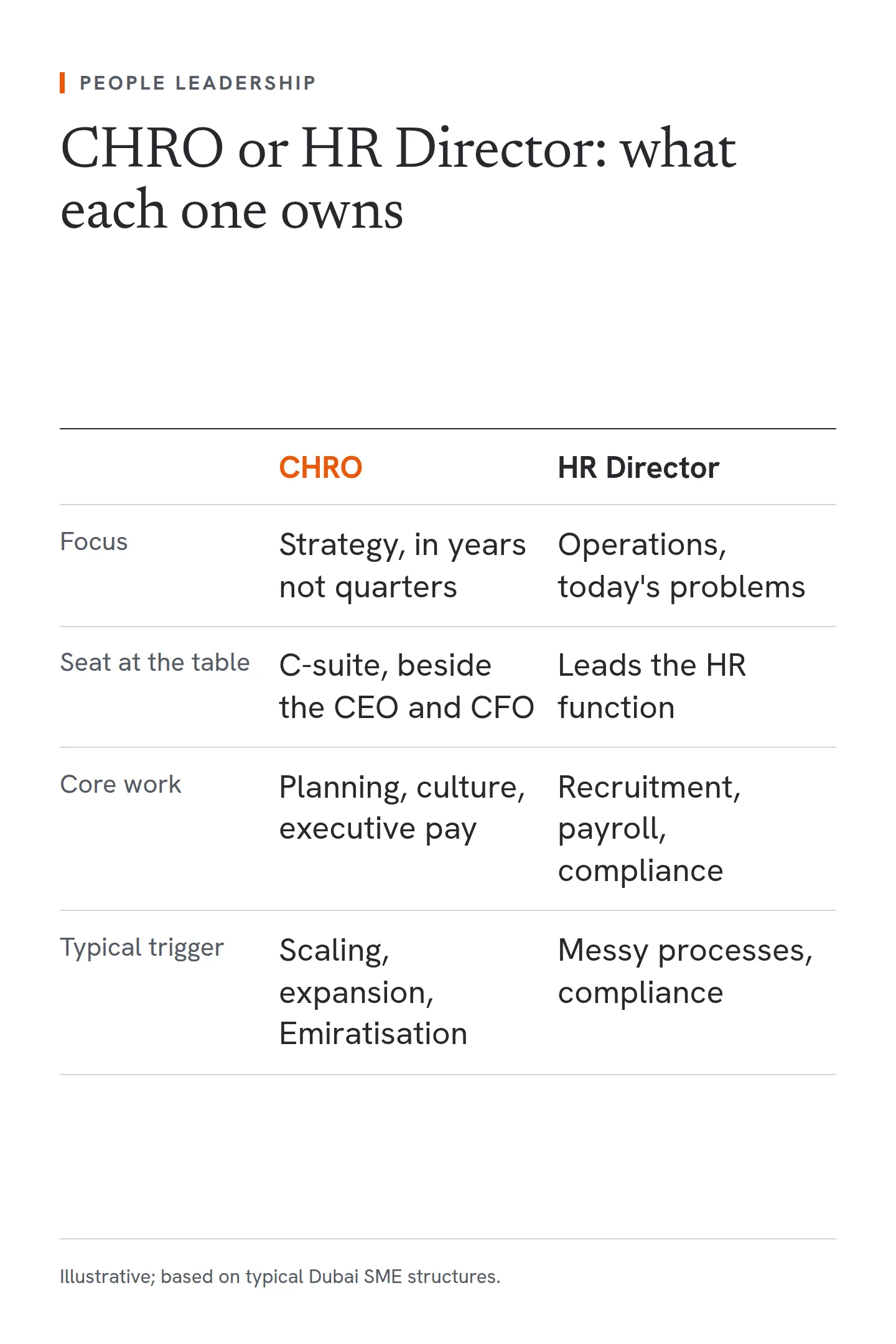
A Chief Human Resources Officer (CHRO) owns people strategy at C-suite level; an HR Director runs the HR function day to day. Most Dubai business owners treat them as two titles for the same job. They are not, and the difference matters more than it looks.
Founders hire HR Directors when they needed a CHRO, and the reverse. Either way it is expensive: not only in salary, but in what the business misses while the wrong person is in the role.
This guide explains what each role actually does and which one your business needs right now.
What a CHRO does
A CHRO aligns human capital with business objectives, rather than managing HR tasks. They sit in board meetings, shape culture from the top and decide how the organisation should evolve as you scale.
They act as trusted advisers to the Chief Executive Officer (CEO) and the rest of the C-suite, working alongside the Chief Financial Officer (CFO) and Chief Operating Officer (COO) to solve business problems through people decisions.
In practice, that looks like this:
Strategic workforce planning. Mapping the talent you will need in 12, 24 and 36 months, and designing the team structure around where the business is headed, not just filling roles.
Culture and values leadership. Dubai teams span many nationalities, so culture cannot be left to chance. A CHRO builds systems that work across backgrounds while respecting local values.
Board-level people strategy. Presenting to the board, making the case for talent investment and explaining how people decisions affect the bottom line.
Organisational design. When you are scaling from 50 to 200 people, someone has to design how the organisation is structured. That is CHRO territory.
Executive compensation strategy. Equitable pay structures, benefits, bonuses and incentive design are core CHRO responsibilities.
A CHRO thinks in years, not quarters. They build systems that still work when the company is five times its current size.
What an HR director does
An HR Director manages HR operations: recruitment, payroll coordination, employee relations and the day-to-day running of the function.
This is not less important, only different. Someone has to make sure payroll runs correctly, compliance is handled and new hires are onboarded properly.
HR programme implementation. The CHRO designs the strategy; the HR Director makes it happen, turning plans into processes that work.
Policy development and compliance. In the UAE this is demanding. The employment relationship is governed by Federal Decree-Law 33 of 2021, as amended by Decree-Law 20 of 2023 and Decree-Law 9 of 2024, which raised employer fines to between AED 100,000 and AED 1 million for serious breaches. Add Emiratisation, work permits and mandatory unemployment insurance (a premium of AED 5 or AED 10 a month plus VAT per employee, depending on basic salary), and the HR Director's job is largely keeping the business out of trouble.
Team management. The HR Director typically reports to the CHRO or another senior executive and leads the HR team.
Employee relations. When conflicts arise, performance issues surface or someone needs coaching, that is HR Director work: tactical, immediate and necessary.
Recruitment and onboarding oversight. Making sure the business is hiring, getting people started and integrating them into the team.
The HR Director keeps the machine running. Without one, nothing works. With one, the CHRO's strategy can actually be executed.
The core differences that matter
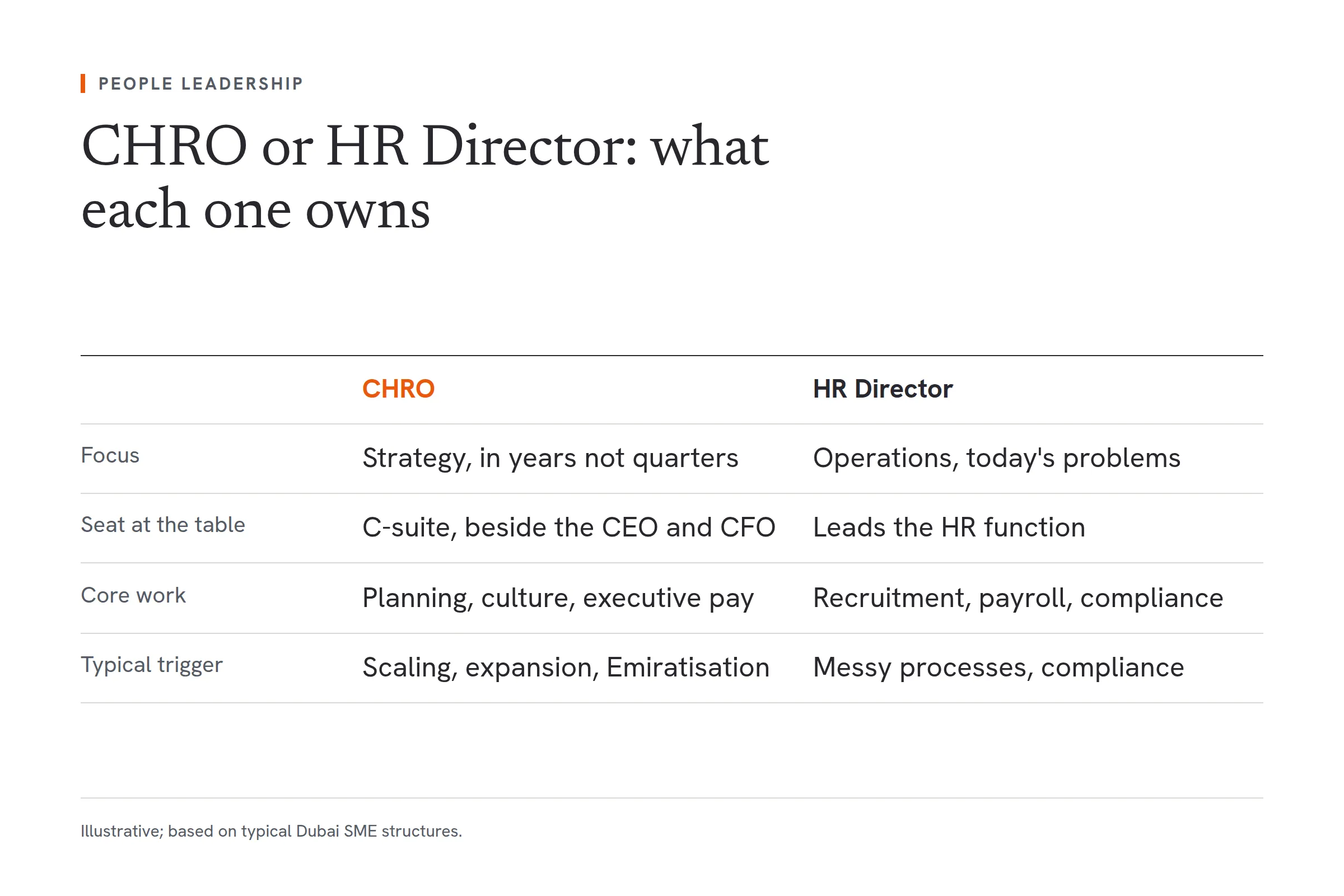
Strategic versus operational focus. The CHRO looks at the bigger picture of how people can contribute to the organisation's success and solves future problems. The HR Director solves today's.
C-suite versus department level. The CHRO is a member of the executive leadership team, at the table where major business decisions are made. The HR Director manages the HR function.
External versus internal orientation. CHROs spend significant time on talent market trends, competitive positioning and benchmarking. HR Directors are mainly internal, making the company's own systems work better.
Board interaction. CHROs are often involved in board selection and orientation, executive compensation and succession planning. HR Directors rarely deal with the board directly.
Scope of influence. The CHRO shapes the organisation's direction through people decisions. The HR Director ensures the HR department delivers what the business needs.
The simple version: deciding whether to open an office in Abu Dhabi is CHRO thinking. Working out how to handle the HR implications of opening it is HR Director work.
When Dubai businesses need a CHRO
You need CHRO-level thinking when you are facing transformation, not just administration.
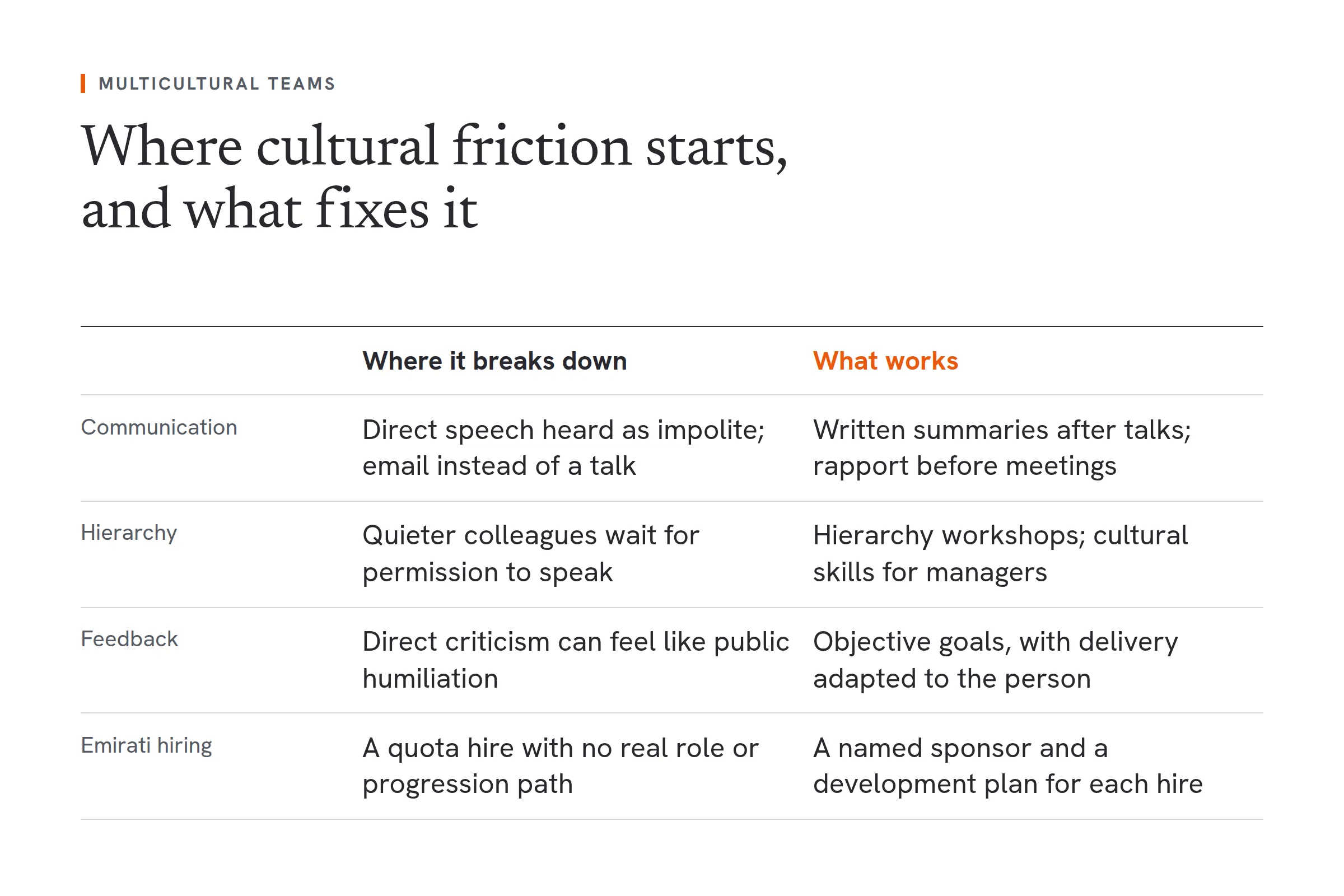
Major cultural transformation. Fifteen nationalities are working together and the culture is fracturing. Someone has to redesign how you operate. Our guide to cultural integration in Dubai's multicultural workforce covers the systems that stop that fracture becoming turnover.
Rapid scaling. You are growing from 30 to 150 people in 18 months. Someone has to design what that organisation looks like before it becomes chaotic. Scale-ups hit this inflection point hardest.
Emiratisation strategy. Private sector companies with 50 or more employees must raise the Emirati share of skilled roles by 2% a year, one percentage point in each half, to reach 10% by the end of 2026. The Ministry of Human Resources and Emiratisation (MoHRE) set 30 June 2026 as the first-half deadline and announced contributions of AED 10,000 a month (AED 120,000 a year) for each unfilled position from 1 July 2026. Smaller employers are not exempt: companies with 20 to 49 employees were required to hire at least one Emirati by the end of 2024 and a second by the end of 2025, in the sectors the rule covers. This is not only compliance. It is workforce strategy that touches hiring, retention and culture, which makes it CHRO work.
International expansion. You are taking a Dubai success story to Saudi Arabia, Egypt or Pakistan. Each market has different talent dynamics, labour laws and cultural expectations, and someone has to design the people strategy across all of them. See our global workforce strategy guide for how CHROs approach market entry from a Dubai hub.
M&A integration. You have just acquired a competitor. Merging two cultures, retaining key talent and rationalising duplicate roles needs CHRO-level strategic thinking.
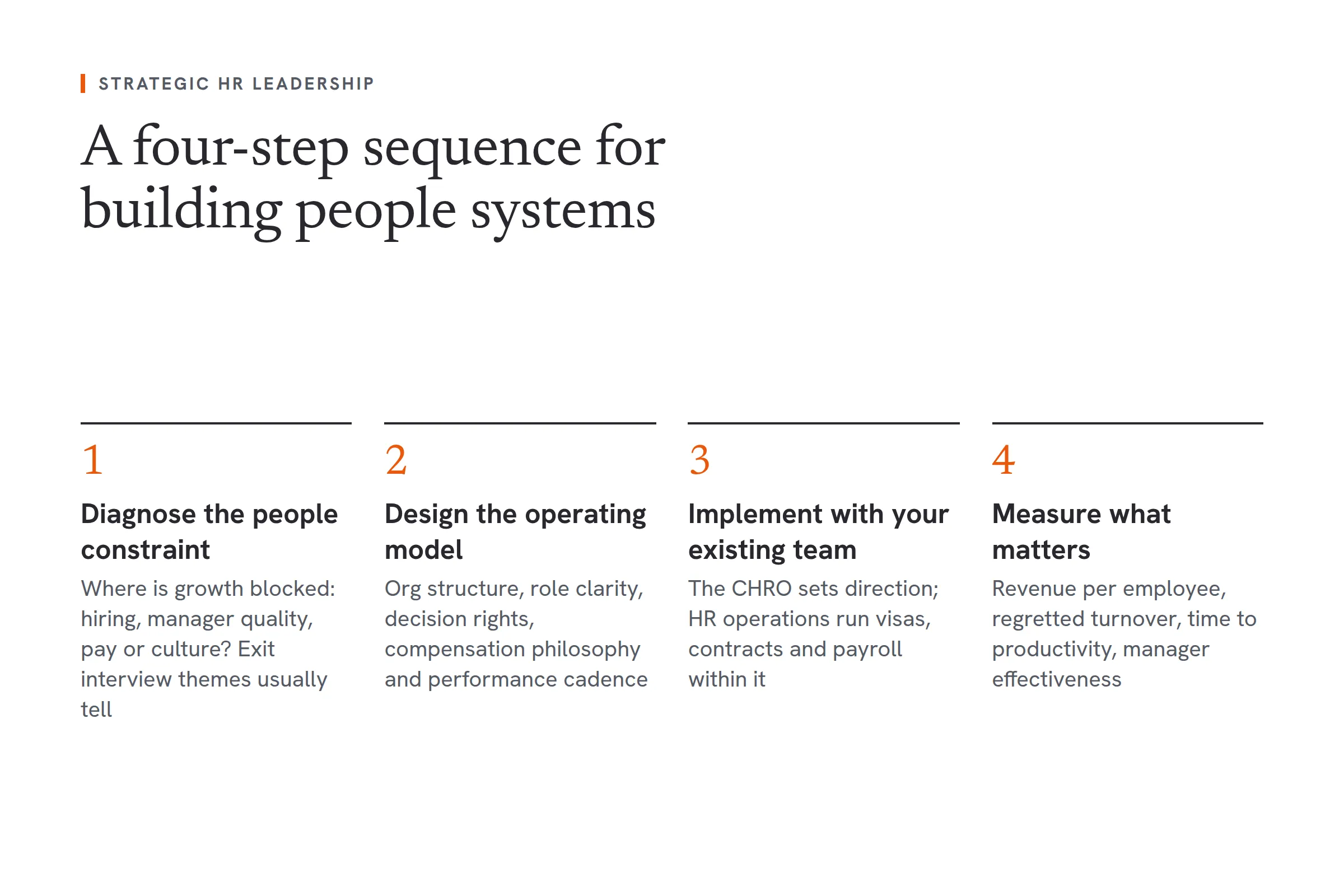
Companies that bring in strategic HR leadership during these moments tend to navigate them well. Those that do not often struggle for years afterwards. For more on strategic people leadership, read our guide to HR leadership in Dubai.
When you need an HR director
You need an HR Director when your problem is execution, not strategy.
HR operations improvement. Processes are messy: onboarding takes too long, payroll has errors, performance reviews are inconsistent. An HR Director fixes these systems.
Compliance and policy. UAE labour law is detailed and changes. You need someone who lives in the detail daily.
Growing HR team leadership. You have hired three HR people and they need management, direction and accountability.
Standard HR programme implementation. You have chosen a new performance management system. Someone has to implement it, train everyone and make it stick.
Day-to-day HR management. The constant flow of employee questions, policy clarifications and administrative tasks is HR Director territory.
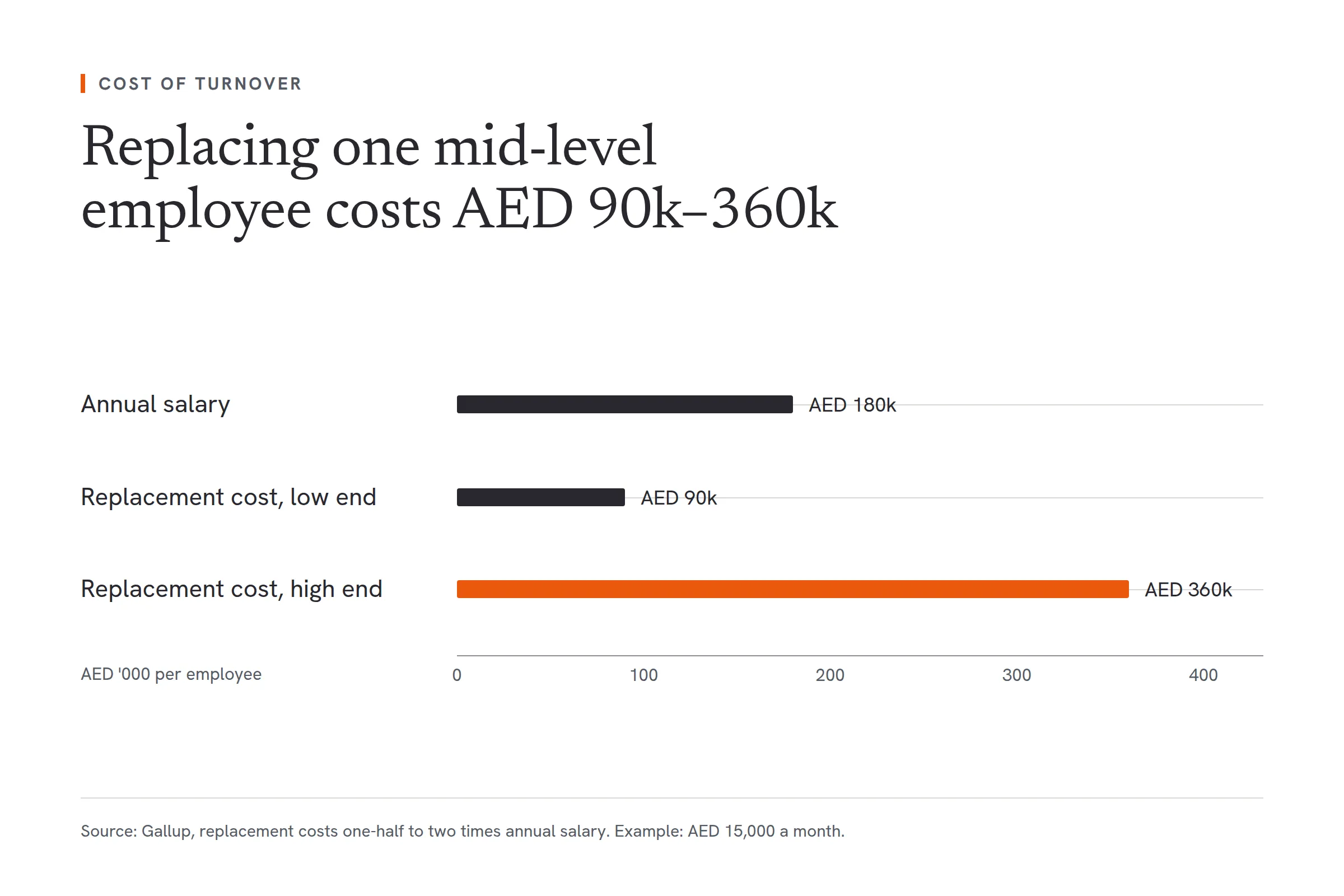
Most SMEs start here. You do not need grand strategy at 20 people; you need someone making sure the basics work. As you pass 50 to 100 people, strategic gaps start to appear, often showing up first as hidden turnover costs rather than an obvious HR vacancy.
UAE-specific HR considerations
Dubai's market creates specific demands for HR leadership.
Labour law complexity. Beyond Decree-Law 33 of 2021 and its amendments, end-of-service gratuity alone needs careful handling: 21 days of basic salary per year of service for the first five years, then 30 days per year, capped at two years' wage, calculated on basic pay only and settled within 14 days of termination. Free zone employers such as those in the DIFC may sit under a different regime, so confirm which framework applies to each entity.
Emiratisation requirements and enforcement. MoHRE reported that 95% of targeted companies met their first-half 2026 targets, with more than 190,000 Emiratis working across nearly 32,000 private companies by July. Enforcement is also visible: the ministry detected 377 fake Emiratisation cases at 266 private companies in the first half of 2026. Whether you need a CHRO or an HR Director for this depends on your approach. If it is only compliance, an HR Director can manage it. If it is part of a broader talent strategy, you need a CHRO.
Multicultural workforce management. Many companies struggle to find Emirati candidates with the right technical expertise while also managing teams spanning dozens of nationalities. This cultural orchestration often needs CHRO-level attention.
Work permit and visa coordination. This is operational complexity, typically HR Director work. Designing an international mobility strategy across GCC markets elevates it to CHRO territory.
The question is not which role is better. It is which problem you are solving.
The fractional CHRO option
Most Dubai SMEs do not need a full-time CHRO, but many need CHRO-level strategic thinking at specific moments. Demand for senior independent talent is rising: Heidrick & Struggles reports a 151% increase in C-suite engagements since 2021, and small and medium-sized companies now account for more than four-fifths of demand for interim talent.
When you are designing your Emiratisation strategy, rethinking culture as you scale or planning international expansion, those are CHRO problems. They rarely need a full-time executive.
A fractional CHRO gives you C-suite people strategy without a full-time package. Our engagements typically run 30 to 60% less than a full-time hire, business to business, with no employment visa, no end-of-service liability and no insurance burden, and one month's notice either way. Learn more about how fractional CHRO services work for Dubai businesses.
We often see fractional CHRO guidance combined with a full-time HR Director for operational execution. The CHRO designs the system; the HR Director runs it. For a detailed breakdown, see our complete fractional CHRO guide.
Making the right choice
Start with your actual problem. If your HR processes are broken, you need an HR Director. If your people strategy does not align with where the business is headed, you need a CHRO.
Most businesses under 50 people need HR Director capability. Between 50 and 200 people, you start needing both, often a fractional CHRO for strategy and a full-time HR Director for execution. Above 200 people, the need for full-time CHRO leadership becomes harder to avoid.
Business stage is only one factor. A 30-person company going international might need more strategic HR thinking than a stable 150-person company doing what it has always done.
Ask yourself: are we facing a transformation moment, or do we just need better execution? The answer tells you which role to prioritise.
Ready to explore what HR leadership structure makes sense for your business? The Fractional Dubai team can help you assess whether you need strategic CHRO thinking, operational HR Director execution, or both. Not sure where to start? Try our CHRO readiness assessment to get clarity on your needs.
Frequently asked questions
Q: Can one person do both CHRO and HR Director work?
In small companies (under 50 people), yes. As you scale, these become distinct skill sets. Strategic thinking and operational excellence need different mindsets, and most people are naturally stronger at one.
Q: How much does a CHRO cost in Dubai?
A full-time CHRO is a senior C-suite package: base salary, bonus, benefits, a residence visa and end-of-service gratuity. Benchmark current ranges against a recent salary guide such as Cooper Fitch or Hays before budgeting. A fractional CHRO works part time, usually 4 to 24 hours a week, and our engagements typically run 30 to 60% less than a full-time hire.
Q: Do we need a CHRO if we already have an HR Director?
If you face strategic people challenges such as rapid scaling, cultural transformation, Emiratisation strategy or international expansion, then yes. The HR Director handles operations; the CHRO provides strategic direction. Many Dubai SMEs use a fractional CHRO for strategy while their HR Director handles day-to-day execution.
Q: What is the first step in determining which role we need?
Identify your primary HR challenge. Is it operational (broken processes, compliance issues, poor execution) or strategic (cultural transformation, scaling challenges, workforce planning)? Operational problems need HR Director solutions. Strategic problems need CHRO thinking. Or take our CHRO readiness assessment for a structured evaluation.
Q: How do Emiratisation requirements affect this decision?
For basic compliance (meeting the targets and avoiding contributions), an HR Director can manage it. A comprehensive strategy covering talent development, retention and cultural integration needs CHRO-level thinking. The financial exposure is significant, with MoHRE contributions of AED 10,000 a month (AED 120,000 a year) per unfilled position from 1 July 2026, so getting it right matters.