Fractional executives vs advisers
In short: a business adviser gives you recommendations. A fractional executive gives you leadership. One stays outside your company and advises. The other joins your leadership team part-time, with real authority to decide and carry the work out. For Dubai SMEs, the question is whether the problem needs analysis or ownership.
Most Dubai business owners think they need advice. Often they need execution.
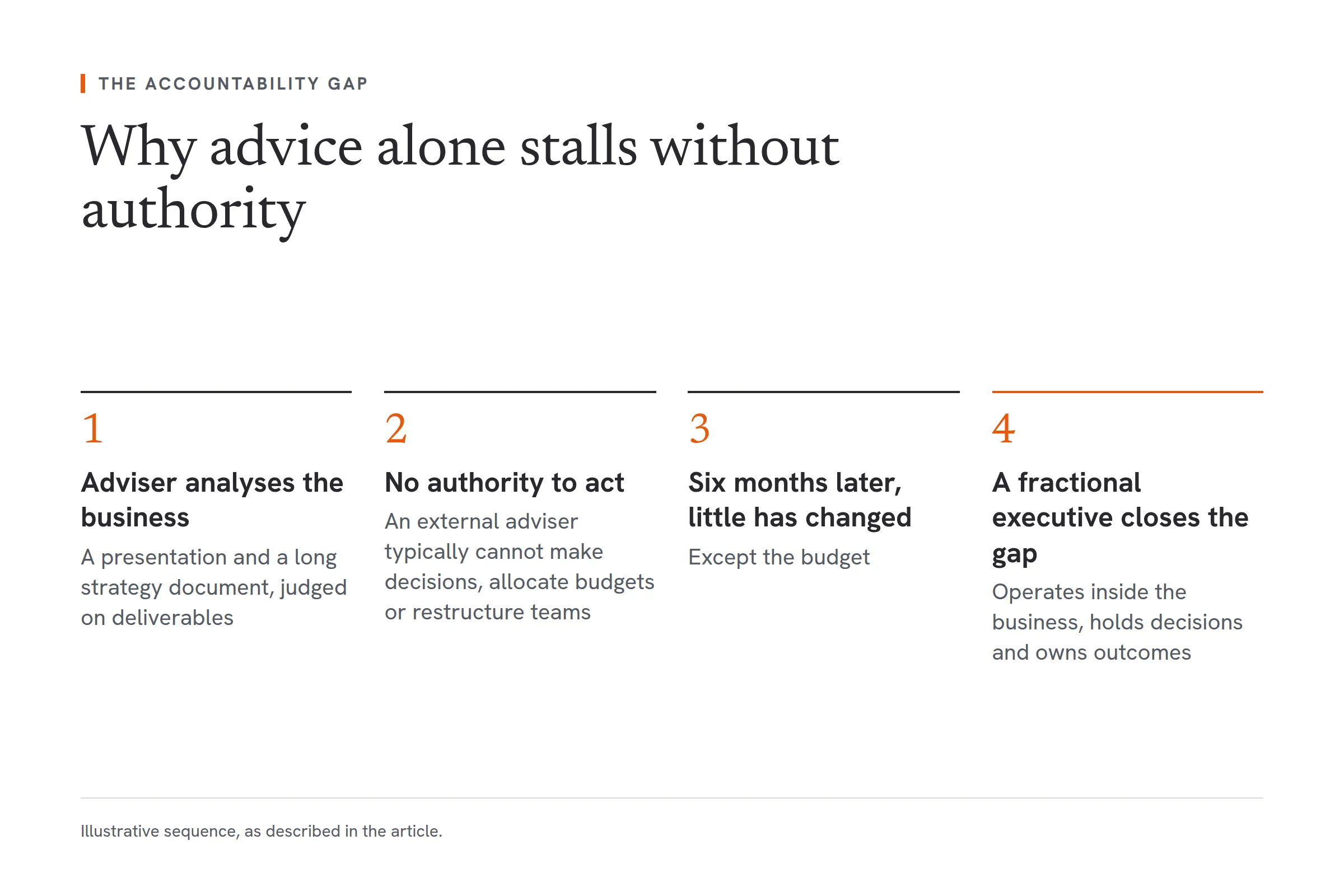
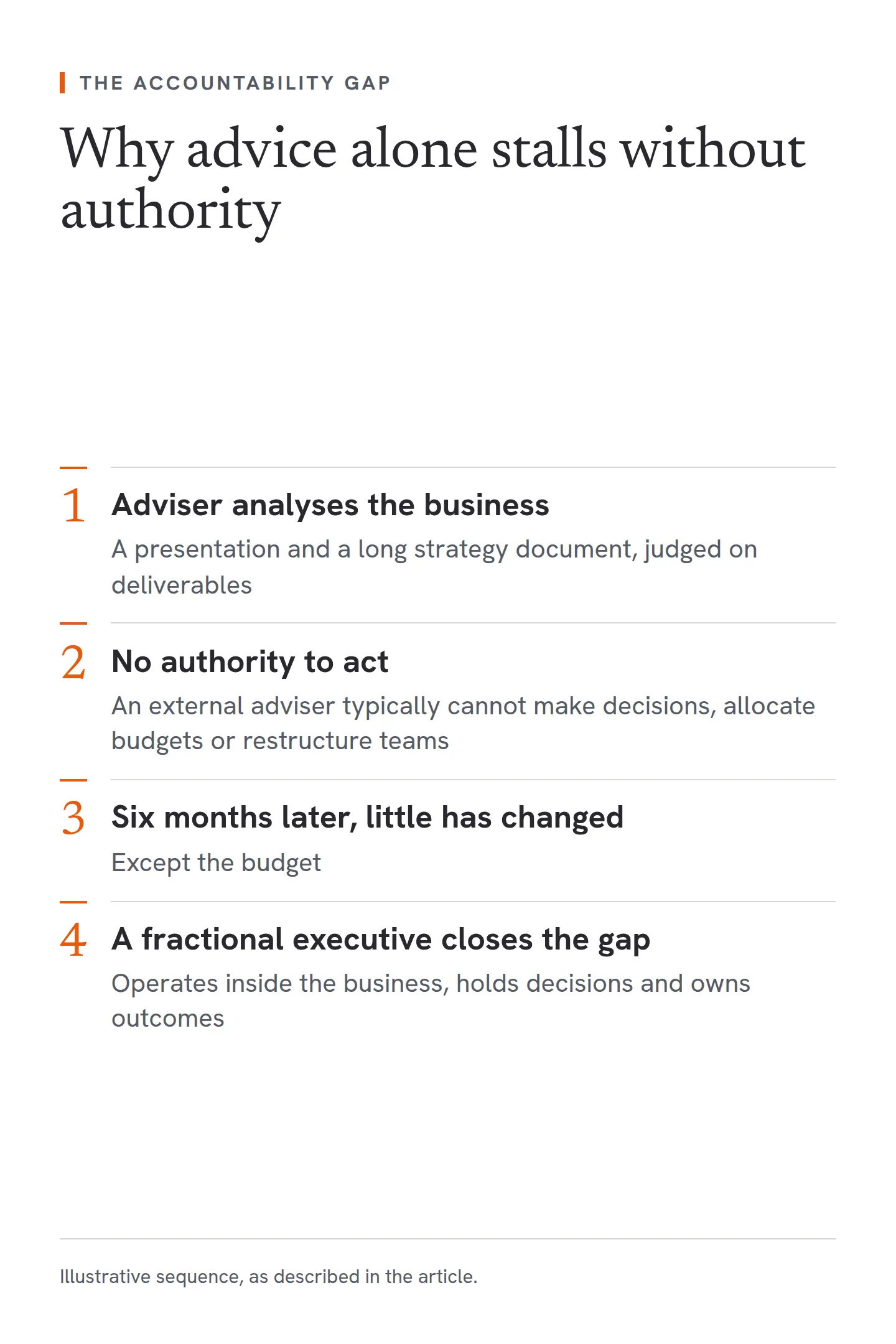
We have written at length about the fundamental differences between consultancy and fractional executive leadership, but the core issue is simple: authority. Many owners hire advisers who analyse everything, produce a polished presentation and hand over a long strategy document. Six months later, little has changed except the budget.
The problem is rarely the quality of the advice. It is that advice without authority has nobody to carry it out.
What most Dubai business advisers actually offer
Business advisers in Dubai do valuable work. Most focus on business setup, licensing, compliance and one-off strategic questions, usually on a project or hourly fee. For a defined task with a clear end date, that is the right tool.
The limits come from the structure. An external adviser typically cannot make decisions, allocate budgets or restructure teams. They observe from outside, make recommendations and rely on someone else to implement them.
This creates what we call the accountability gap. Advisers succeed when they deliver the project on time and on budget, whether or not the recommendations work. They are measured on their deliverables, not on your business results.
This is why fractional leadership has emerged as the answer for many Dubai businesses.
The strategic leadership gap in Dubai SMEs
Leadership gaps are common in a market of this size. The UAE passed about 1.4 million registered companies at the end of 2025, with around 250,000 added during the year, and SMEs make up around 94% of all businesses. Most of them are run by founders without a full senior team beneath them.
Dubai SMEs also face complexity that external advisers cannot fully share: managing multinational teams, working across different regulatory regimes (mainland, free zone, DIFC) and balancing international practice with regional expectations. Emiratisation is a good example. The Ministry of Human Resources and Emiratisation sets annual targets for private-sector employers and applies financial contributions where positions go unfilled, so hiring plans, budgets and workforce strategy have to be designed together.
These are not problems you solve with a report. They need ongoing executive attention and decision-making authority. Then the real question becomes when your business actually needs a CXO. Most SMEs reach that inflexion point earlier than they expect.
How fractional executives work differently
A fractional executive does not advise from the sidelines. They hold the decisions in their domain and are accountable for the outcome.
When you engage a fractional CFO in Dubai, they do not just analyse your cash flow. They rebuild your financial systems. They do not just recommend process improvements; they put them in place. They become part of your leadership team with real line authority within their domain.
The difference is structural:
Business advisers:
- External perspective only
- Project-based engagements with a defined end date
- No decision-making authority
- Success is measured by deliverable completion
Fractional executives:
- Internal integration as leadership team members
- Ongoing relationships, typically six to twenty-four months
- Decision-making authority within their domain
- Success is measured by business outcomes
Think of it this way: an adviser tells you how to renovate your house. A fractional executive picks up the tools and does the renovation, to a plan you have agreed.
The engagement length reflects this. Heidrick & Struggles reports that 42% of interim engagements now last longer than six months, up from 27% in 2021, and that small and medium companies account for more than four-fifths of demand. Companies are keeping senior leaders in place for as long as the work needs them.
The cost comparison favours embedded leadership too. A full-time SME CFO in the UAE commands a base salary of AED 61,000 to 92,000 per month (Cooper Fitch UAE Salary Guide 2025), before bonus, benefits and end-of-service gratuity. Our engagements typically run 30 to 60% less than a full-time hire, and because they are business to business there is no employment visa, no end-of-service liability and no insurance burden.
UAE-specific advantages
Fractional executives understand Dubai's business environment from the inside.
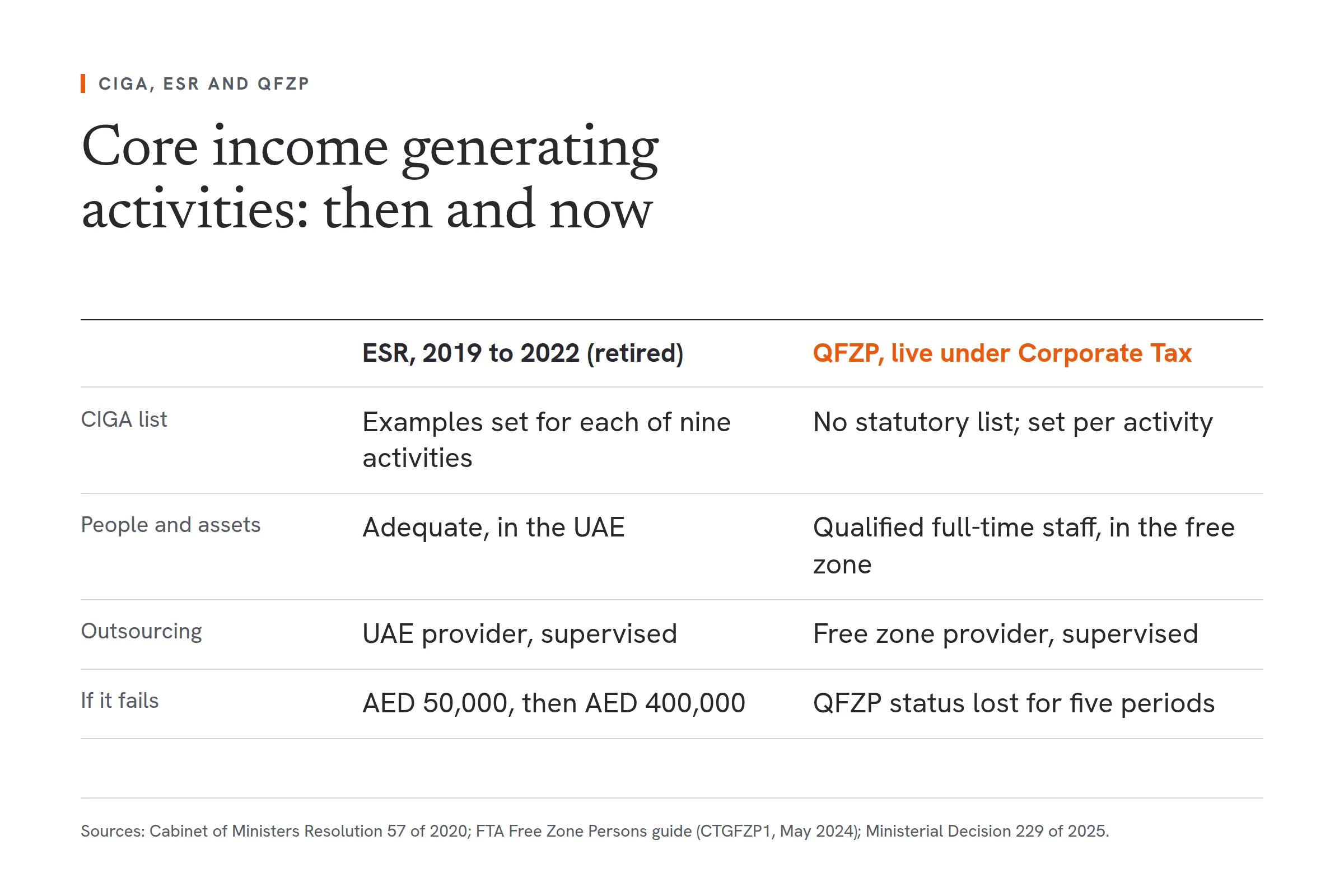
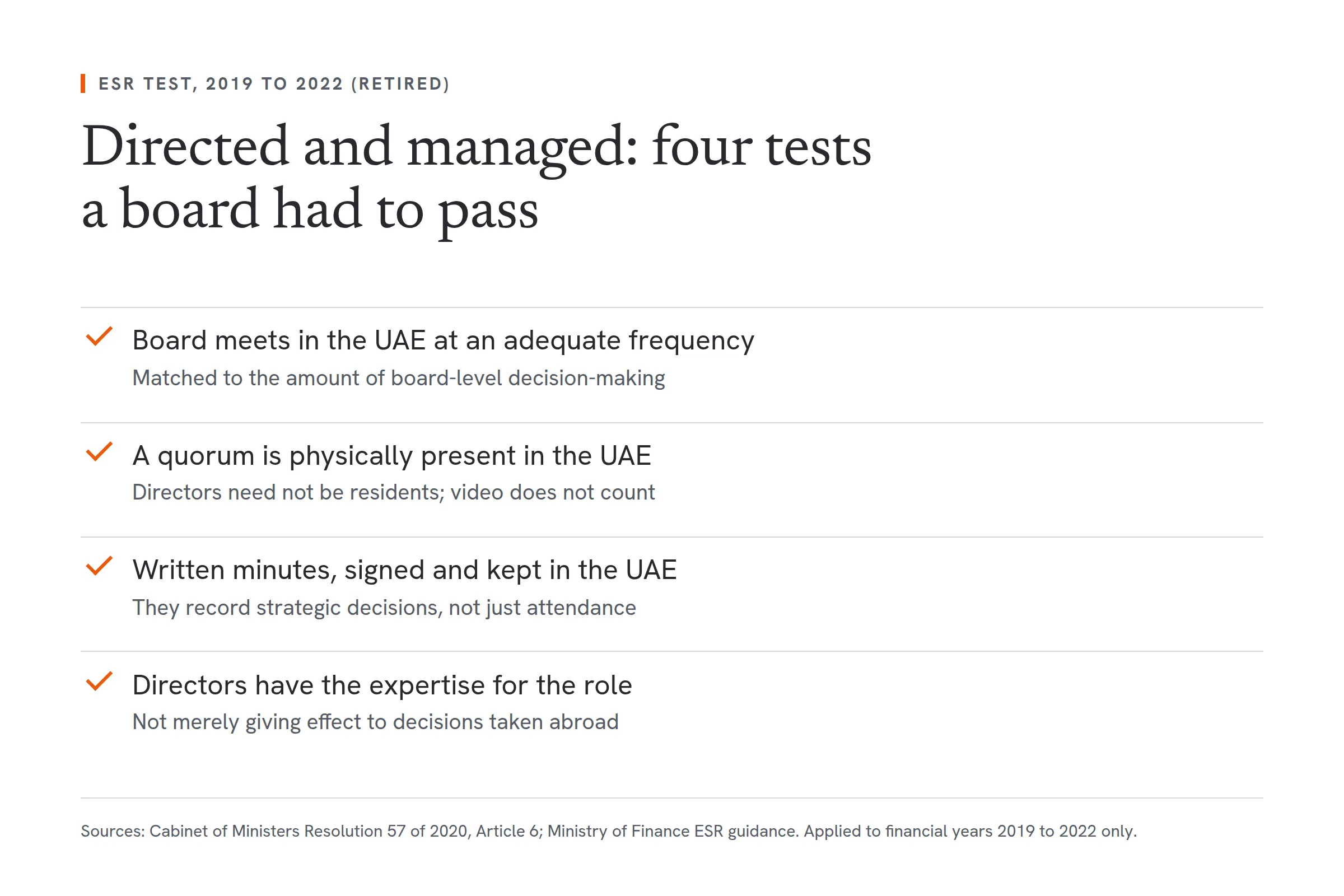
They know the difference between operating in DIFC and on the mainland. They understand how to manage across different Emirates. They worked through the Economic Substance Regulations that applied to financial years 2019 to 2022, and they understand the adequate-substance condition that free zone companies must now meet to hold Qualifying Free Zone Person status under corporate tax.
Regulation keeps moving, and an executive who owns the function keeps pace with it. The first corporate tax returns for 31 December 2025 year ends fell due on 30 September 2026, and e-invoicing becomes mandatory for businesses with revenue of AED 50 million or more from 1 January 2027, with smaller businesses following from 1 July 2027. An adviser can scope the e-invoicing project. A fractional CFO then runs the finance function that has to live with it.
Working across several businesses also gives a fractional executive a wider view than a single-employer executive has. Lessons from one sector inform decisions in another, which is hard for a full-time hire to replicate.
Whether you need a fractional COO to fix operations, a fractional CTO to drive digital transformation or a fractional CMO to build your brand, the principle is the same: execution needs authority.
When to choose each option
The decision framework is simpler than most people think.
Choose business advisers for:
- Specific compliance projects with a clear scope
- Business setup and licensing requirements
- One-time strategic planning exercises
- Process optimisation with defined timelines
Choose fractional executives for:
- Ongoing leadership gaps requiring authority
- Scaling operations while maintaining quality
- Building financial controls and forecasting systems
- Developing technology roadmaps
- Creating marketing strategies for new markets
- Restructuring teams and building culture
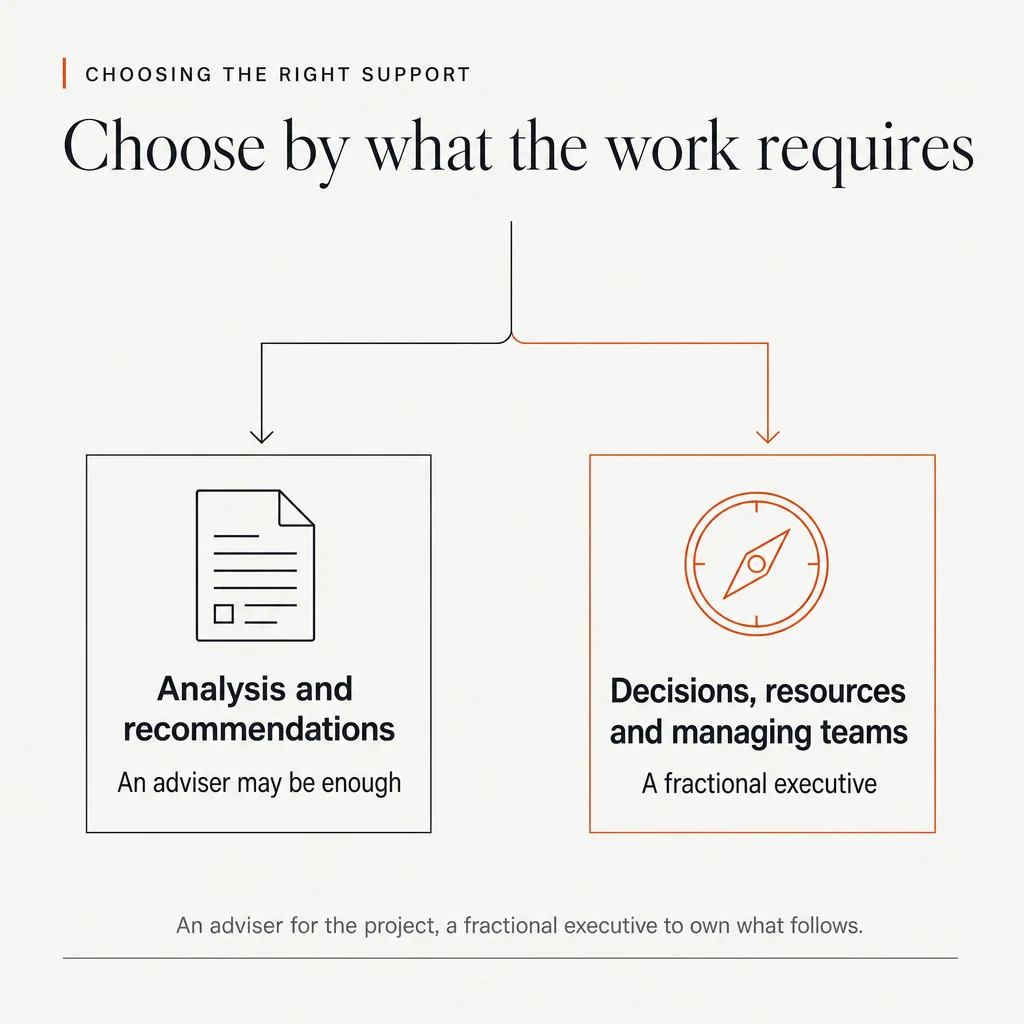
If your challenge requires someone to make decisions, allocate resources and manage teams, you need a fractional executive. If you only need analysis and recommendations, an adviser may be enough. Many businesses use both: an adviser for the scoped project, and a fractional executive to own what follows.
Making the right choice for your Dubai business
Many Dubai SMEs have already tried the adviser route. They have the reports to prove it. What they lack are results.
The shift to fractional executives is not only about cost, though the economics are compelling. It is about leadership that is accountable for outcomes, not just outputs.
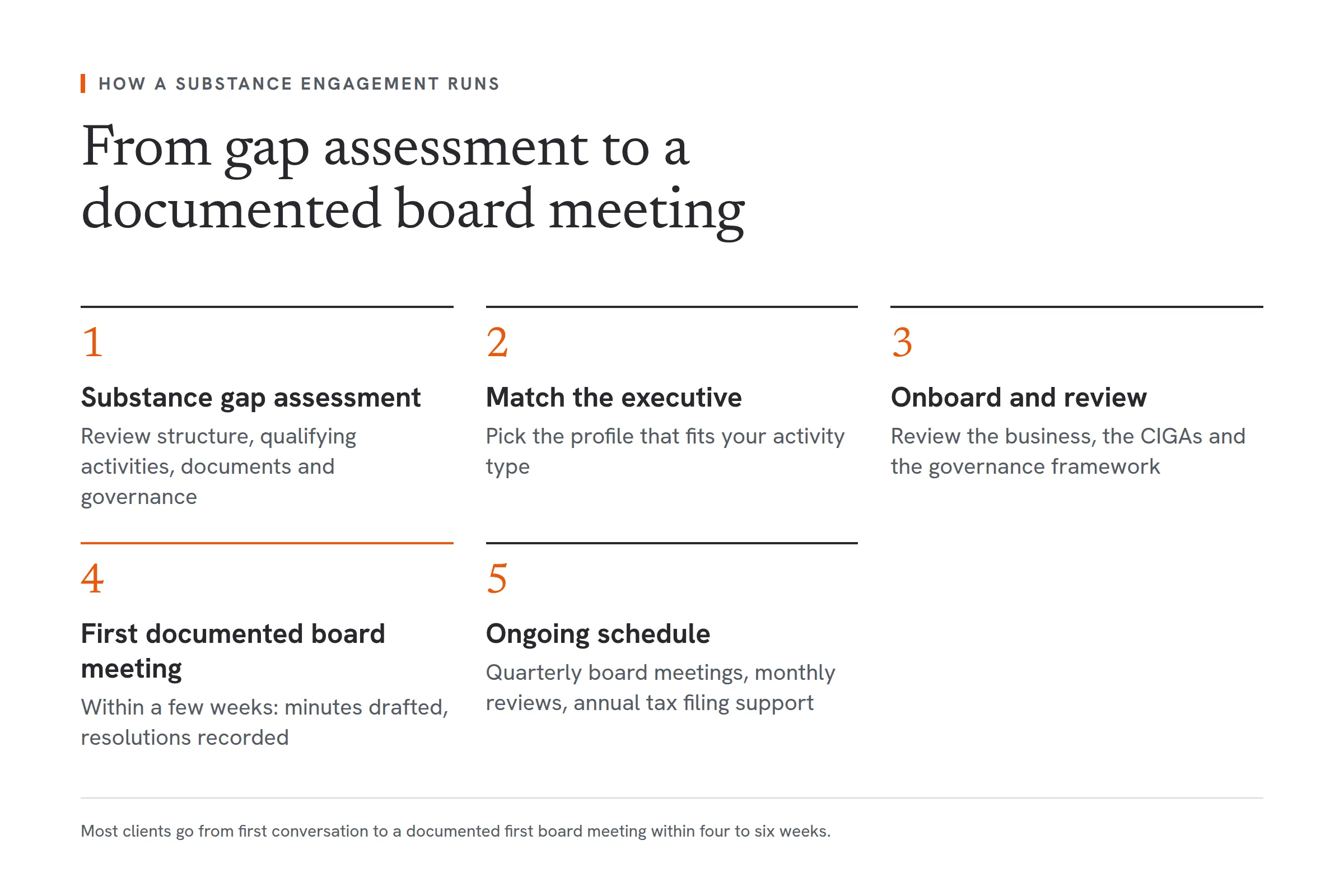
Integration speed determines impact speed. A fractional executive embeds in your organisation quickly: attending team meetings, learning customer relationships and understanding the company's history. An executive from our collective of 350+ curated and vetted executives can typically be deployed within weeks. They are not studying your business from outside; they are running part of it.
We do not simply make an introduction and step away. We provide the support, structure and governance for both the SME and the executive to succeed, business to business, with one month's notice either way.
For Dubai SMEs choosing between an expensive full-time executive, a limited advisory relationship and fractional leadership, the question is what the business needs the person to do. If the answer is to decide, lead and be accountable, fractional leadership gives you that authority and integration without the weight of a full-time package.
Ready to move beyond advice to actual execution? Take one of our Fractional Executive Readiness Assessments to discover which type of executive leadership your business needs most, read how a fractional engagement unfolds , or learn more about what fractional leadership means for UAE businesses .