Most Dubai founders hiring their first senior tech leader make the same mistake. They post for a Chief Technology Officer (CTO) when they need a Vice President (VP) of Engineering, or the other way around. Both hires fail, not because the person is wrong, but because the role is.
A CTO decides what to build and a VP of Engineering makes sure it gets built. Before you commit to either, it is worth understanding what you are buying, because for most growing SMEs in Dubai the answer is not a full-time hire in either direction.
The real difference
The CTO decides what to build. The VP Engineering makes sure it actually gets built.
The CTO looks outward: at the market, at investors, at where technology is heading. They set architecture direction, represent your technology vision to the board, and own the decisions that are expensive to reverse. Their question is: "Are we building the right things?"
The VP Engineering looks inward. They manage the team, own delivery, and fix the processes that quietly break when headcount grows. Their question is: "Are we building things right?"
| CTO | VP Engineering |
|---|---|---|
Focus | Technology strategy | Delivery and execution |
Orientation | External | Internal |
Success metric | Technology differentiation | Shipping reliably |
Time horizon | 2–5 years | This quarter |
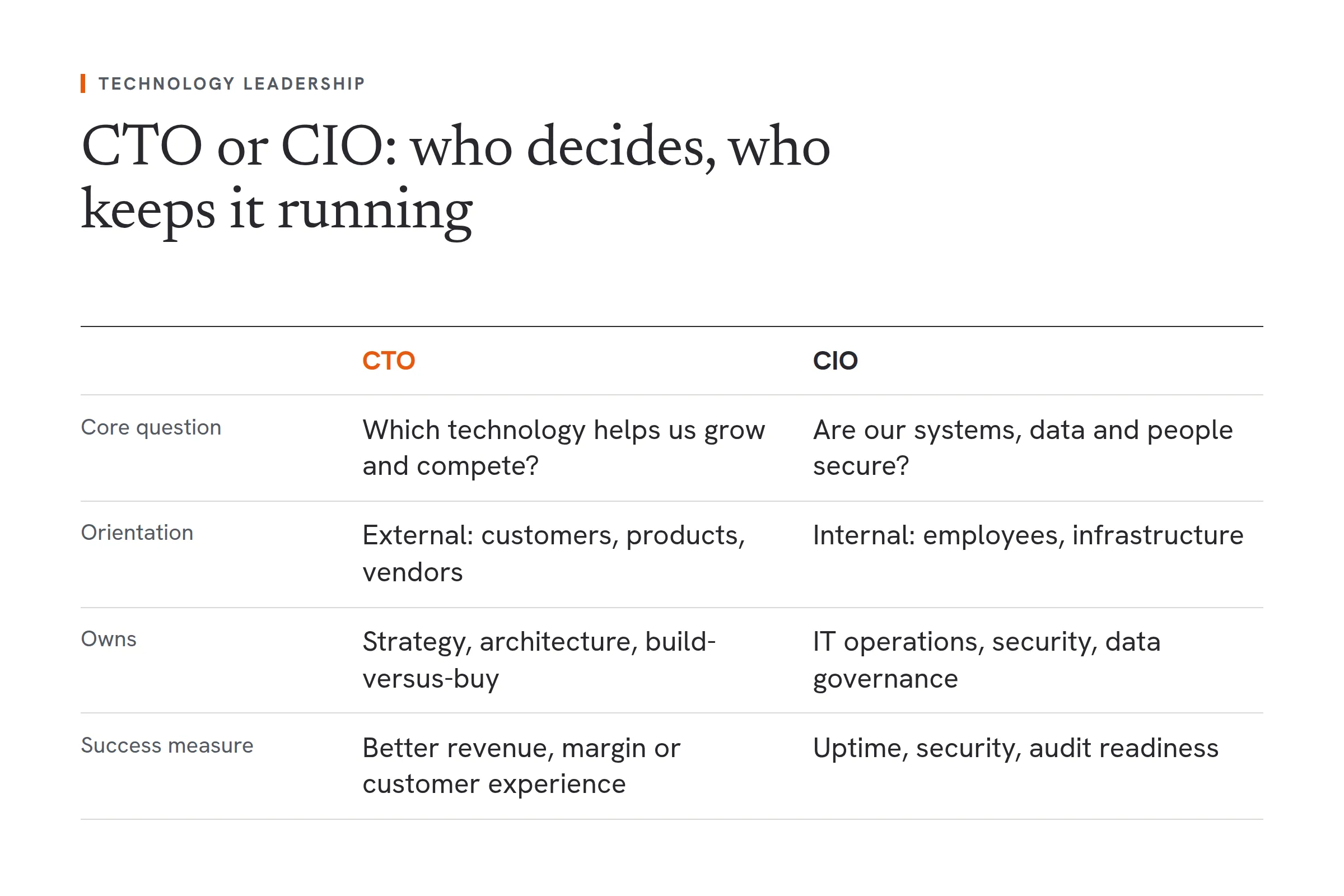
Both roles matter. But most Dubai SMEs are solving a strategy problem, not an execution problem, and they are trying to solve it with an execution hire. If you are unsure whether the gap is strategic or operational, our guide to CTO versus CIO technology leadership covers a related distinction.
The strategy problem most SMEs actually have
Here is what we hear repeatedly from founders: the engineering team is delivering, but the technology direction feels unclear. Nobody owns the architecture decisions. Investor conversations about technology are vague. The product roadmap is driven by whoever shouts loudest, not by a coherent technical vision.
That is a CTO problem.
In Dubai specifically, it surfaces in a particular way. Companies scaling here often need to adapt products for local infrastructure, data residency, government APIs and payment integrations. Those are high-stakes, hard-to-reverse decisions, and several now have dated rules attached:
- Personal data. The PDPL (Federal Decree-Law No. 45 of 2021) has applied since 2 January 2022 and sets consent and cross-border transfer requirements. Law-firm commentary in July 2026 notes that its executive regulations remain pending, after the government created a federal Artificial Intelligence and Data Authority on 14 June 2026 that absorbs the UAE Data Office.
- Data residency. Where data is hosted is an architecture decision with legal consequences. Sector laws such as Federal Law No. 2 of 2019 on ICT in healthcare add conditions beyond the PDPL, so check your sector before choosing a cloud region.
- E-invoicing. The Ministry of Finance phases the UAE e-invoicing programme by revenue. Businesses with annual revenue of AED 50 million or more must go live on 1 January 2027, with the deadline to appoint an accredited service provider extended to 30 October 2026. Other in-scope businesses must appoint a provider by 31 March 2027 and go live on 1 July 2027. Any product that issues invoices has to be designed for this.
- Digital identity. UAE PASS offers authentication and digital signature services to government entities and private organisations, which is worth weighing for onboarding flows.
Without someone who owns these decisions deliberately, they get made by default, usually badly.
A full-time VP Engineering does not fix this. A strong engineering team executing the wrong strategy just gets you to the wrong place faster.
What these companies need is senior technology strategy: someone who can set direction, make the architecture calls, and represent the technology vision externally. That is, by definition, a CTO. Our guide to measuring technology investment ROI shows how that strategic layer pays for itself.
So why don't SMEs just hire a CTO?
Because a full-time CTO in Dubai is a large fixed commitment: base salary plus bonus, allowances, visa sponsorship, medical insurance and end-of-service gratuity. Senior technology pay varies widely, so benchmark against a current UAE salary guide from Cooper Fitch, Michael Page or Hays rather than a rule of thumb. For a founder-led startup that has not reached Series B, that is a significant bet on a single hire, and one that often cannot be fully used at that stage anyway.
Most SMEs do not need a CTO across five days a week. They need the output of a CTO: technology strategy, architecture guidance, investor-ready technical vision, and sound build-versus-buy decisions. That work does not require full-time presence. It requires the right expertise, applied consistently.
That is what a fractional CTO delivers. Typically 4 to 24 hours per week, you get the strategic technology leadership your company needs, and our engagements typically run 30 to 60% less than a full-time hire. The engagement is business to business with one month's notice: no employment visa, no end-of-service liability, no insurance burden. Our complete guide to fractional CTO engagements explains how these engagements typically work in practice.
When a full-time VP Engineering makes sense
To be fair, there is a point where VP Engineering becomes the right hire. As a rule of thumb, it is when your engineering team has grown past 20–25 people, you already have strategic technology direction locked in, and your primary challenge has shifted to execution consistency at scale.
At that stage, a dedicated people leader for engineering earns their cost. Sprint predictability, retention and delivery systems become the lever that matters most.
But that is a Series B+ problem. If you are reading this as a founder of a growing Dubai SME, you are almost certainly not there yet. The execution problems many SMEs experience, such as missed deadlines, poor quality and team instability, often trace back to unclear strategic direction rather than poor people management. Fix the strategy first. For scaling companies, our scale-ups solution page shows how we approach this stage.
The fractional CTO readiness assessment takes five minutes and will tell you whether this is your gap.
The practical model that works
For most Dubai SMEs, the optimal structure looks like this:
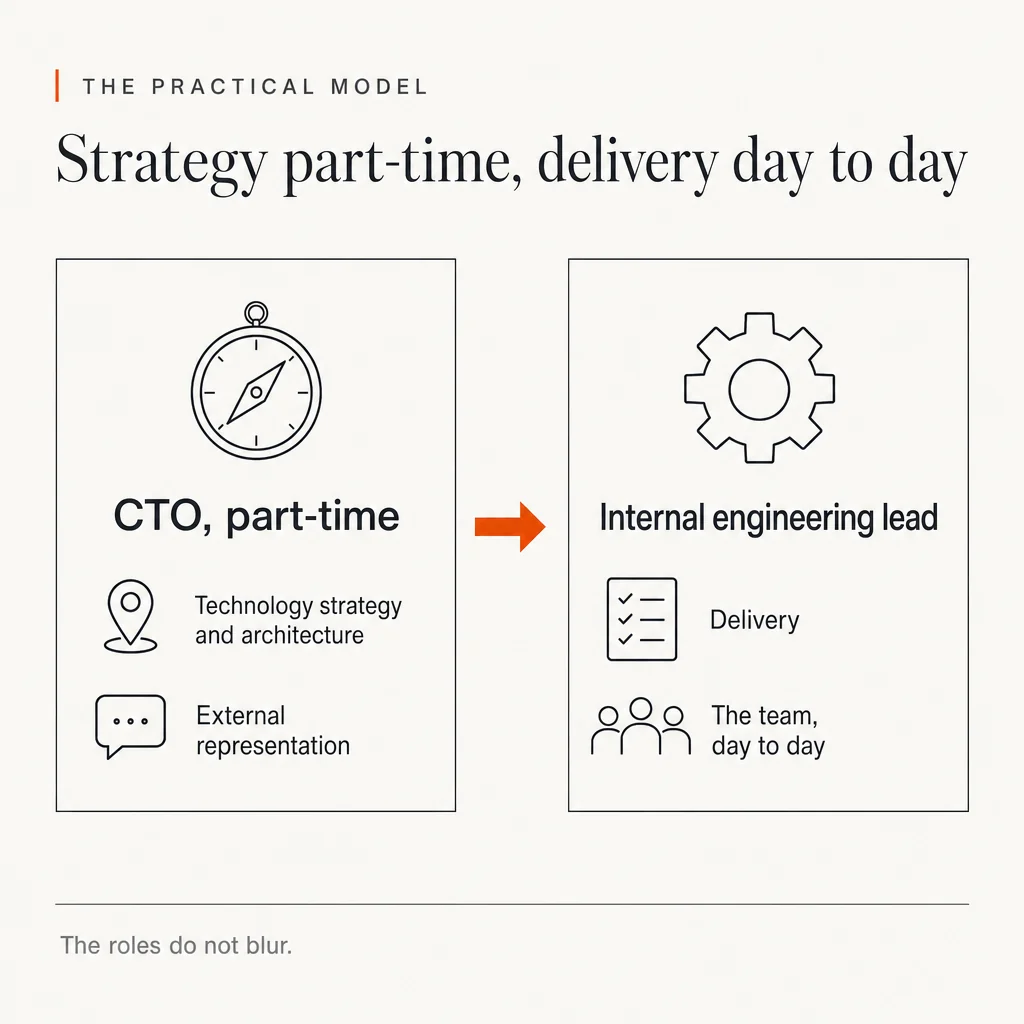
A fractional CTO owning technology strategy, architecture and external representation part-time, combined with a strong internal engineering lead managing delivery and the team day to day.
You get both capabilities. You do not pay two senior full-time salaries. And critically, the roles do not blur: the fractional CTO sets direction, the engineering lead executes it, and the executive is accountable for outcomes in their domain.
This is not a compromise. It is the appropriate structure for a company at your stage. For non-technical founders especially, our guide on on-demand CTO support in the UAE is worth reading.
As the business scales and the engineering team grows, the model evolves. But starting with a fractional CTO is almost always the right first move.
Making the decision
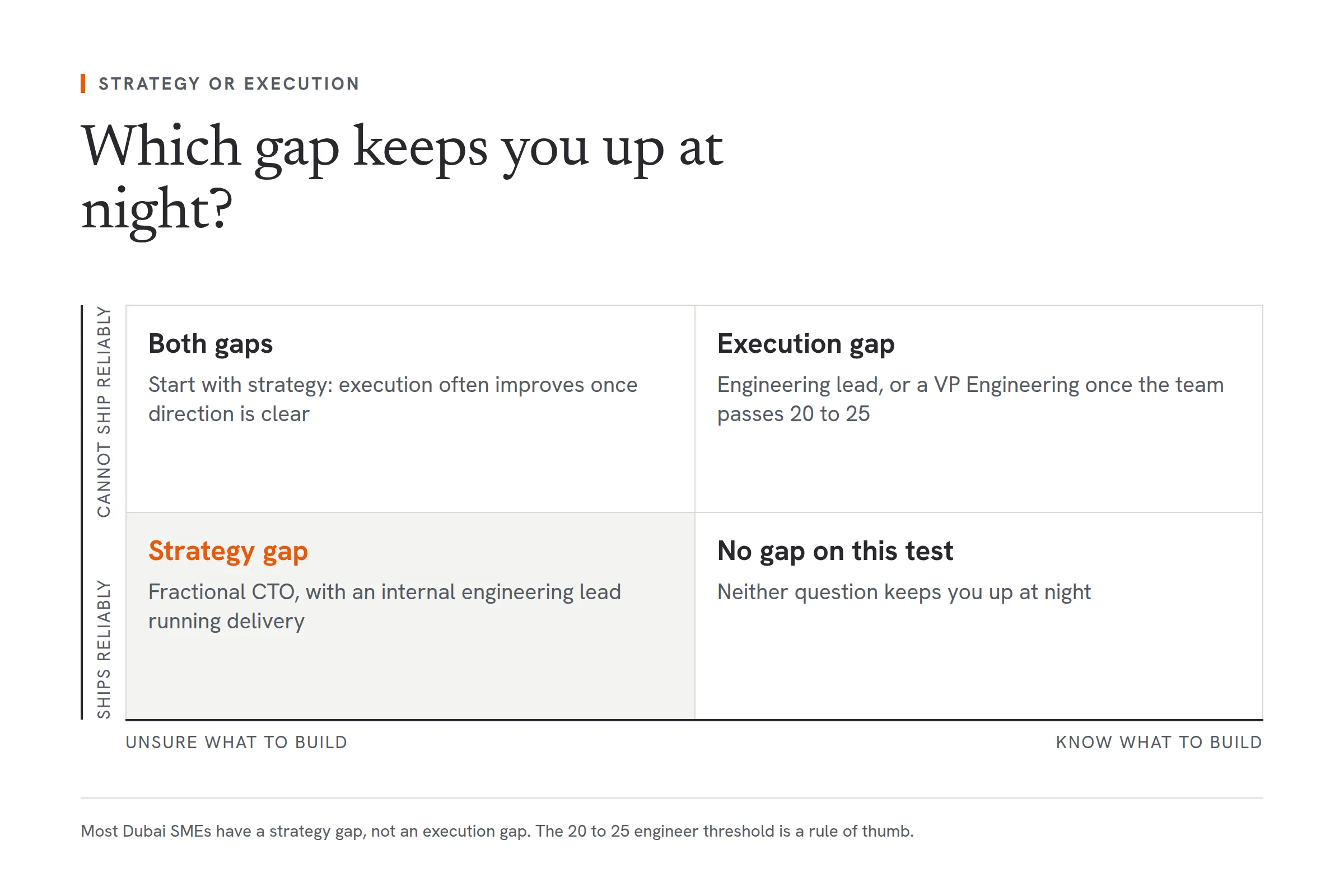
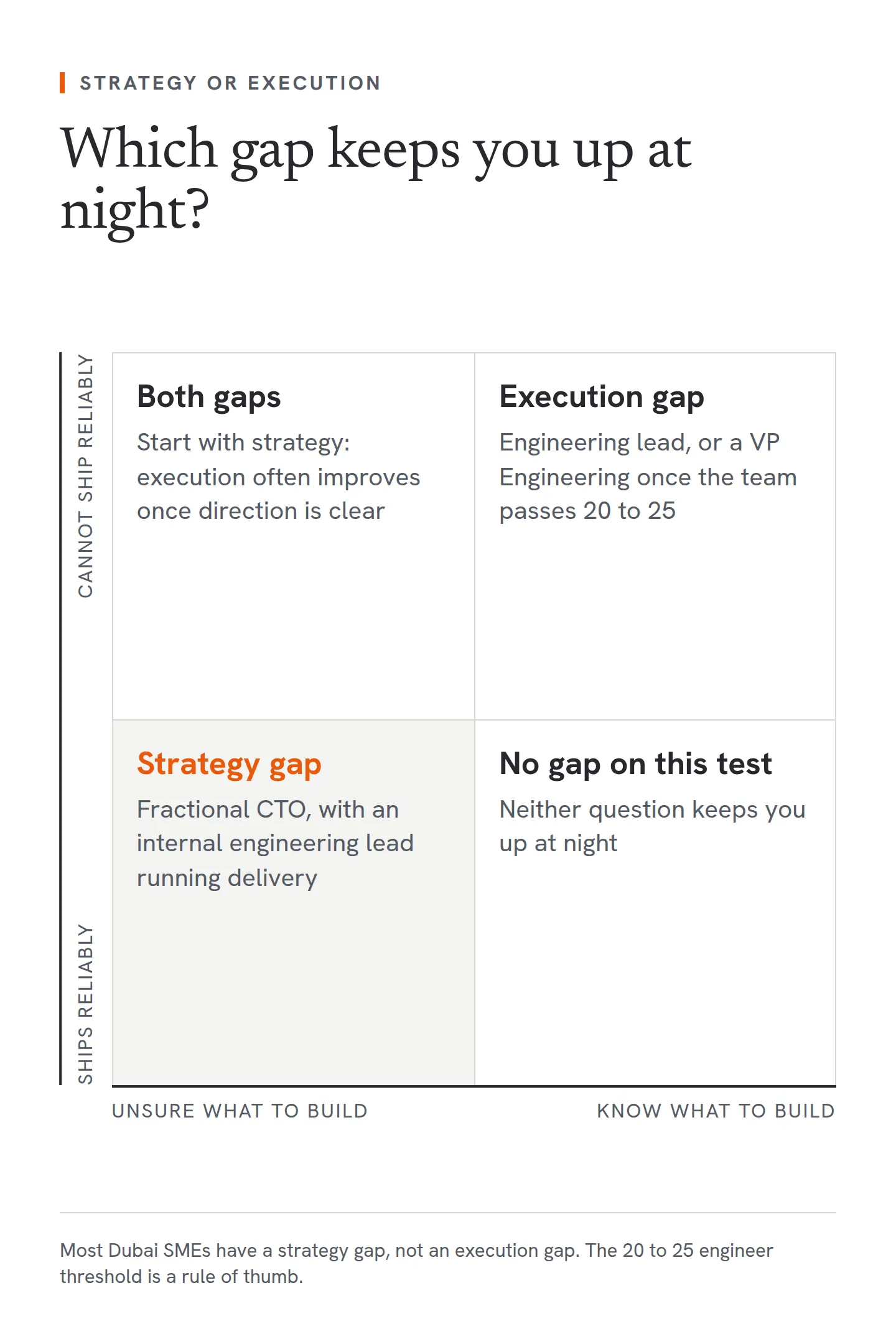
One question cuts through most of the noise: What keeps you up at night about technology?
"I don't know if we're building the right things" → strategic gap → fractional CTO.
"I know what to build but can't ship reliably" → execution gap → engineering lead or VP Engineering.
"Both" → start with strategy first; execution problems often resolve once direction is clear.
Under 15 engineers, one internal lead plus a fractional CTO covers most needs. Over 25, consider whether a full-time split makes sense. Either way, the fractional CTO is the right starting point, not the fallback.
FAQs
Why not just hire a full-time CTO from the start?
At SME stage, a full-time CTO is often over-specified and underfunded. You pay for five days when you need two or three. A fractional CTO gives you the same strategic output, and our engagements typically run 30 to 60% less than a full-time hire.
Can't a VP Engineering also set technology strategy?
Some can, but it is not their primary orientation. VPs Engineering are optimised for execution and team management. Asking them to also own long-term technology vision creates role confusion and usually means one of the jobs gets done badly.
When does a startup need both a full-time CTO and VP Engineering?
Typically Series B and beyond, with 25+ engineers and a clear need to separate strategy from execution at scale. Most Dubai SMEs are not there yet.
How does a fractional CTO engagement typically work?
Typically 4 to 24 hours per week, covering technology strategy, architecture reviews, investor and board representation, and build-versus-buy decisions. Engagements are usually structured around quarterly objectives rather than open-ended retainers.
Ready to close the technology strategy gap? Talk to the Fractional Dubai team to find out how a fractional CTO from our collective of 350+ curated and vetted executives can give your business the technical leadership it needs without the full-time cost.