The COO hiring mistake most UAE founders make
Most UAE SMEs do not need a full-time Chief Operating Officer (COO) yet. They need senior operational leadership aimed at a defined problem, and a fractional COO provides exactly that, part-time and without the permanent overhead.
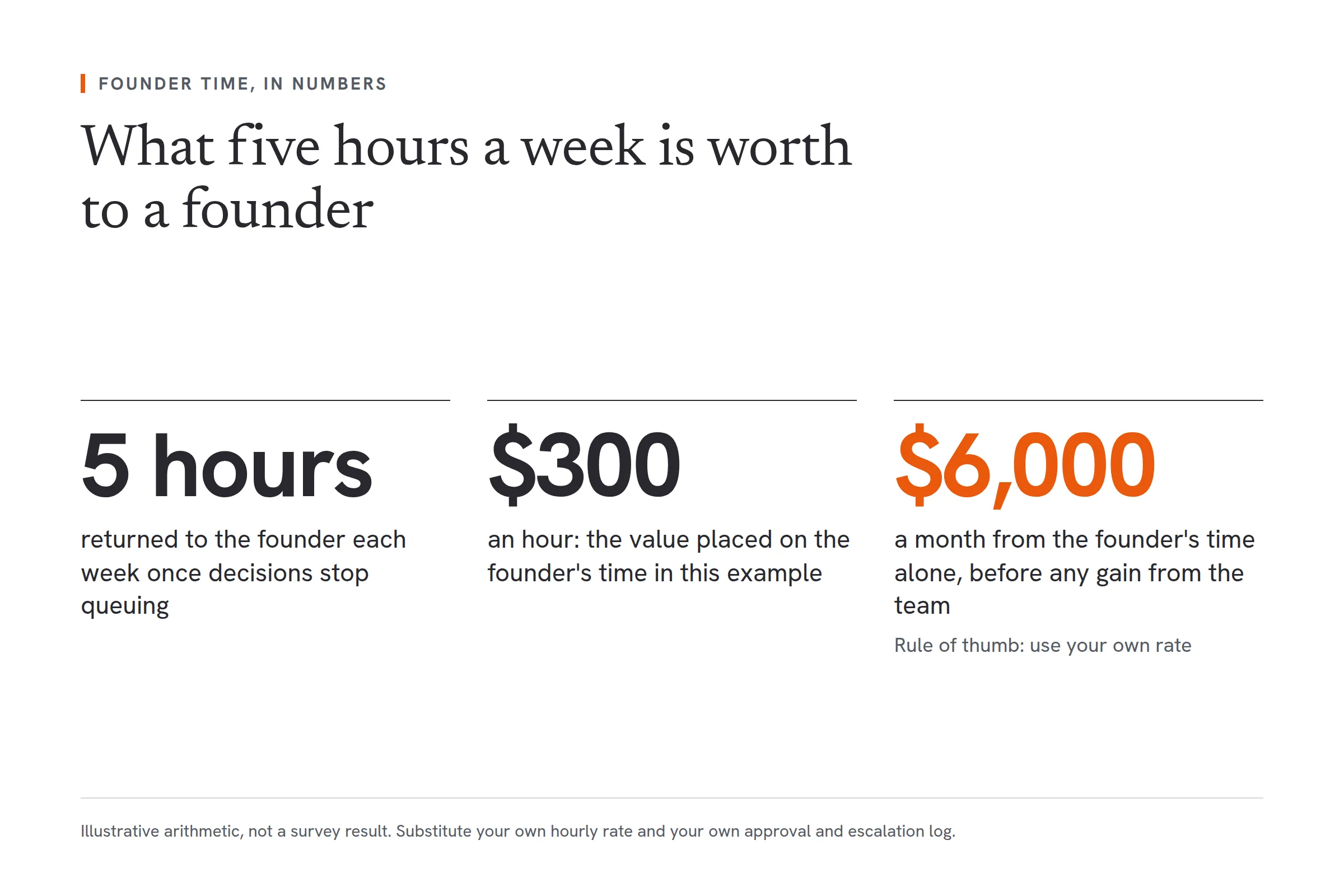
The pattern is familiar. Revenue is growing. Your finance lead is drowning in operational requests. You are spending much of your week fixing broken processes instead of closing deals. The obvious answer seems simple: hire a COO, put them on a multi-year contract and let them fix everything.
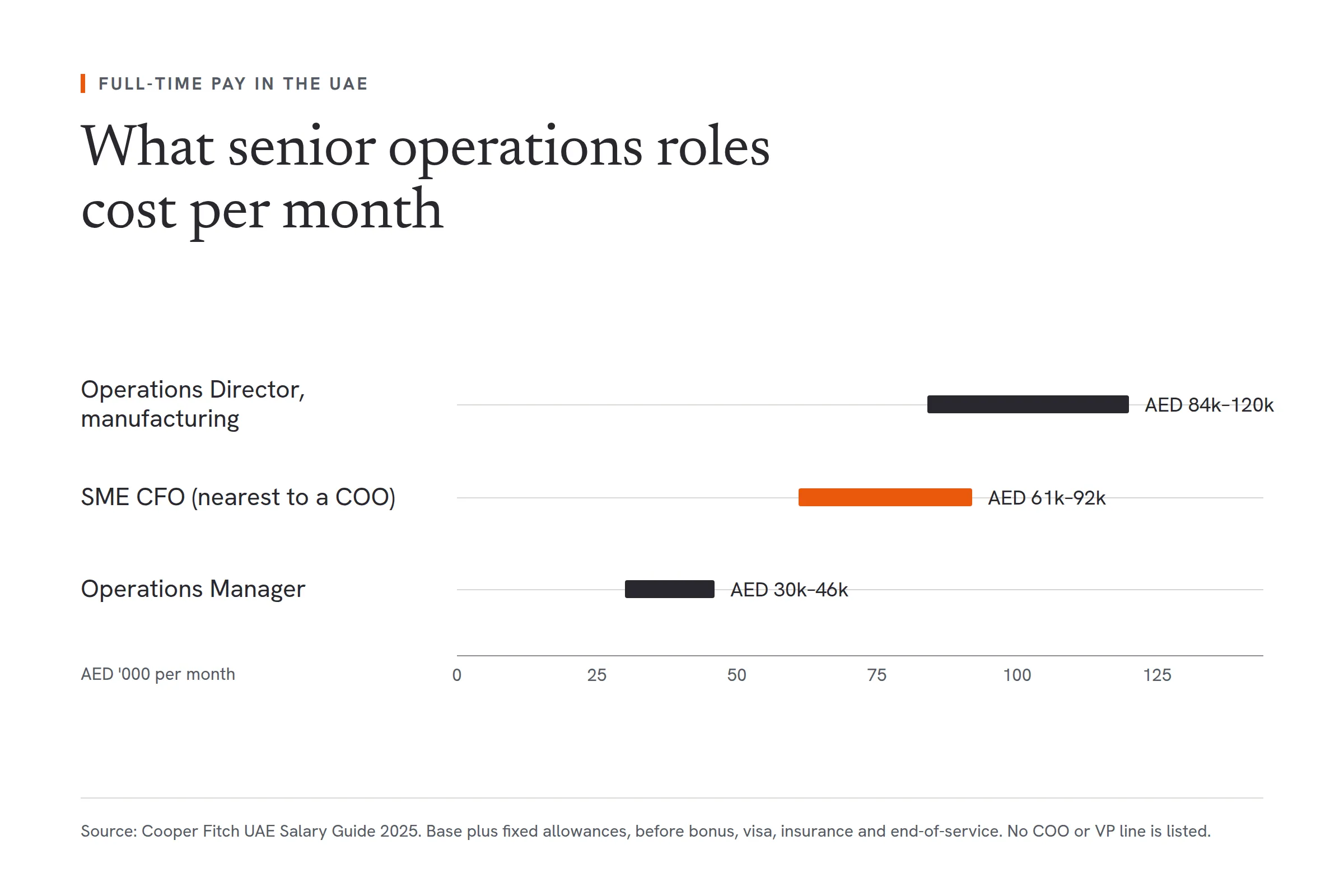
Then the real numbers arrive. A full-time COO is a C-suite hire with C-suite pay, plus gratuity, visa, insurance and recruitment costs, plus a ramp period where you are still working out which problems the role should solve first.
Founders then tend to do one of two things: hire anyway and overpay for capability they do not yet need, or keep muddling through with the existing team while operations stay broken for another two years. The founder bottleneck is usually the root cause in both cases.
There is a third path that most UAE SMEs never consider.
Why full-time COO hiring works for large companies (but not for you yet)
A full-time COO makes sense for businesses that have solved product-market fit and are now scaling complex operations. These companies typically have:
- Operational efficiency that directly moves margins at scale
- Large teams across multiple functions, needing dedicated coordination
- Repeatable, well-defined processes that need systematic improvement
- Multi-site or multi-location operations that demand constant executive attention
- Regulatory or compliance complexity that justifies a dedicated, embedded leader
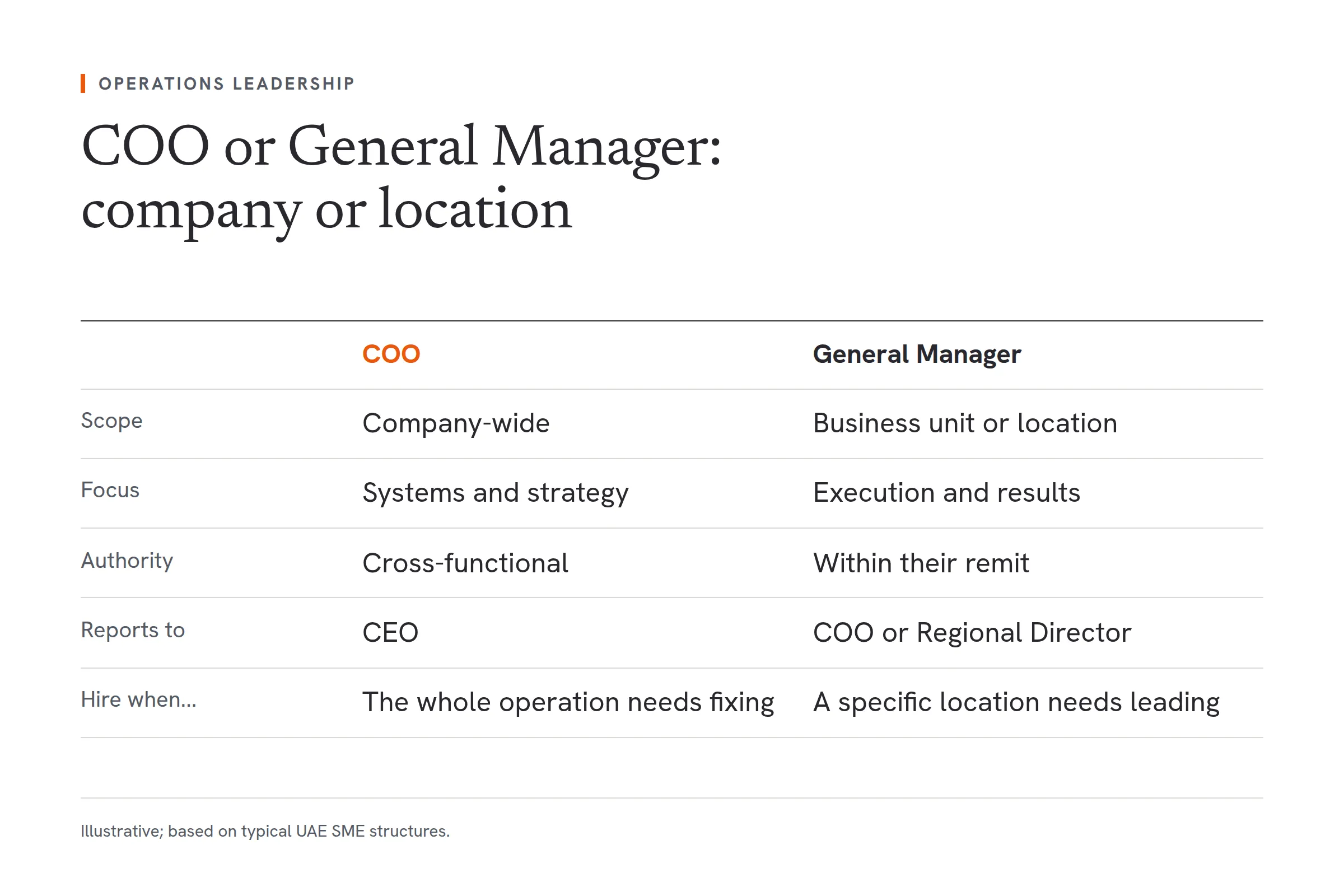
If this describes your business, a full-time COO is the right hire. Most UAE SMEs looking to hire a COO do not fit this profile. They are small to mid-sized teams, classic SME territory, where operations is broken but not in ways that justify a permanent C-suite seat.
Yet the hiring market assumes you do. Recruitment processes assume multi-year contracts. CV review focuses on "enterprise operations experience". The entire machine is built for permanent executives.
What often happens next: you hire an experienced COO at a premium salary. For the first couple of months they are valuable. Later, you are paying a full executive salary for someone who spends a growing share of their time in status meetings instead of building capability. They then become part of the existing power structure in ways that make change harder, not easier.
Enter the fractional COO model
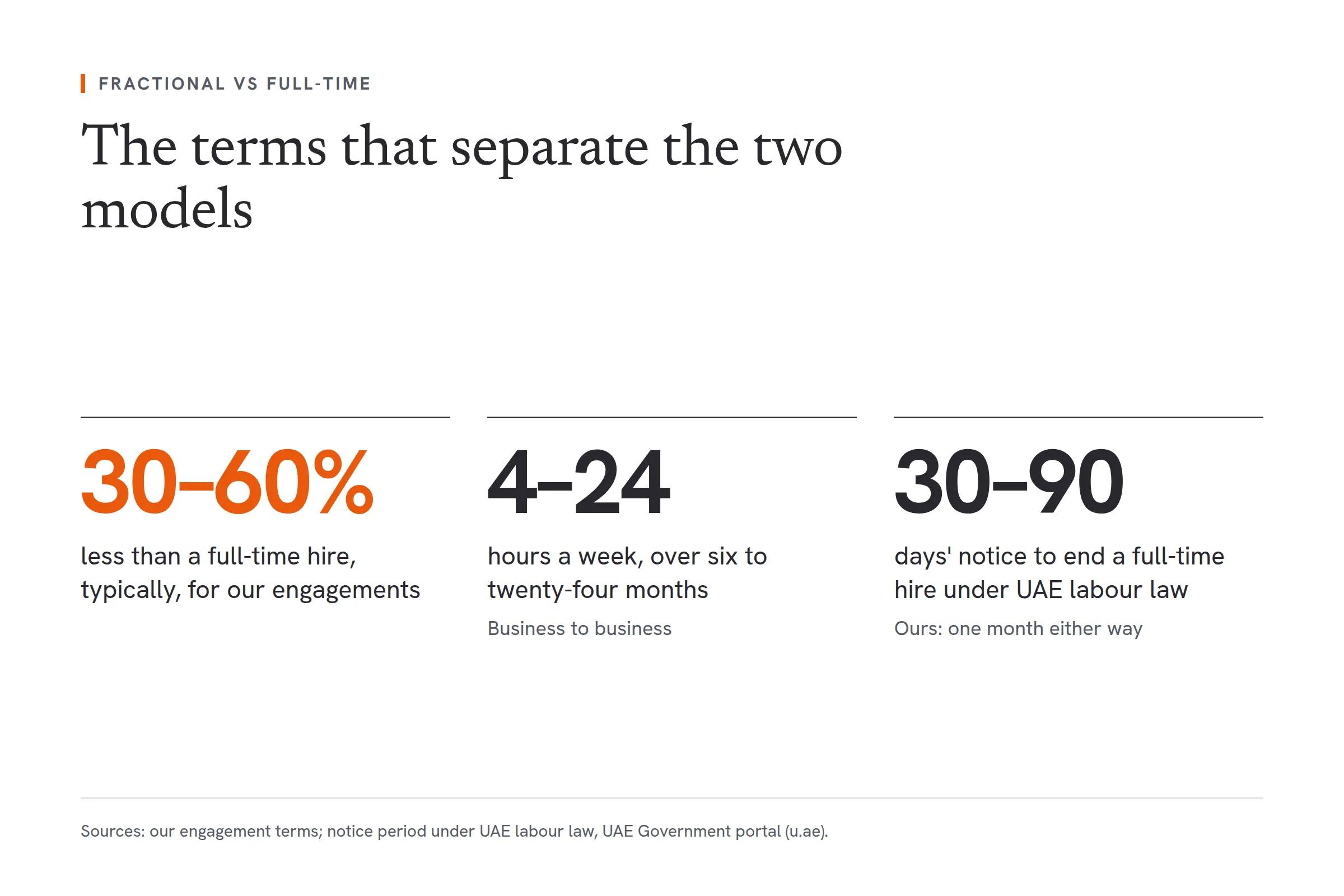
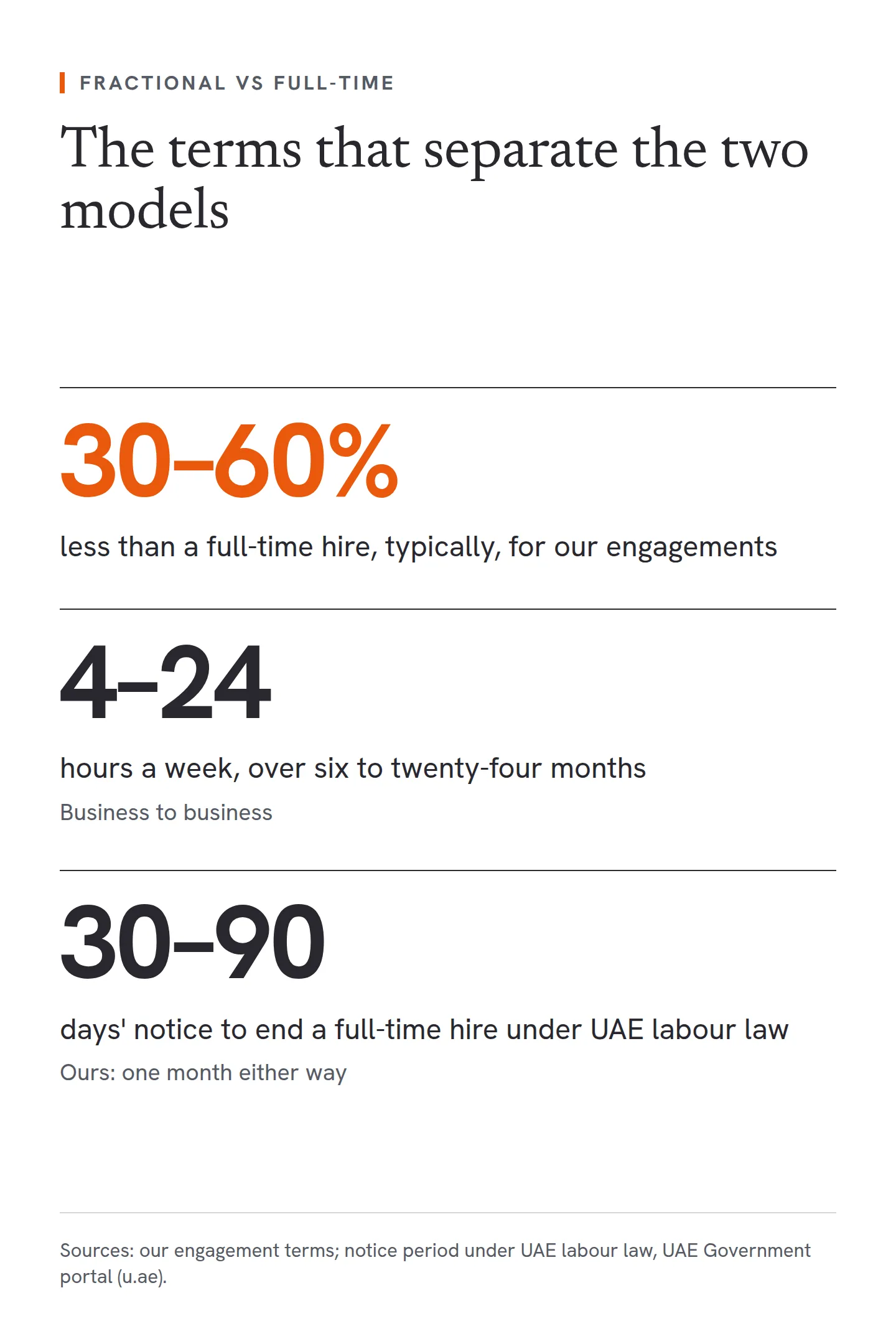
A fractional COO is an experienced operations leader who embeds in your business part-time, typically 4 to 24 hours per week over six to twenty-four months, business to business with one month's notice either way.
This is not an interim stop-gap. It is a different model that suits mid-stage businesses because it aligns cost and commitment with the size of the problem. The executive owns the operational outcomes in their domain. We do not simply make an introduction and step away: we provide the support, structure and governance for both the SME and the executive to succeed.
Here is what changes:
Cost structure. A full-time COO is paid for five days a week whether the work needs them or not. A fractional COO is scoped in hours against the work. Our engagements typically run 30 to 60% less than a full-time hire, and because the engagement is business to business there is no employment visa to sponsor, no end-of-service liability and no insurance burden. For the full-time side, UAE law sets end-of-service gratuity at 21 days of basic wage for each of the first five years of service, then 30 days for each year after, up to a cap of two years' wage.
Focus. A fractional COO works to agreed outcomes that are reviewed regularly, which creates natural pressure to prioritise. When access to a senior resource is limited, conversations about which processes to fix get clearer. Full-time operators often default to the loudest problem, which is rarely the most important one.
Perspective. Fractional executives bring frameworks from several other businesses. They see patterns, and they know which operational moves work because they have tried them in different industries, team sizes and market contexts. That outside view is valuable precisely because it is not embedded in how things have always been done.
Flexibility. Business needs change. If priorities shift, you adjust the hours or scope. Ending a full-time hire that did not work means a notice period of 30 to 90 days under UAE labour law, plus gratuity. A fractional engagement is business to business with one month's notice.
Demand for interim COOs is rising fast
Companies are turning to outside operational leaders in growing numbers. Heidrick & Struggles reports that requests for interim COOs rose 250% year on year in its 2026 High-End Independent Talent Report, the sharpest rise of any C-suite role, while demand for interim C-suite leaders overall is up 151% since 2021.
Keep the base in view: the same report shows interim COOs are still a small share of requests (4% of interim C-suite demand, against 51% for Chief Financial Officers), so the percentage reflects a role starting from a low base. The direction is clear all the same. Operations is where growing companies feel the gap.
Engagements are also lengthening. In Heidrick's Talent Lens Survey, 42% of interim engagements now last longer than six months, up from 27% in 2021. Both reports cover interim and independent talent globally (the survey is weighted to North America), so read them as a signal of the model's direction, not a UAE measure.
Fractional COO vs full-time: head to head
Dimension | Fractional COO | Full-time COO |
|---|---|---|
Cost | Our engagements typically run 30 to 60% less than a full-time hire | Fixed pay plus gratuity, visa, insurance and recruitment costs |
Commitment | Business to business, one month's notice | Employment contract, 30 to 90 days' notice under UAE labour law |
Time to start | Within weeks | Recruitment first, then the candidate's notice period |
Typical time input | 4 to 24 hours per week over six to twenty-four months | Full-time, five days a week |
Best stage | Small to mid-sized teams with a defined operational problem | Larger, multi-site operations needing a daily embedded leader |
Learning-curve risk | Lower: bounded scope, regular review | Higher: full salary during the ramp |
External perspective | Built in from day one | Fades as the person embeds in the culture |
Regulatory or compliance heavy? | Less ideal if you need a permanently embedded specialist | Better fit |
When fractional makes sense for you
You are a good candidate for fractional operations leadership if:
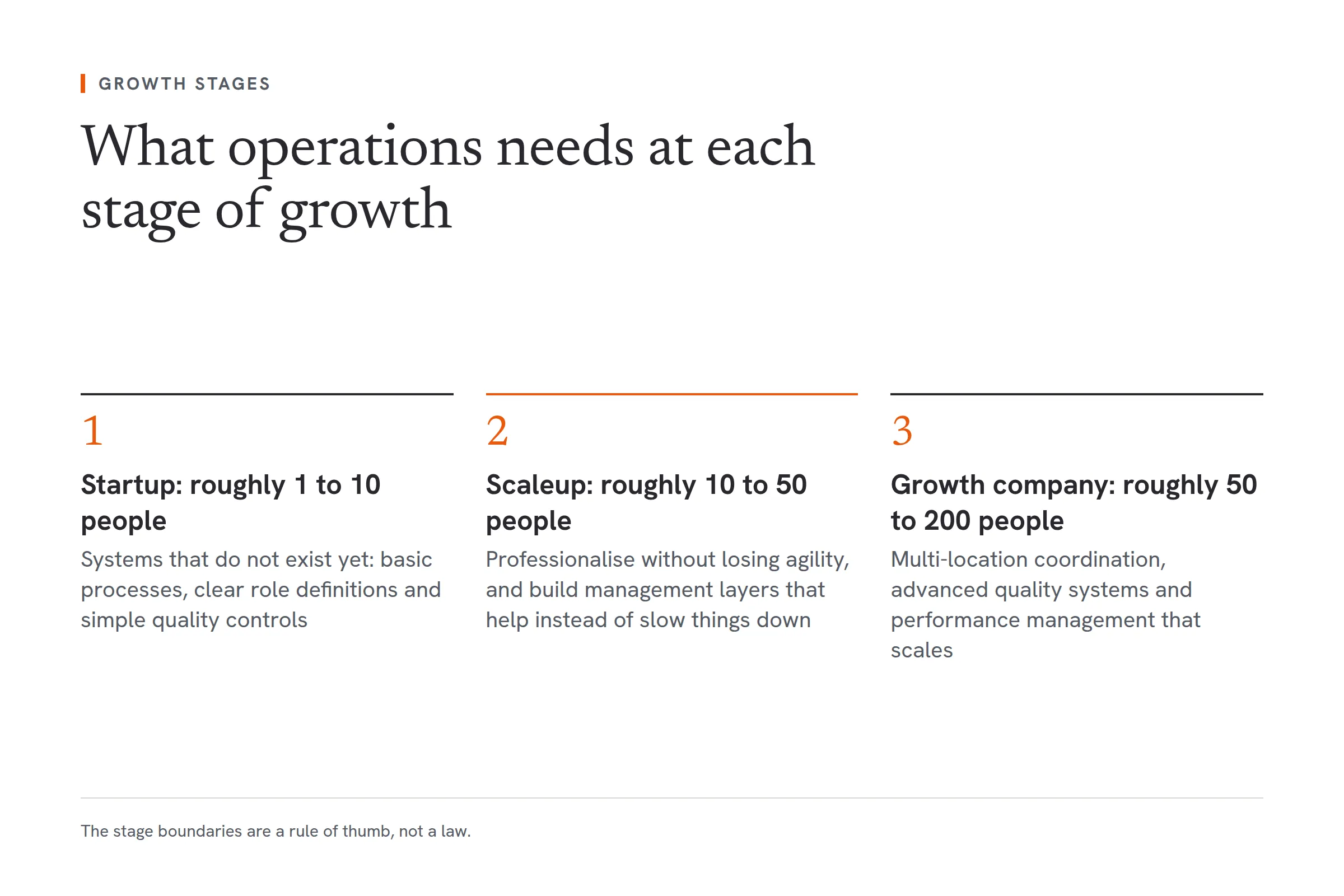
- You have crossed the complexity threshold where founder-led operations breaks, and the business is growing. Our clients typically sit between 2M and 40M USD in revenue. You are not yet at the scale where a full-time executive is obviously justified.
- You have a specific operational problem in view. Maybe your supply chain is inefficient, you are losing customers to delivery delays, or your team is overwhelmed by ad-hoc client requests. A fractional COO can diagnose and systematise the fix. This is more efficient than hiring someone "to improve operations generally".
- You are willing to be hands-on during discovery. The fractional model needs founder involvement early. You cannot hire someone and disappear. That is a strength: you will understand the problems deeply and know how to lead once the systems are in place.
- You are uncomfortable with the full-time cost. If a permanent COO hire feels risky, that instinct is probably right. Being unsure whether the investment is justified suggests you are not yet at the scale where full-time operations leadership is obvious.
How to structure a fractional COO engagement
Most fractional relationships follow this pattern, with hours heaviest at the start and lighter once the systems run:
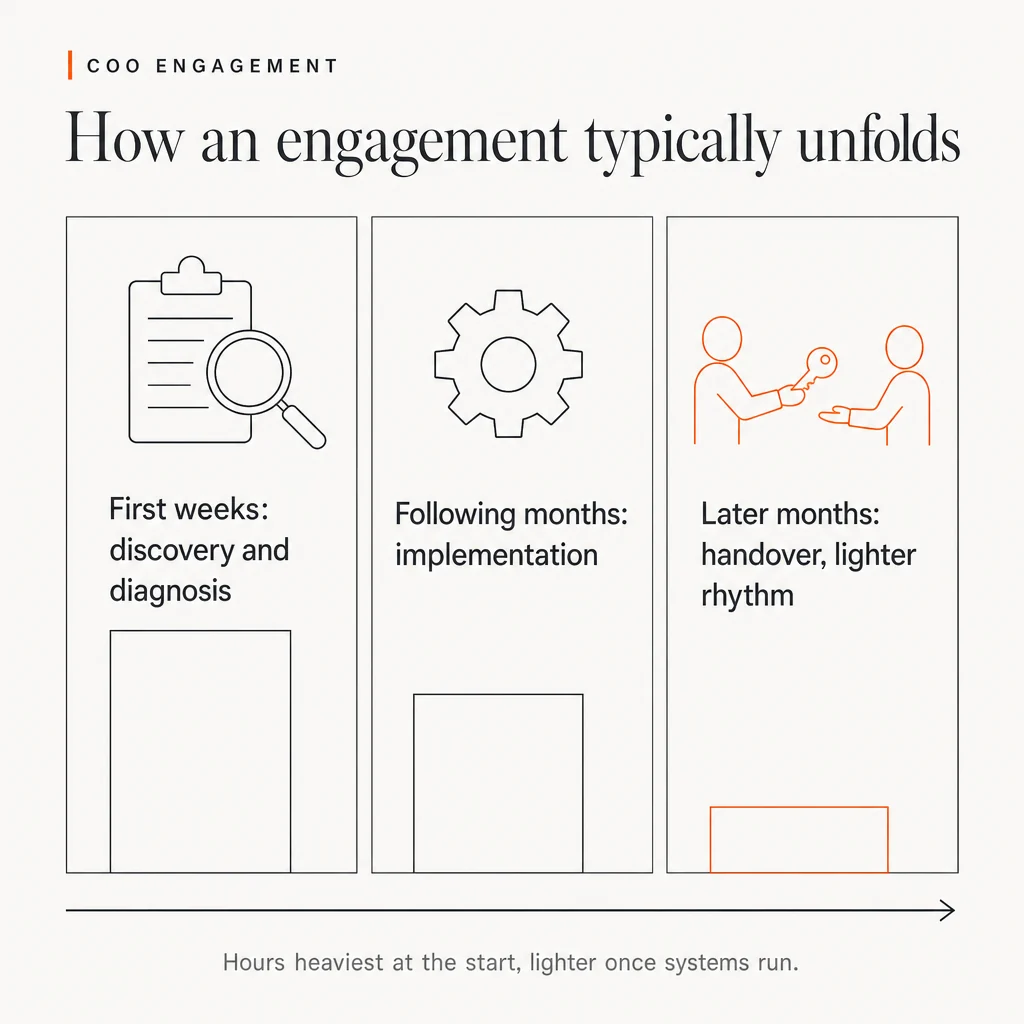
The first weeks: discovery and diagnosis. The fractional COO meets you, your finance team, operations people and frontline staff, and reviews the last twelve months of data. They rank the operational problems by impact, then agree two or three priority areas. Our flexible operations leadership guide walks through what good looks like at each growth stage.
The following months: implementation. The focus narrows to things like vendor management, a customer feedback loop, hiring and onboarding playbooks, or project delivery tracking. The fractional operator leads this work but increasingly delegates it to your team, which builds capability you keep.
Later months: handover and a lighter rhythm. Your team maintains the systems that have been built. The fractional operator documents everything, trains your lead people and sets the metrics that show whether improvements stuck. Hours usually taper to a lighter steady-state rhythm, and the engagement continues, changes scope or ends, with one month's notice either way.
The real comparison: what you are actually buying
When you hire a full-time COO, you are buying:
- Permanent availability for whatever crisis emerges
- Long-term cultural integration and strategic input
- Executive credibility with banks, investors and partners
- Deep knowledge of your business over years
- A leader invested in the company's long-term future
When you engage a fractional COO, you are buying:
- Rapid diagnosis and structured problem-solving
- Implementation of proven frameworks tested elsewhere
- Capability transfer to your team
- Operational improvement with lower risk and cost
- Flexibility to adjust or end the engagement based on results
These are not equivalent services. A full-time COO should be thinking years ahead. A fractional COO should deliver measurable improvement within the first months and leave the business running better without them.
The mistake most UAE SME founders make is hiring a full-time operator when they actually need a fractional one. Then, when the hire feels expensive or underused, they assume the COO role itself was wrong, not the model.
What happens after fractional?
Some founders like the fractional model so much that they never move to full-time. They keep an engagement running at lighter hours, or bring in different expertise as the business changes (operations, then finance systems, then people operations). That is perfectly reasonable.
Others use fractional as a proving ground. Once the core operational problems are fixed, you understand what full-time operational leadership looks like. You might then hire a full-time COO with much clearer requirements, knowing they will improve known systems, not build from scratch. Or you might hire a full-time Head of Operations to manage day to day, with fractional executive input on strategy.
The worst outcome is staying broken. If operations is holding you back from scaling, fix it. Full-time is not the only way.
Next steps
If fractional operations leadership sounds like it could fit your business, explore what this engagement might look like. We help UAE SME founders solve the operations problems that hold back growth, without the permanent overhead. Not sure yet? Take our fractional COO readiness assessment or read COO vs VP Operations if you are weighing titles.
Still not sure? Read about why your business probably needs a fractional COO, or dive deeper into the real numbers around COO value creation in Dubai SMEs.
Ready to explore whether fractional is right for you? Get in touch. We will spend 30 minutes understanding your situation, no obligation.