In short: A Chief Financial Officer (CFO) sets financial strategy and manages the company's external financial relationships; a VP Finance runs the internal finance function. For most SMEs the better answer is a fractional CFO rather than a full-time hire in either role.
A Chief Financial Officer (CFO) sets financial strategy and manages the company's external financial relationships; a VP Finance runs the internal finance function. Dubai founders often ask "do I need a CFO or a VP Finance?" and then hire a full-time executive for either role, only to spend a year wondering why the cost does not feel worth it.
The better question is: do you actually need either one full-time? For most SMEs the answer is no, and understanding why requires understanding what these roles do and where they differ.
What a CFO actually does
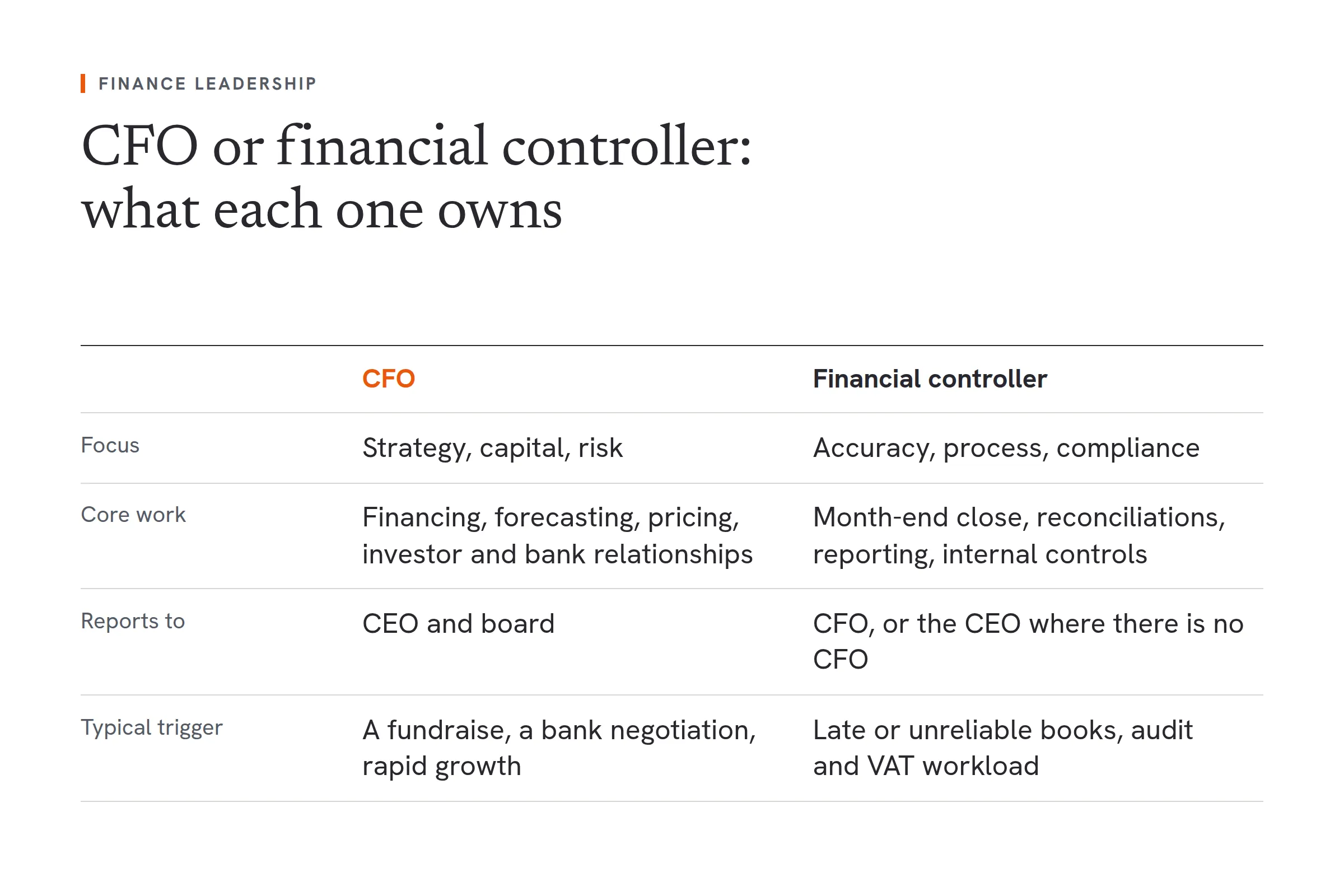
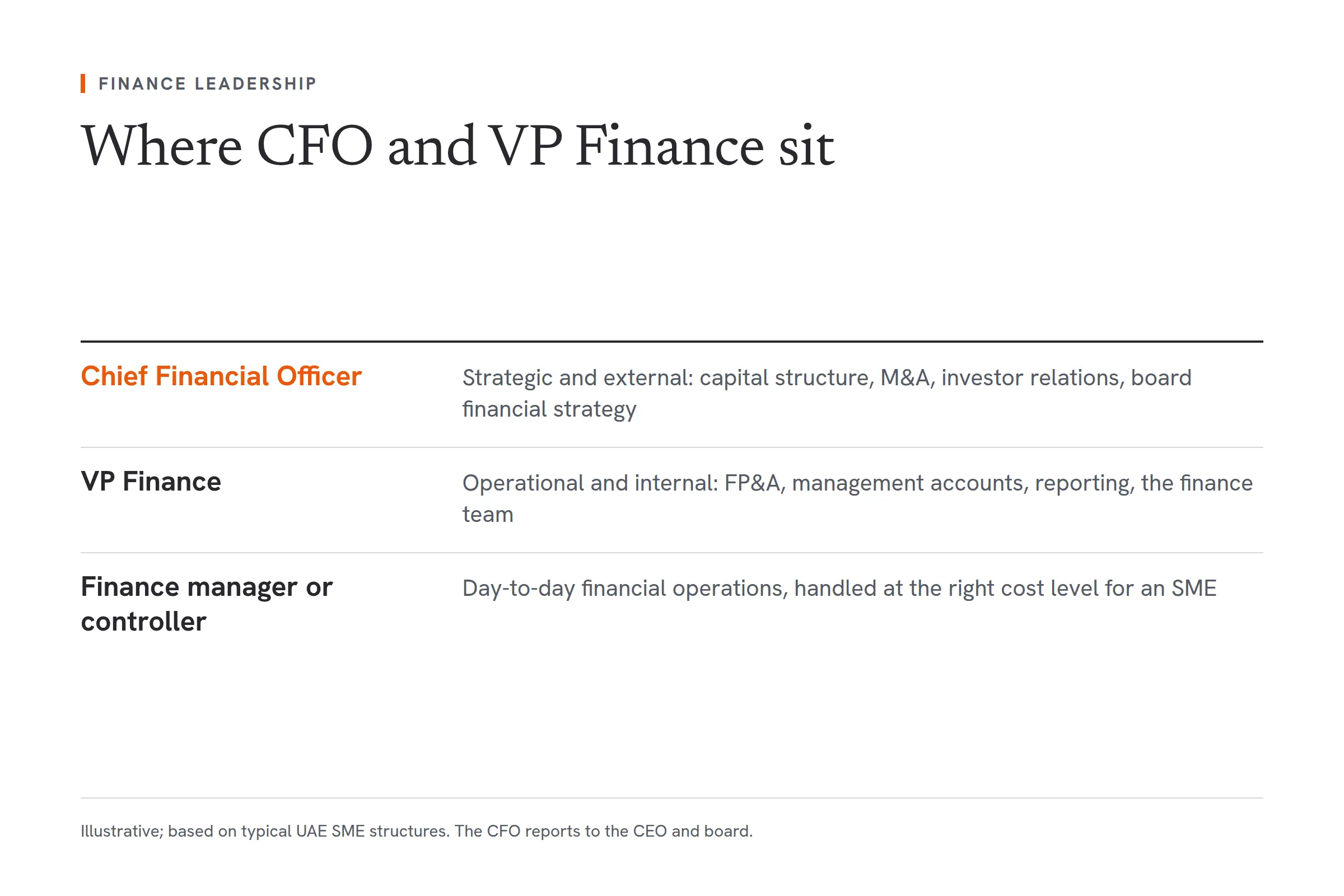
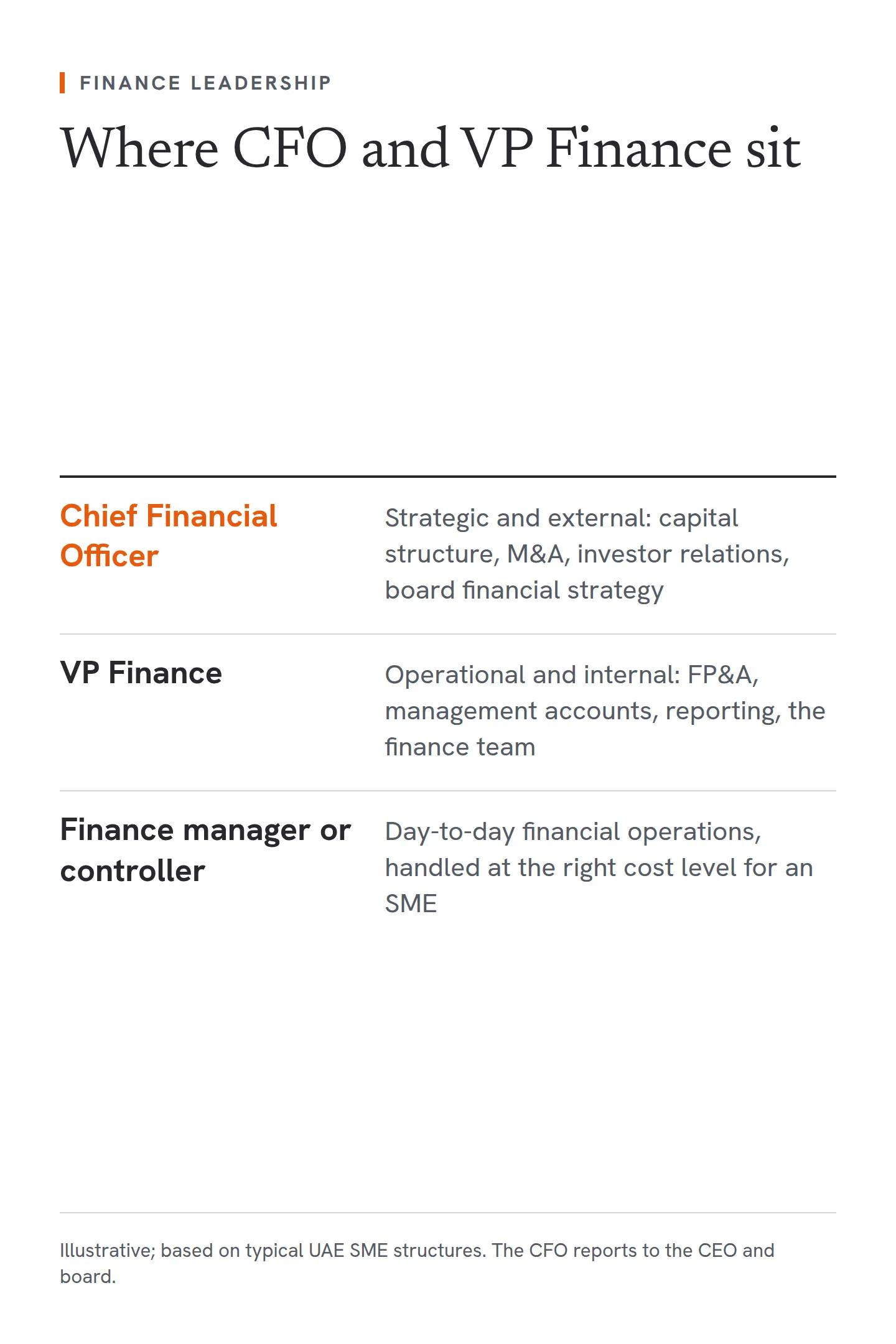
A CFO operates at the boundary between your business and the outside world.
They negotiate your credit facility with the bank, sit across from investors, structure a deal when an acquisition appears and manage what your board believes about your financial position. The CFO's value is not in running your finance function. It is in representing your financial credibility externally and directing how capital gets deployed.
Capital structure, M&A, investor relations and enterprise-wide financial strategy are high-stakes, high-judgement, externally facing activities. They require someone operating as a genuine C-suite peer, making strategic calls alongside you rather than managing your monthly close.
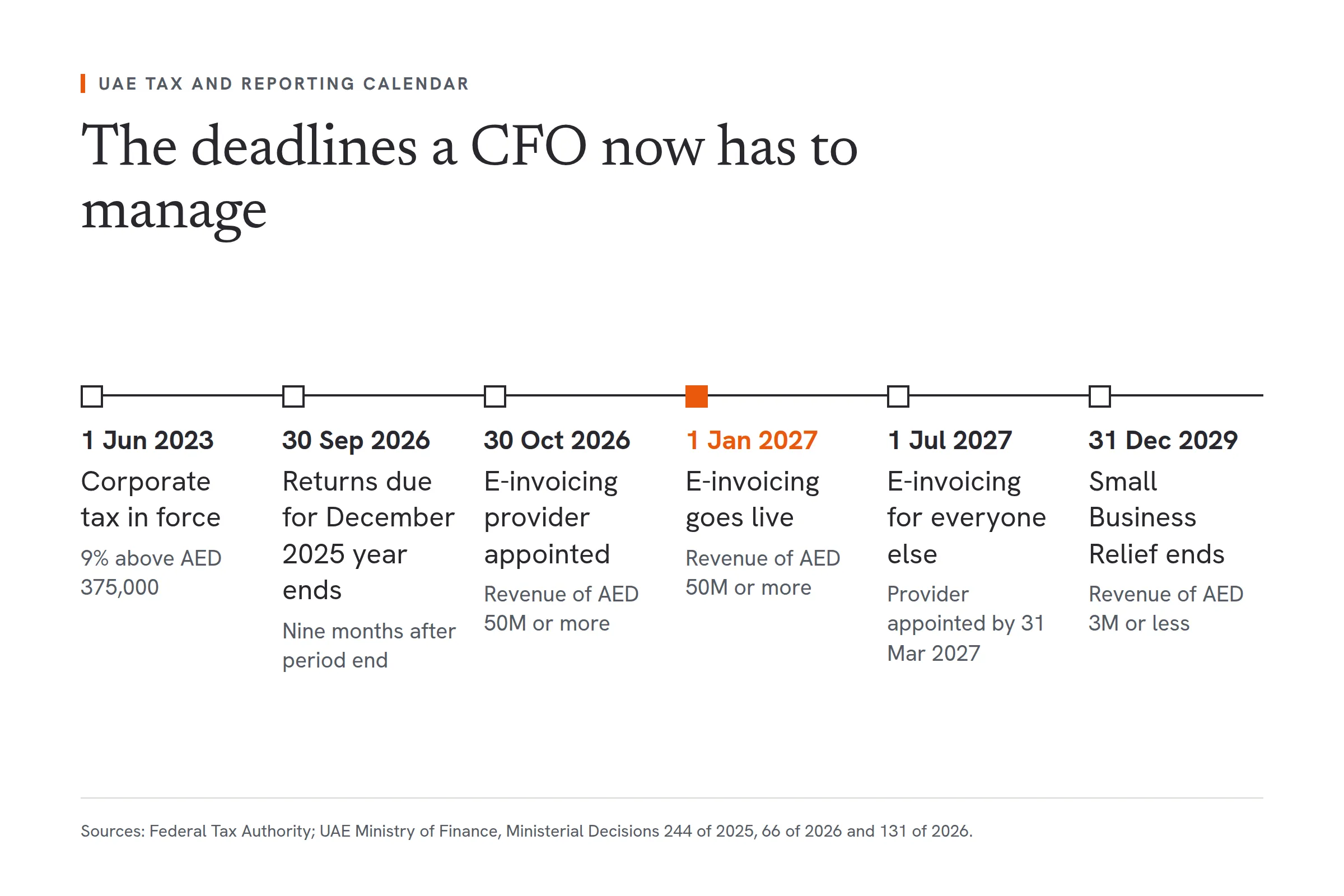
In Dubai the tax landscape adds another dimension. UAE corporate tax is 9% on taxable income above AED 375,000, with the return and payment due within nine months of the end of the tax period. Group structure, related-party pricing and compliance posture require CFO-level thinking, which is a very different skill set from managing an FP&A team.
What a VP Finance actually does
A VP Finance runs your finance function.
They own the FP&A process, manage the finance team and are responsible for accurate management accounts, reliable reporting and financial systems that do not break. When you want to know why this month's margin dropped, the VP Finance is who you ask. That operational layer overlaps with what many Dubai SMEs assign to a financial controller before they add VP-level leadership.
This work matters enormously, but it is internal. The VP Finance makes your finance department work. The CFO makes your company's financial strategy work. Think of it like this: the VP Finance builds and maintains the engine; the CFO decides where to drive.
The key differences
| CFO | VP Finance |
|---|---|---|
Focus | Strategic and external | Operational and internal |
Reports to | CEO / board | CFO or CEO |
Primary stakeholders | Investors, banks, board | Finance team, internal leadership |
Core activities | Capital, M&A, strategy | FP&A, reporting, systems |
Full-time cost (Dubai) | SME CFO base of AED 61,000 to 92,000 a month, before bonus and benefits | Normally lower than a CFO |
These roles are not interchangeable in cost or in skill set.
Why most Dubai SMEs need a fractional CFO, not a full-time anything
Most SMEs do not have enough CFO-level work to justify a full-time CFO, and they do not have enough VP Finance-level complexity to justify a full-time VP Finance either. The data points the same way: Heidrick & Struggles reports that small and medium companies now account for more than 80% of demand for interim talent, and that C-suite interim engagements have risen 151% since 2021.
What most SMEs need is strategic financial leadership, available when it matters and off the payroll when it does not.
A fractional CFO gives you that: capital strategy, investor relations, board credibility and tax structuring, without a full-time executive salary. Our engagements typically run 30 to 60% less than a full-time hire, and they are business to business with one month's notice, no employment visa and no end-of-service liability. It is not a compromise. For most SMEs it is the better model.
A pattern we see: a founder hires a full-time CFO, then finds within months that most of the person's time goes on reporting and team management, which is VP Finance work, and only a fraction on the strategic activities that justified the hire. That is an expensive way to learn the lesson.
The fractional CFO model inverts this. You engage a senior financial leader for the moments that need them most: fundraising, banking relationships, board presentations, major transactions and tax structuring. Day-to-day financial operations are handled at the right cost level by a finance manager or a small internal team.
Our complete guide to fractional CFO in Dubai covers how this works in practice for SMEs at different stages.
When a fractional CFO makes the most sense
Almost always, but specifically in these situations.
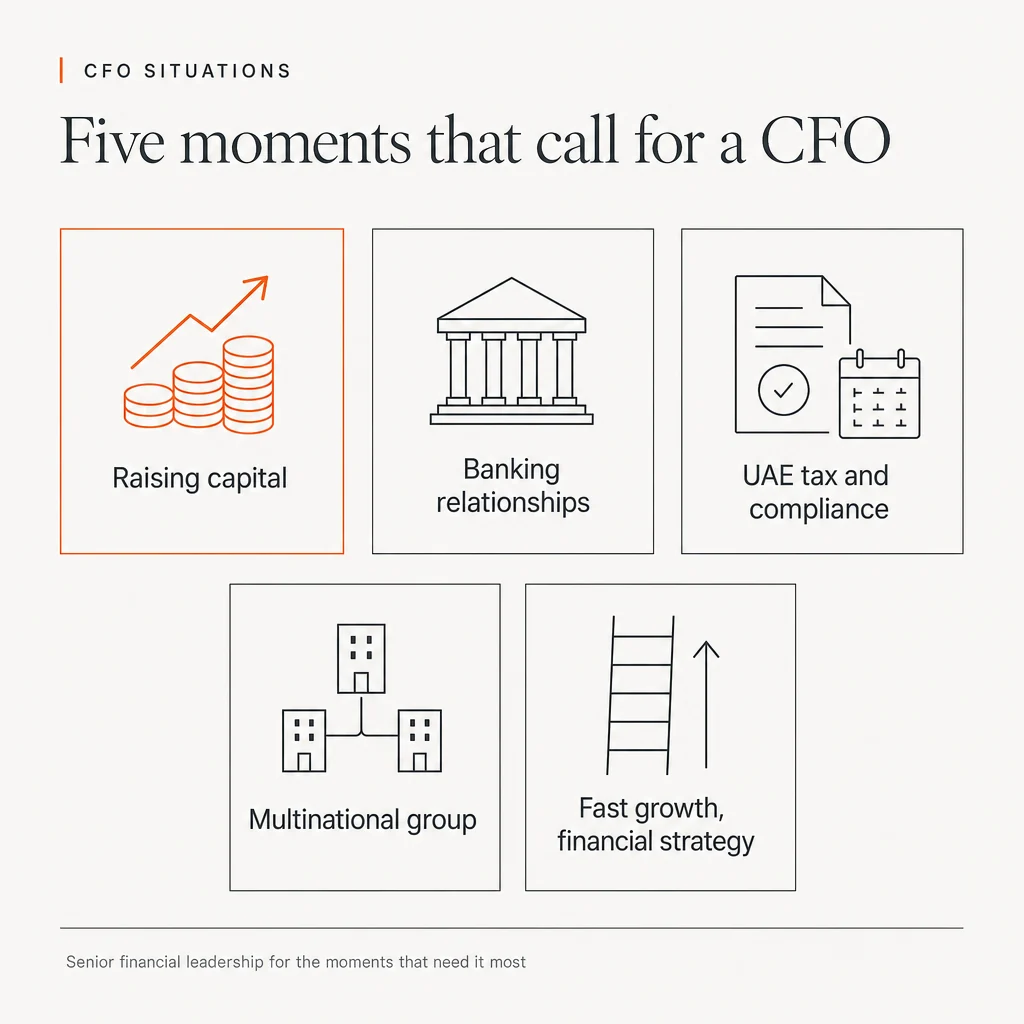
You are raising capital. A fractional CFO with the right investor relationships and track record is more valuable here than a full-time executive who has never done it. Fundraising readiness is as much about defensible models and clean books as it is about the pitch. Investors care about capability, not employment structure.
You need banking relationships. Negotiating a credit facility or a trade finance line requires someone who can walk into a bank as a credible financial counterpart. That is CFO territory.
You are navigating UAE tax and compliance. Group structure, related-party pricing and tax planning are CFO-level work that most SMEs need only periodically. Two 2026 developments raise the stakes. Small Business Relief has been extended to tax periods ending on or before 31 December 2029, with the AED 3 million revenue threshold unchanged. And e-invoicing becomes mandatory on 1 January 2027 for businesses with revenue of AED 50 million or more, and on 1 July 2027 for everyone else, which needs an owner who can choose an Accredited Service Provider and manage the rollout.
You are part of a multinational group. The 15% Domestic Minimum Top-up Tax, the UAE's version of Pillar Two, applies to groups with consolidated annual revenue of EUR 750 million or more, for financial years beginning on or after 1 January 2025. Most SMEs are well below that line, but a subsidiary of a large group may be in scope and needs senior judgement.
You are growing fast and need financial strategy. How you structure equity, when to raise, what margins to target and how to think about cash are strategic decisions that benefit from a CFO's perspective without needing one full-time.
Not sure if you are at this stage? The fractional CFO readiness assessment will tell you in five minutes. When you do engage someone, ten questions to ask your CFO will help you gauge whether the fit is right.
The one scenario where you might need both
If your business is larger, with a complex multi-entity structure or an active investor base, you may need a fractional CFO and a VP Finance working together.
The fractional CFO handles the external strategic work. The VP Finance runs the internal function. Together they give you comprehensive financial leadership, and you are still paying significantly less than for two full-time executive hires.
This is the structure that makes the most sense at scale. The CFO ROI calculator can help you model whether the economics work for your situation. For a business with revenue of 2M to 40M USD, a fractional CFO supported by a finance manager or small internal team is the usual starting point.
Ready to work out whether a fractional CFO is right for your business? Talk to the Fractional Dubai team. We will help you map the right financial leadership structure for where you are now and where you are going.