In short: If the revenue problem spans marketing, sales and retention, you need a Chief Revenue Officer (CRO). If it sits inside the sales team, a VP of Sales is usually enough.
A Chief Revenue Officer (CRO) owns revenue across sales, marketing and customer success, while a Vice President (VP) of Sales runs the sales team. Most Dubai SMEs need one or the other, not both, and the choice depends on where your revenue problem actually lives.
Revenue leadership has become more complicated. Ten years ago, most businesses had a sales director and left it there. Now there's a whole vocabulary: CRO, VP Sales, Revenue Operations (RevOps), Growth Lead. If you run an SME in the UAE, you're probably wondering which of these you need and whether you can afford to get it wrong. The competition for buyers is only rising: the UAE passed 1.4 million registered companies at the end of 2025, with about 250,000 added during that year, so a clear revenue structure matters more than it did.
What does a CRO actually do?
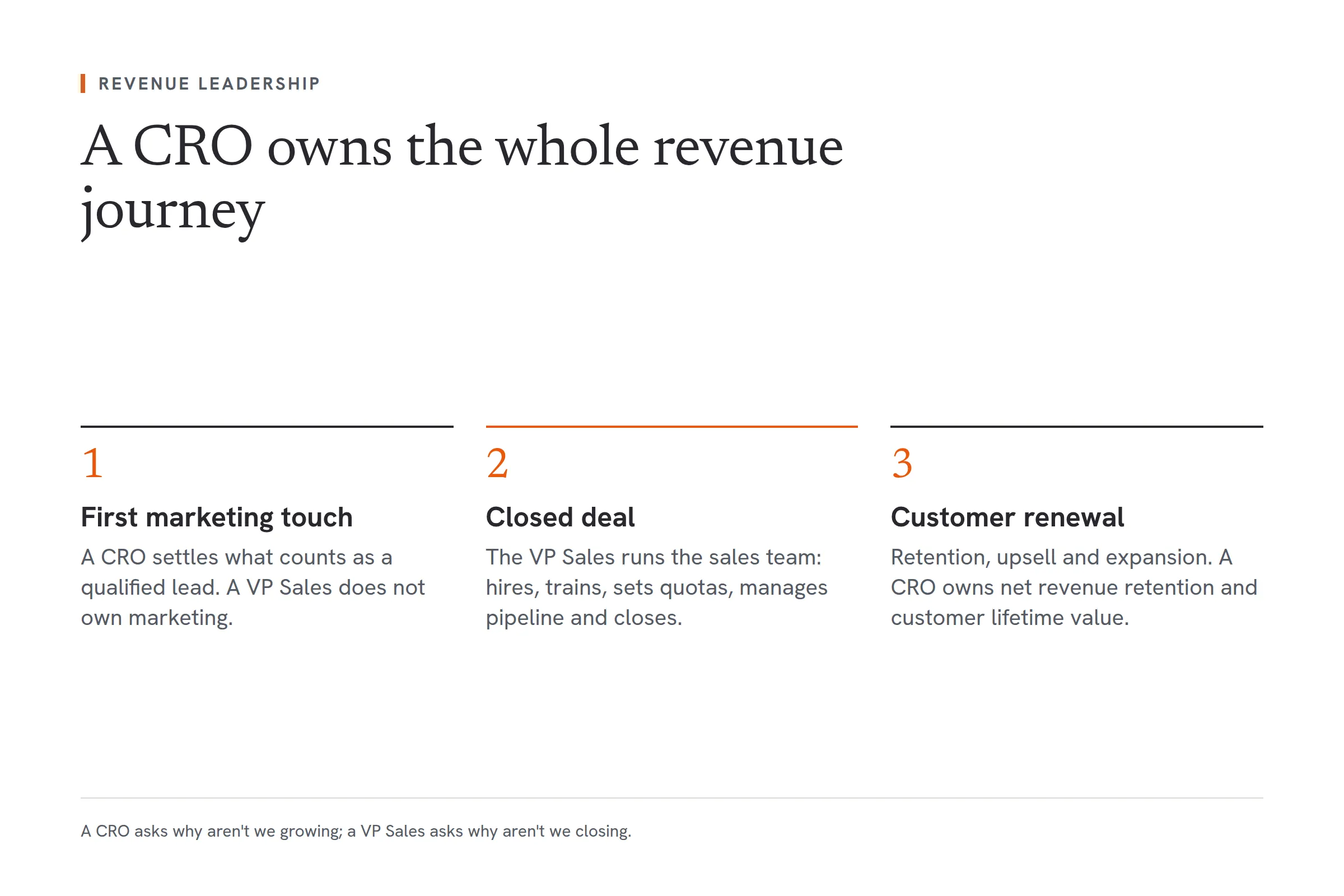
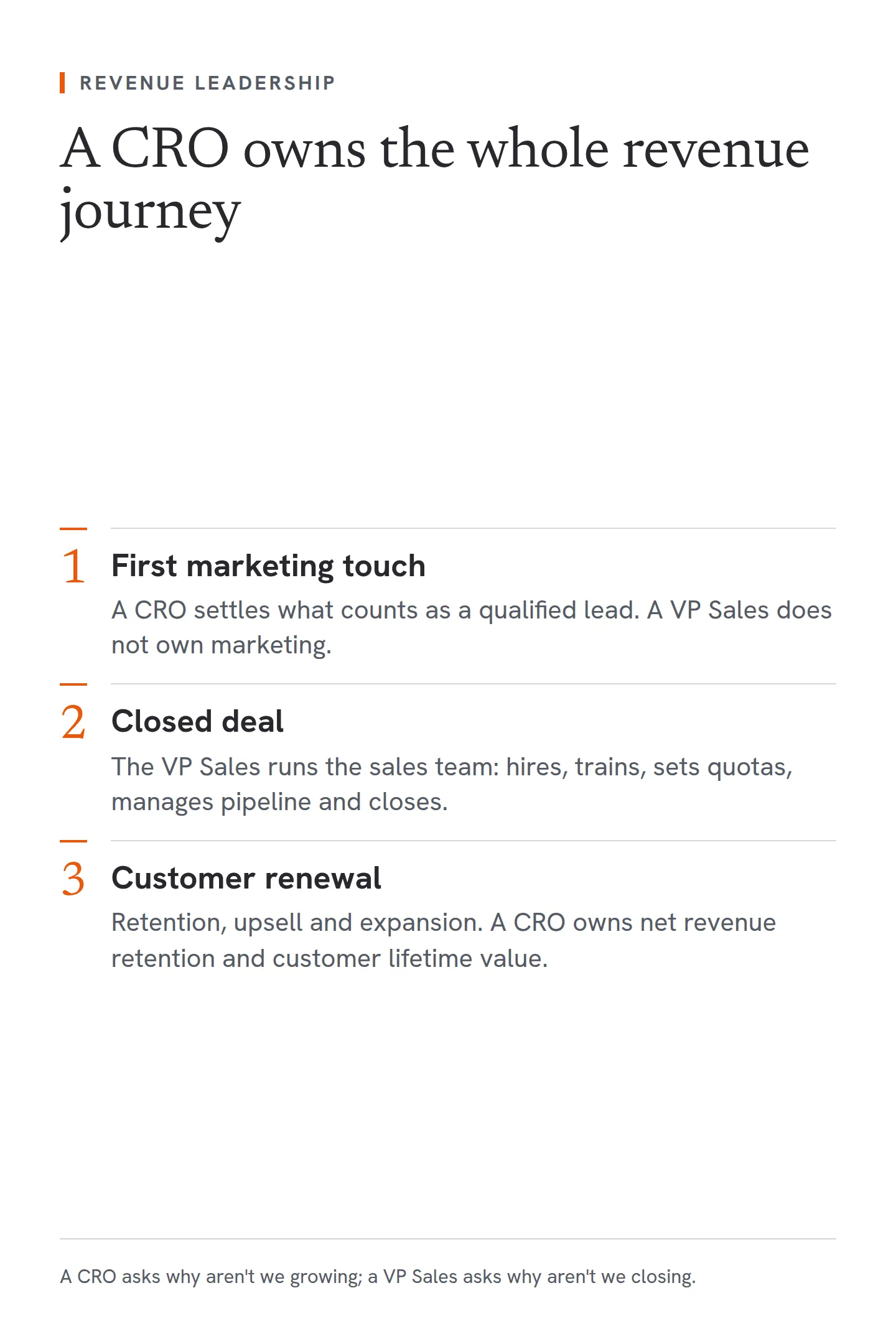
A Chief Revenue Officer owns the entire revenue path, from first marketing touch to closed deal to customer renewal. That's the key distinction. They don't just run the sales team. They're responsible for aligning sales, marketing, and customer success into a single, coherent system.
In practice, a CRO will ask: why are leads coming in from marketing but dying in the sales pipeline? Why are we closing deals but losing customers at renewal? Where exactly is the revenue leaking? They own the metrics that span the whole customer lifecycle: pipeline velocity, customer acquisition cost, customer lifetime value, net revenue retention.
This is genuinely hard work. Getting marketing and sales to agree on what constitutes a qualified lead is, in our experience, one of the great unsolved problems of business. A CRO's job is to settle that definition and then hold both teams accountable to the same number.
What does a VP Sales actually do?
A VP Sales is more focused. They run the sales team. Full stop. They hire, train, set quotas, manage pipeline, coach reps, and make sure deals close. It's an execution role, not a strategic coordination role.
That doesn't make it less important. A great VP Sales will systematise your sales process, lift conversion rates, and build a team that can hit targets consistently. If your revenue problem is that your sales team is inconsistent, poorly managed, or lacks process, a VP Sales is exactly what you need.
The confusion happens because many people use "VP Sales" and "CRO" interchangeably. They're not the same. A VP Sales reports into the revenue function. A CRO owns it.
The actual differences
The simplest way to think about it: a CRO asks "why aren't we growing?" and a VP Sales asks "why aren't we closing?"
| CRO | VP Sales |
|---|---|---|
Scope | Sales + marketing + customer success | Sales team |
Focus | Revenue strategy | Sales execution |
Key metric | Customer lifetime value | Quota attainment |
Reports to | CEO | CRO or CEO |
A VP Sales can report to a CRO. That's actually the natural structure as companies scale. But if you only have one revenue leader, the question is which problem you're trying to solve.
When Dubai businesses need a CRO
You need a CRO when your revenue problem isn't just about closing deals. Common signs we hear from founders:
Marketing says they're generating leads. Sales says the leads are rubbish. Nobody agrees on what the number should be. These are alignment problems, not execution problems. No VP Sales can fix them, because they don't own marketing.
SaaS and subscription businesses almost always need CRO-type thinking, because revenue doesn't just come from new sales. It comes from retention, upsell, and expansion. If nobody owns the whole picture, you'll optimise one part and damage another. It's the leakage pattern to look for in revenue growth work before choosing between a CRO and a VP Sales.
Dubai's market also has particular complexity. Many B2B businesses here operate across the UAE, GCC, and sometimes further into Africa and South Asia. Managing a revenue function across those markets, with genuinely different buyer behaviours, needs strategic coordination, not just sales management.
If your business has multiple revenue streams, is expanding regionally, or has a customer success problem as much as a sales problem, you need someone who sees the whole board. That's a CRO.
When Dubai businesses need a VP Sales
You need a VP Sales when the problem is simpler: your sales team isn't performing. Deals are stalling. Conversion rates are poor. New reps take too long to ramp. There's no consistent methodology.
This is actually the more common situation for Dubai SMEs. The founder has been selling personally and hasn't built a repeatable process. Or the team has grown but nobody has installed proper pipeline discipline. Or you're about to scale and need someone who can hire and train quickly.
For transactional sales models, where deals are relatively straightforward and the sales cycle is short, you rarely need CRO-level strategic coordination. A sharp VP Sales who can systematise execution is the right hire.
The Dubai B2B context
Dubai's sales culture is heavily relationship-driven. This matters when you're thinking about which role to prioritise. In many markets, a strong CRO can implement automated demand generation and reduce dependence on individual relationships. In Dubai, that's harder. Relationships are genuinely a competitive moat, and they take time to build.
Sales cycles in government, semi-government and enterprise accounts tend to be long, so pipeline management discipline is genuinely important. A VP Sales who can manage a pipeline that runs for many months without losing momentum is worth a great deal.
Regional expansion from a Dubai base adds another layer. Companies expanding into Saudi Arabia, Egypt, or further afield often find that what worked in Dubai needs significant adaptation. That's where CRO-level thinking earns its keep, because your marketing approach and your sales approach need to be redesigned together, not separately.
Where RevOps fits
Revenue Operations (RevOps) is the function that runs the shared process, data and tooling behind sales, marketing and customer success. It covers CRM hygiene, lead and stage definitions, forecasting, reporting and the handoffs between teams. It's neither a CRO nor a VP Sales, but both depend on it.
A CRO sets the revenue strategy and the definitions RevOps maintains: what counts as a qualified lead, when an opportunity moves stage, what "renewal at risk" means. A VP Sales relies on RevOps for clean pipeline data and a forecast the board can trust. In an SME, RevOps is rarely a team. It's usually one analyst, or part of a fractional CRO's remit in the first months.
The CRM is also where your obligations under the UAE Personal Data Protection Law sit. The law has been in force since 2 January 2022, and customer and prospect data held in your CRM falls within it, so consent and opt-out handling belong in the revenue system design from the start. For B2B prospecting, DataReportal's 2026 UAE report counts 10.0 million LinkedIn members, which is why outbound and social selling are a routine part of the sales motion here.
The fractional option is worth serious consideration
Here's the thing that most articles on this topic won't tell you. For many Dubai SMEs, hiring a full-time CRO or VP Sales is expensive, risky, and probably unnecessary.
A senior CRO's package can be hard for a growing SME to justify, and if you get the hire wrong you lose months and salary while the problem compounds. A full-time hire also brings an employment visa, insurance and end-of-service liability. A fractional engagement is business to business with one month's notice, and our engagements typically run 30 to 60% less than a full-time hire.
A fractional CMO working alongside a part-time VP Sales can deliver much of the revenue coordination a CRO would. A dedicated fractional CRO may be the better fit when retention and expansion revenue matter as much as new sales. The model suits businesses with both a marketing gap and a sales process problem that can't afford two senior hires at once.
The fractional model suits the UAE market because it gives you strategic seniority without the permanent overhead. It's also where hiring is heading. Heidrick & Struggles reports that small and medium companies now account for more than four-fifths of demand for high-end interim talent, and that 42% of interim engagements now last longer than six months, up from 27% in 2021. Those figures cover interim leaders across functions, not revenue roles alone. Even so, they show senior part-time leaders being used as strategic partners, not stopgaps.
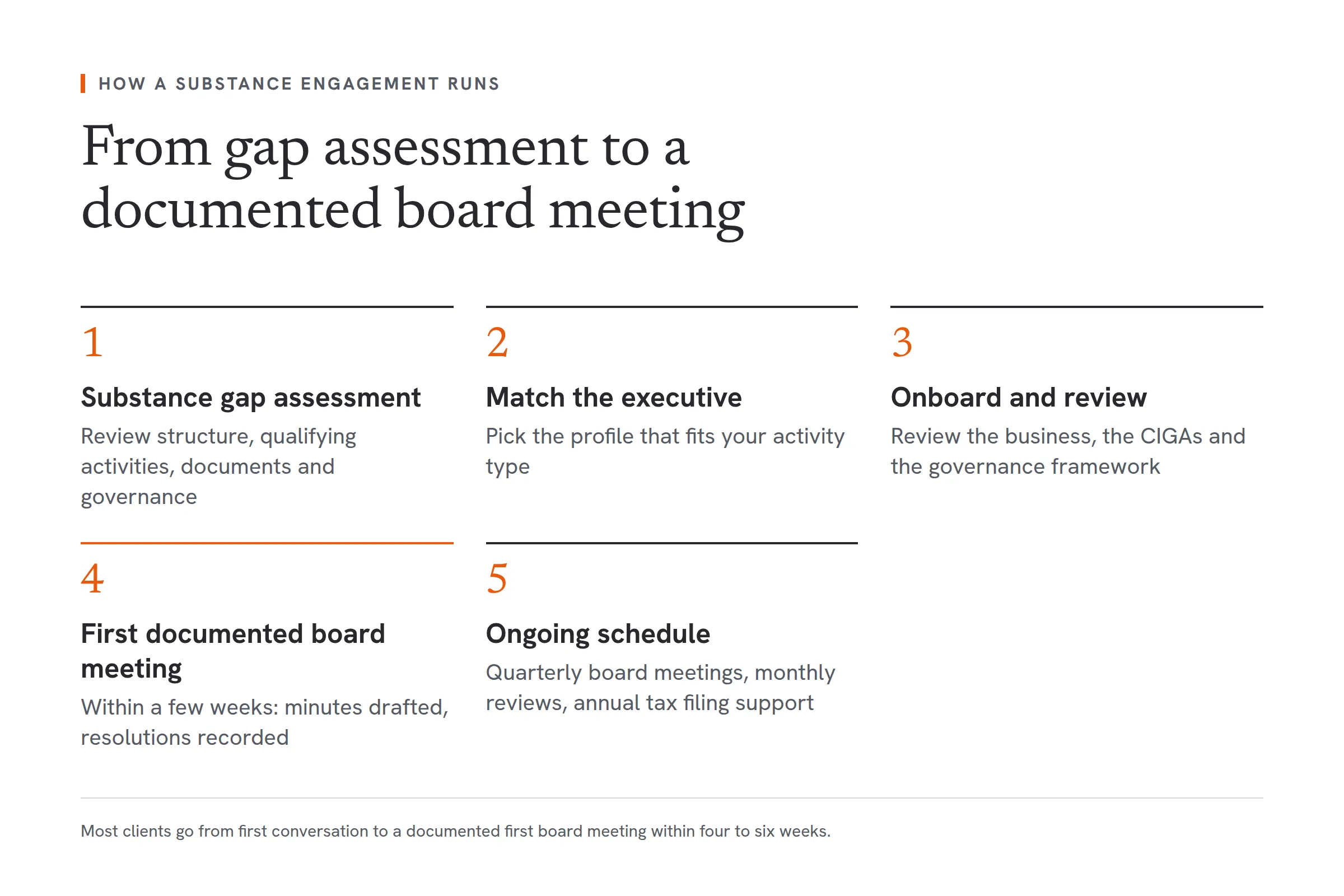
You get someone who has solved this problem before, can install systems quickly, and can step back once the function is working. Engagements typically run four to 24 hours per week over six to twenty-four months, and the executive owns the outcomes while we provide support, structure and governance.
If you're not sure which type of revenue leadership you actually need, take our fractional CRO readiness assessment or the broader fractional executive readiness assessment.
Making your decision
Ask yourself one question: is my revenue problem strategic or executional?
If sales and marketing are misaligned, if customer retention is hurting your growth, if you have multiple revenue streams that nobody is coordinating, that's a strategic problem. You need CRO-type leadership. Our guide to CMO versus CRO roles explores a related distinction for marketing-heavy businesses.
If your sales team is underperforming, your pipeline lacks discipline, and your process is inconsistent, that's an executional problem. You need a VP Sales.
And if you're honest that you need both but can't justify two senior hires, the fractional model gives you a practical way through. Understanding what your business actually needs before you hire anything is the most valuable thing you can do.
Name the problem first. Then hire for it.
FAQs
Can a VP Sales become a CRO? Yes, and this is a natural progression. A VP Sales who shows strategic thinking and the ability to work across functions is a strong CRO candidate. But don't assume the promotion is automatic. The skillsets are genuinely different.
Where does RevOps fit? RevOps runs the process, data and tooling that sales, marketing and customer success share. The CRO sets the strategy and definitions, the VP Sales depends on the data, and in a small business RevOps is often one analyst or part of a fractional CRO's remit.
Do small Dubai businesses need a CRO at all? Not always. If you have a straightforward sales model and a single revenue stream, a VP Sales is usually sufficient. CRO-level thinking becomes valuable when your revenue architecture gets more complex.
What does a fractional CRO actually do day-to-day? In a fractional engagement, a CRO typically spends time diagnosing revenue leaks, aligning marketing and sales processes, and installing measurement frameworks. They're not managing the team daily. They're building the system.
How do I know if my problem is sales execution or revenue strategy? If your pipeline is full but deals aren't closing, it's probably execution. If your pipeline is inconsistent, or customers are churning after closing, it's probably strategic. Often it's both, which is why the fractional model is attractive.
Ready to work out which revenue leader your business actually needs? Talk to the Fractional Dubai team and we'll help you diagnose the problem before you hire for the solution.