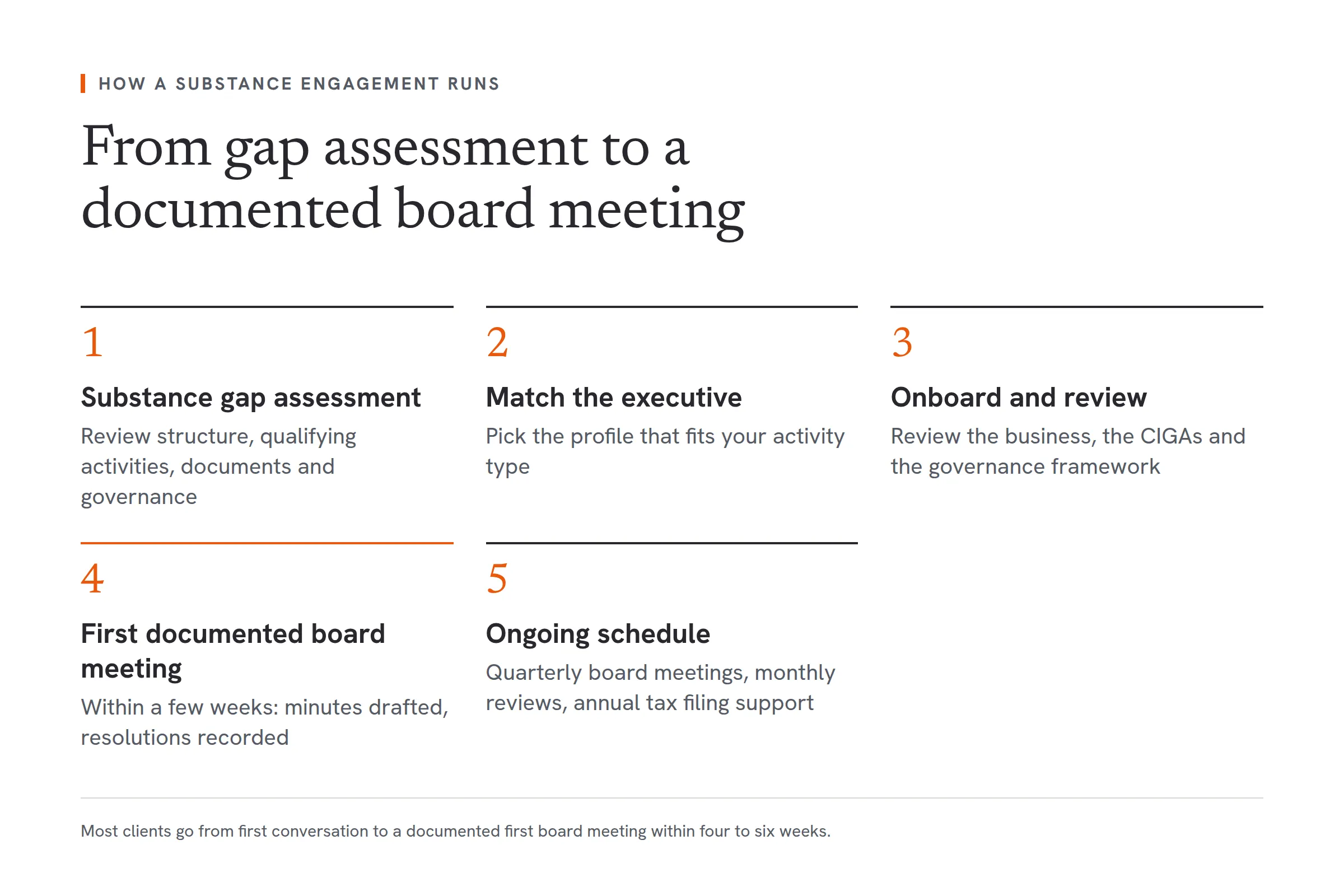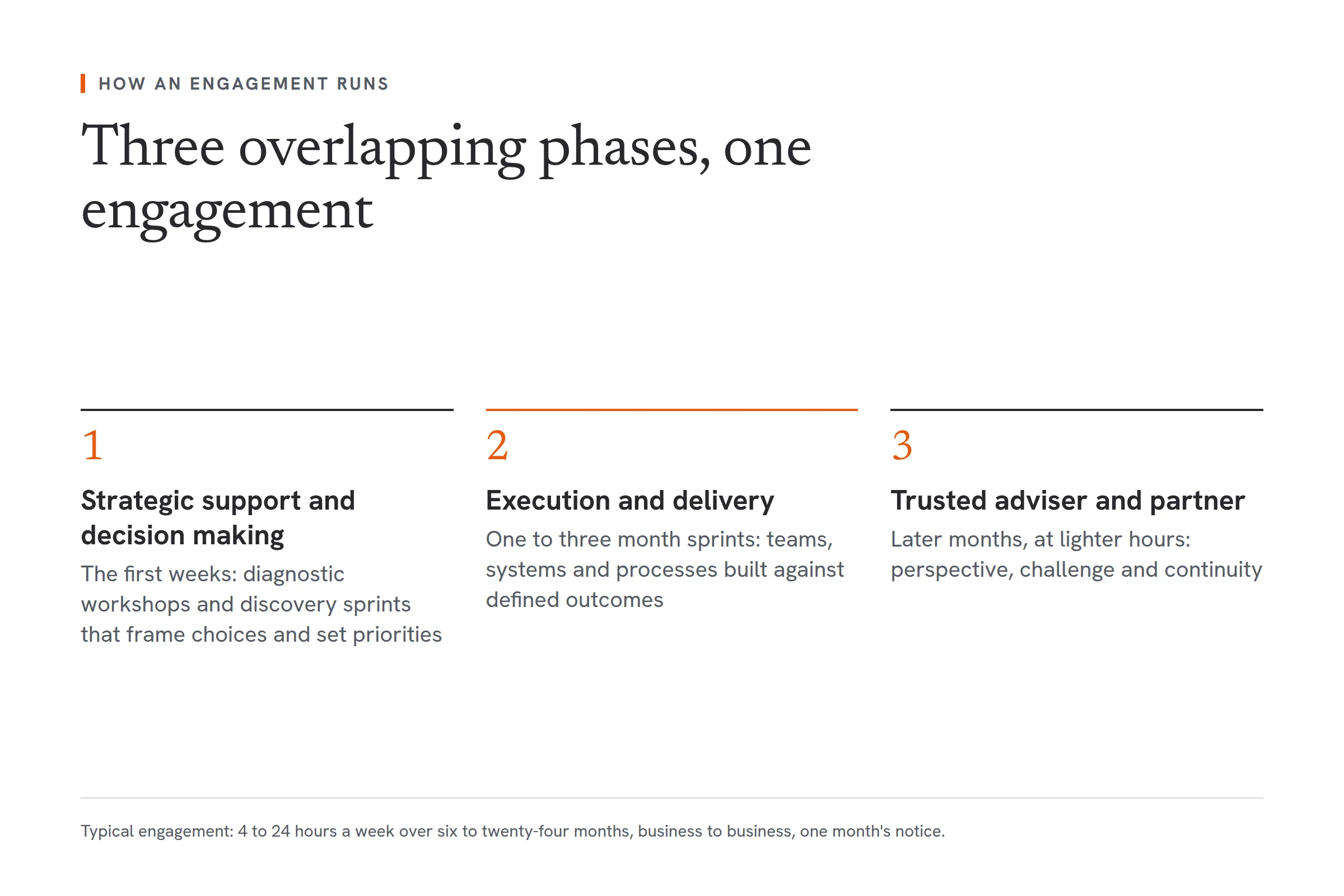
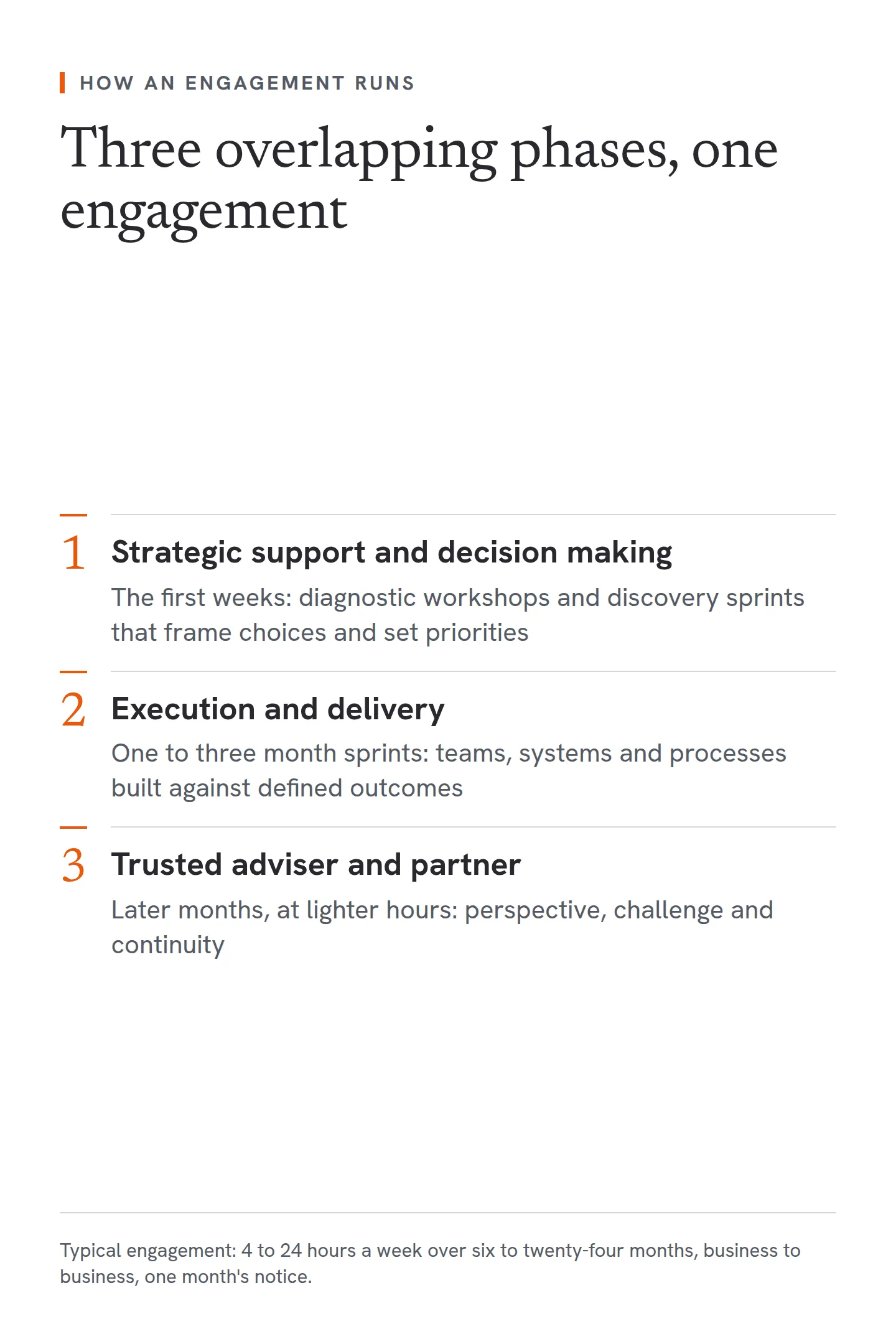
In short: A fractional engagement follows three overlapping stages: strategic support at the start, execution and delivery in the middle, and a trusted adviser role once the foundations are set. A typical engagement is 4 to 24 hours a week over six to twenty-four months, business to business, with one month's notice.
A fractional engagement is not a single project with a fixed end. It follows a lifecycle in three overlapping stages: strategic support at the start, execution and delivery in the middle, and a trusted adviser role once the foundations are set. Understanding it helps you get the right support at the right time as your needs change. Fractional leadership needs a spectrum of skills, and this pattern is how they are usually deployed.
The basis for any productive relationship is trust. As the saying goes:
Trust is not just given, it has to be earned
At each stage, the executive's job is to demonstrate value: that they are listening, that they understand what you are trying to achieve and that they have a solution. As incremental value is delivered, trust builds and perceived risk diminishes.
The terms around the lifecycle
The stages sit inside a simple commercial frame. A typical engagement is 4 to 24 hours per week over six to twenty-four months. It is business to business, with one month's notice either way, so there is no employment visa to sponsor, no end-of-service liability and no insurance burden. We can deploy within weeks.
The length is not unusual for outside leadership. In Heidrick & Struggles' Talent Lens Survey, 42% of interim engagements now last longer than six months, up from 27% in 2021. The survey covers independents globally and is weighted to North America, so treat it as a signal of direction, not a UAE measure. Within a long engagement, the work moves through three stages.
Stage | Typical timing | What happens |
|---|---|---|
Strategic support and decision making | The first weeks | Diagnostic workshops and discovery sprints that frame choices and set priorities |
Execution and delivery | 1 to 3 month sprints | Teams, systems and processes built against defined outcomes |
Trusted adviser and partner | Later months, at lighter hours | Perspective, challenge and continuity, often seeding the next cycle |
Lifecycle in action
1. Strategic support and decision making
Early on, founders and CEOs face ambiguity and noise. This stage is about cutting through complexity, framing choices and setting priorities that align with long-term vision, not just immediate pressure. It takes the form of short, sharp diagnostic workshops or discovery sprints focused on strategic solutions to immediate risks or blockers to growth.
Whether you need on-demand CTO expertise for technology decisions or flexible COO support for operational strategy, this first phase establishes the foundation for long-term value. Founders at scale-ups facing their first C-suite hire decision often begin here rather than committing to a full-time executive too early.
2. Execution and delivery
Ideas without momentum stall. This stage is about translating strategy into action: building teams, systems and processes that can scale sustainably, while keeping delivery sharp and measurable. The focus is execution with well-defined outcomes over meaningful timescales, and 1 to 3 month sprints work well.
This is where fractional executives differ from traditional consultants: they are embedded in your business and accountable for outcomes, not just recommendations. The executive owns those outcomes; we do not simply make an introduction and step away, we provide the support, structure and governance for both the business and the executive to succeed. From strategic marketing leadership to financial planning and execution, fractional executives drive tangible results.
3. Trusted adviser and partner
Once foundations are set, founders often need perspective more than direction. Here, the role shifts to confidant and challenger, balancing empathy with objectivity and helping leaders navigate the isolation of decision-making at the top. Continued strategic guidance and experience on demand is critical to maintain momentum. Impartial objectivity and support for founders and CEOs are central to a successful strategic decision-making process.
This advisory relationship becomes particularly valuable when executive decision paralysis sets in or when navigating critical business partnerships.
The virtuous circle
Moving through the lifecycle stages with a client to a retained adviser position does not end the process. It can be the starting point for the next cycle. There are always challenges to solve, risks to mitigate and opportunities to meet. The cycle starts again, compounding the value already generated from a relationship based on alignment and trust.
This continuous cycle is what makes fractional leadership a sustainable model for growing businesses: you get the expertise you need, when you need it, building on an established foundation of trust and proven results. And because notice is one month either way, the scope can be scaled up, down or out as the business changes.
Ready to explore how fractional leadership can support your business journey? Whether you need strategic guidance, hands-on execution or ongoing advisory support, talk to us about matching you with the right executive. Take our fractional executive readiness assessment, learn more about when your business needs a CXO, or see the full range of fractional executive services.