In short: A Chief Operating Officer (COO) runs the whole operating system; a General Manager runs one location or unit and owns its P&L. Hire a COO when the problem is company-wide systems and scaling, and a general manager when you need someone accountable for a single site or business unit.
A COO runs the whole operating system; a General Manager runs one location or unit. Most Dubai founders confuse the two because both sound like "the person who runs things". They solve different problems, and hiring the wrong one shows quickly.
Here is the honest breakdown.
What a COO actually does
A Chief Operating Officer (COO) owns the whole engine. Not one department. Not one location. All of it.
They work alongside the CEO to turn strategy into execution. If the CEO asks "where are we going?", the COO asks "how do we actually get there?" They build the systems, processes and structures that let the business run without the founder touching everything personally.
In practice: cross-functional coordination, removing growth blockers structurally, and making sure the business can scale without falling apart.
A COO is company-wide, strategic and focused on infrastructure that lasts.
What a general manager actually does
A General Manager (GM) is accountable for a specific slice of the business: a location, a business unit or a product line. They own the P&L for that slice. They lead the team, make day-to-day calls and are responsible for results in their patch.
Think of the GM running your DIFC branch, your Sharjah operation or your franchise outlet in Abu Dhabi. Their focus is execution within their remit, not redesigning how the whole company works.
A GM typically reports upwards to a COO or regional director. They are critical when you have multiple locations or distinct units. But they are not the person fixing how the whole business operates.
The core difference
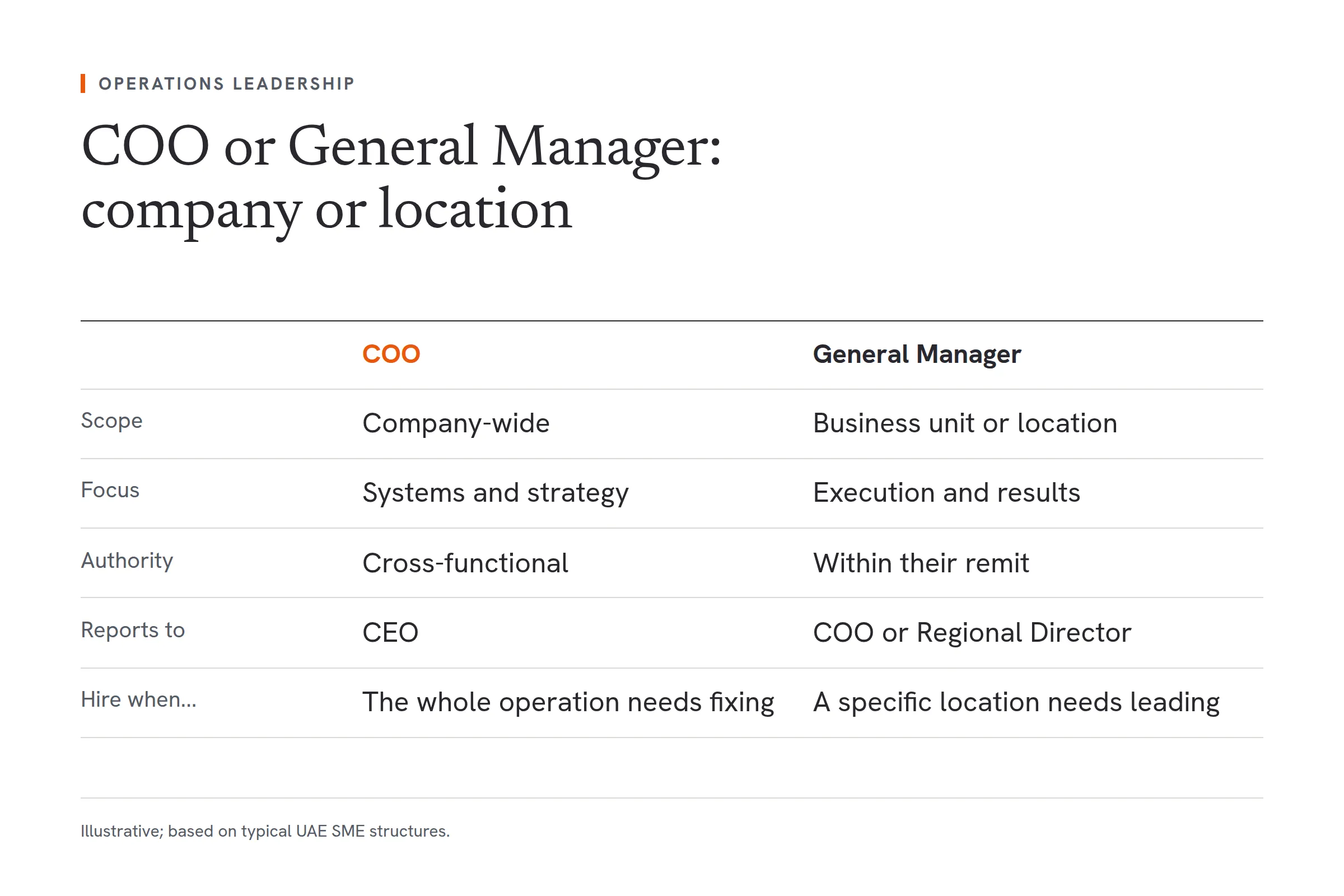
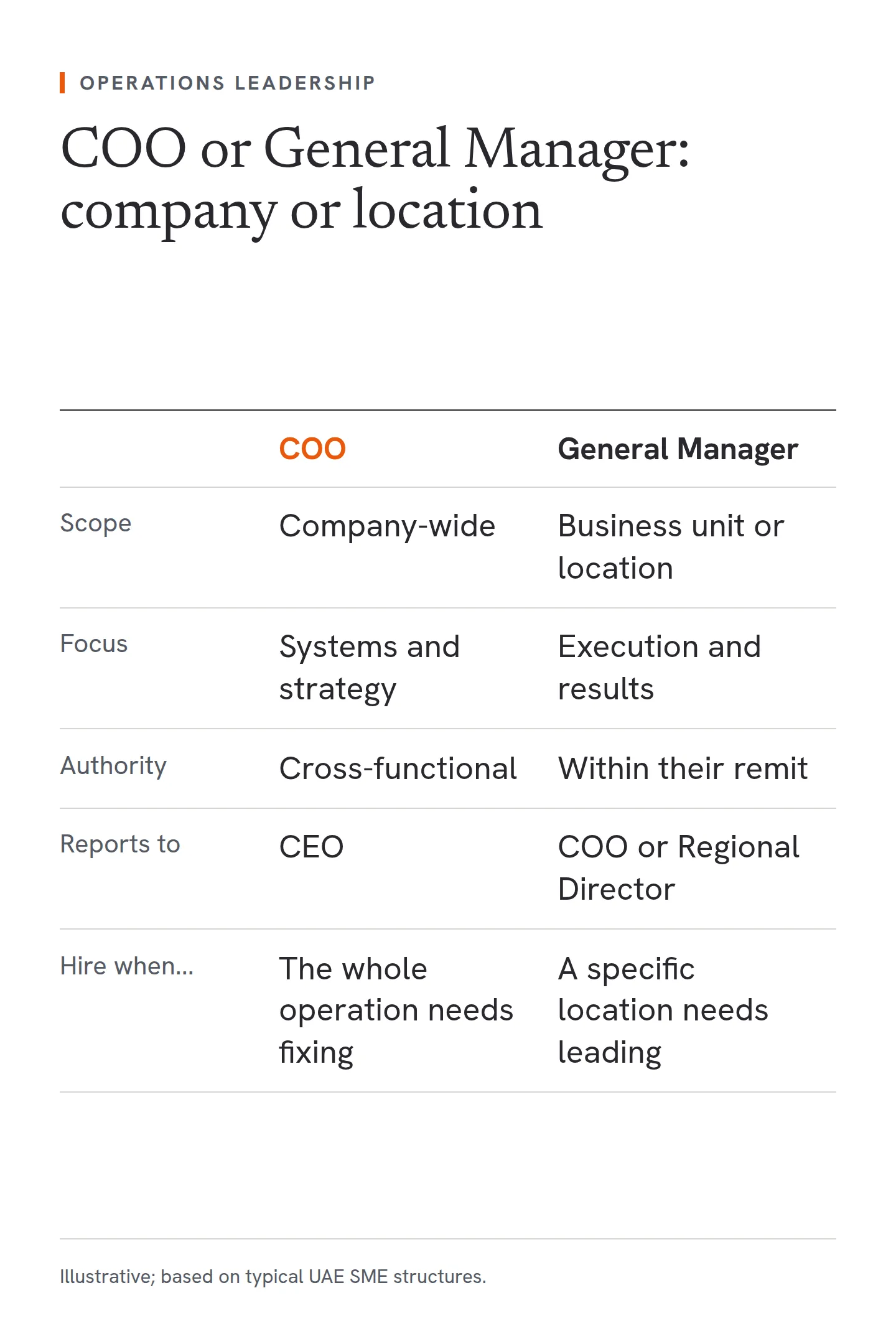
| COO | General Manager |
|---|---|---|
Scope | Company-wide | Business unit or location |
Focus | Systems and strategy | Execution and results |
Authority | Cross-functional | Within their remit |
Reports to | CEO | COO or Regional Director |
Hire when... | The whole operation needs fixing | A specific location needs leading |
The simplest framing: a COO makes sure the company works. A GM makes sure their part of the company works.
What each role costs in Dubai
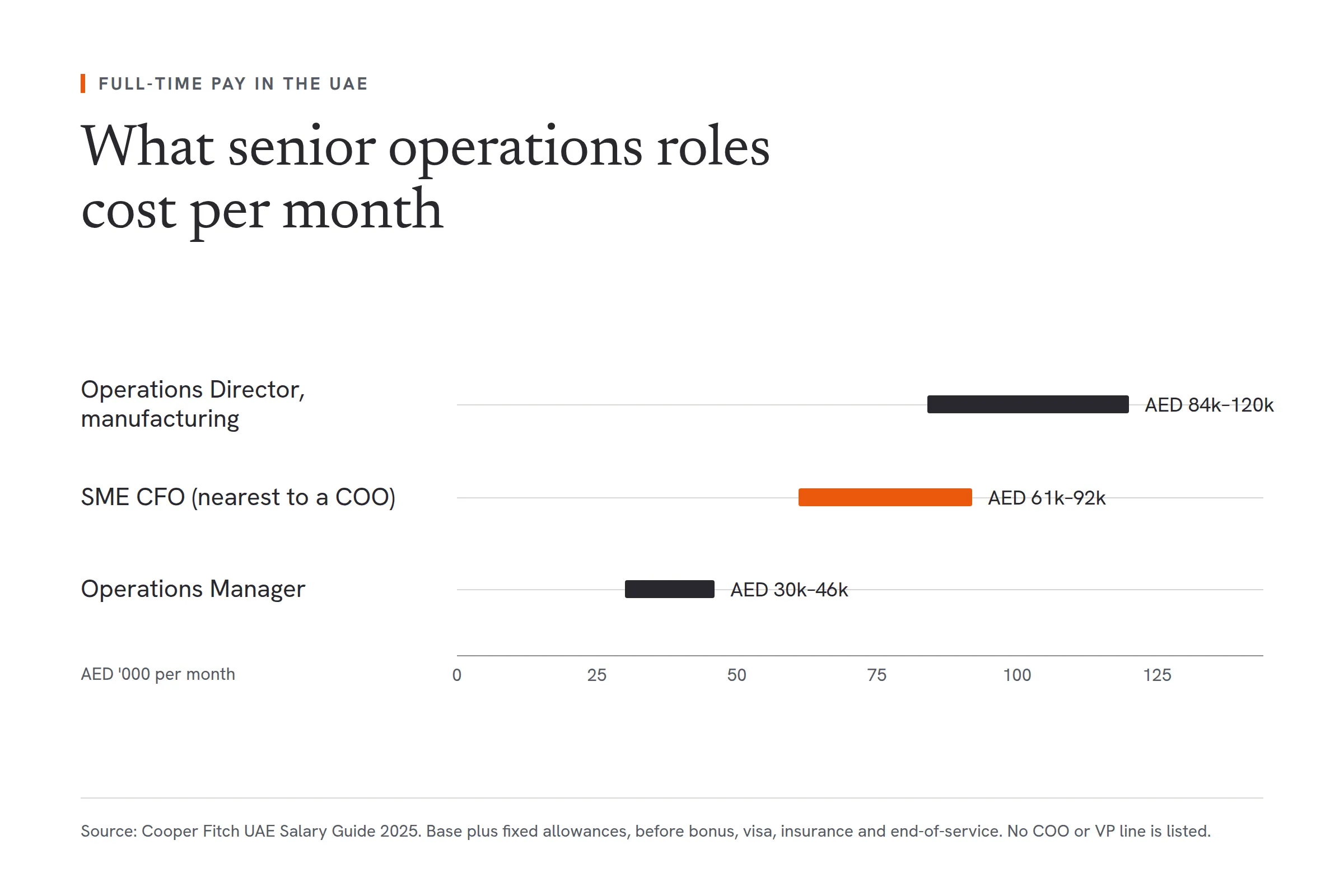
Salary is where many founders get the comparison wrong, because a GM is not a "cheaper COO". Cooper Fitch's 2025 UAE salary guide lists General Managers at roughly AED 55,000 to 99,000 a month depending on sector, for example AED 59,000 to 82,000 in manufacturing. It lists an Operations Director in manufacturing at AED 84,000 to 120,000 a month.
Those figures are base salary plus fixed allowances, before bonus, and exclude visa, insurance and end-of-service costs. The guide has no standalone COO line. The nearest SME benchmark is the Chief Financial Officer, listed at AED 61,000 to 92,000 a month for small and medium enterprises, and a COO sits at similar seniority. Treat these as a range to test your own offer against, not a quote.
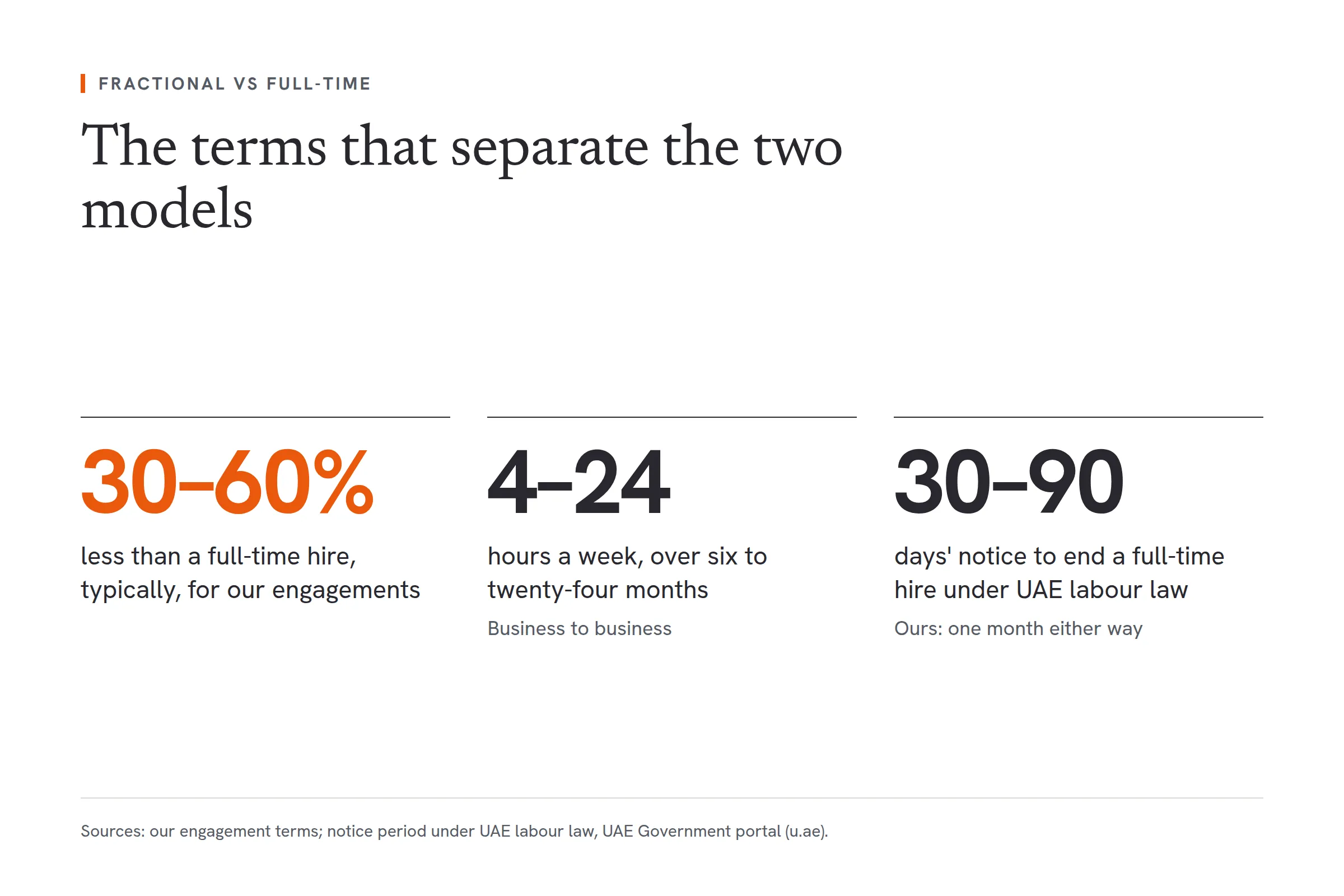
Our engagements typically run 30 to 60% less than a full-time hire, with no employment visa, no end-of-service liability and no insurance burden. That is the practical case for a fractional COO when the problem is company-wide but the workload does not yet justify a full-time seat.
When your Dubai business needs a COO
You need a COO when the problem is company-wide. A few clear signals:
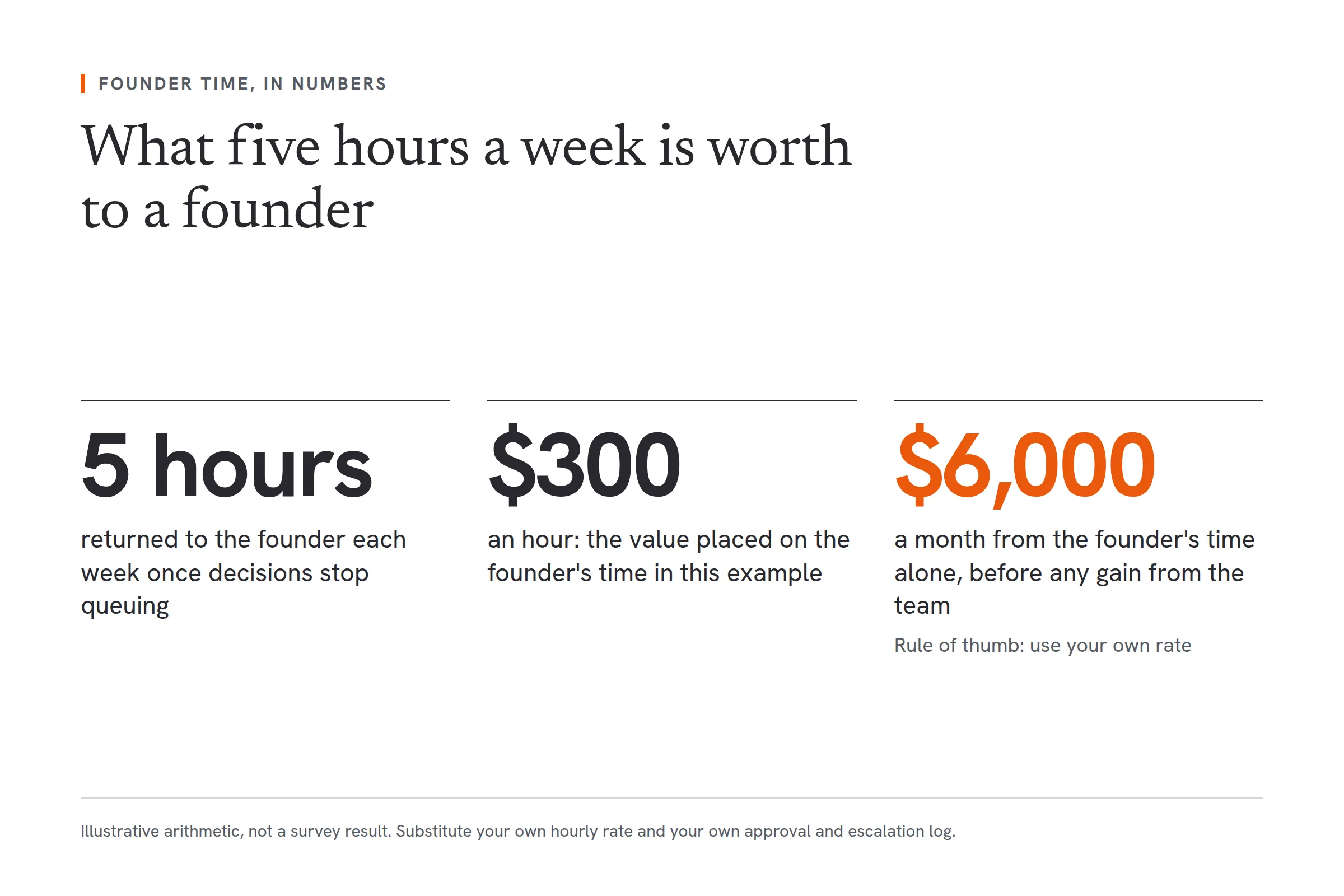
The founder has become the bottleneck. If nothing moves without your input, that is a structural problem, not a time-management problem. We have written about this in detail, because it is one of the most common patterns we see in Dubai SMEs. A COO is specifically designed to break that pattern.
You are scaling across the UAE. Coordinating operations across Dubai, Abu Dhabi and Sharjah at once is genuinely complex. Free zone and mainland structures have different regulators, licensing conditions and compliance requirements. Someone needs to own that coordination at company level. Our COO vs VP Operations comparison helps if you are unsure whether the gap is company-wide strategy or functional execution.
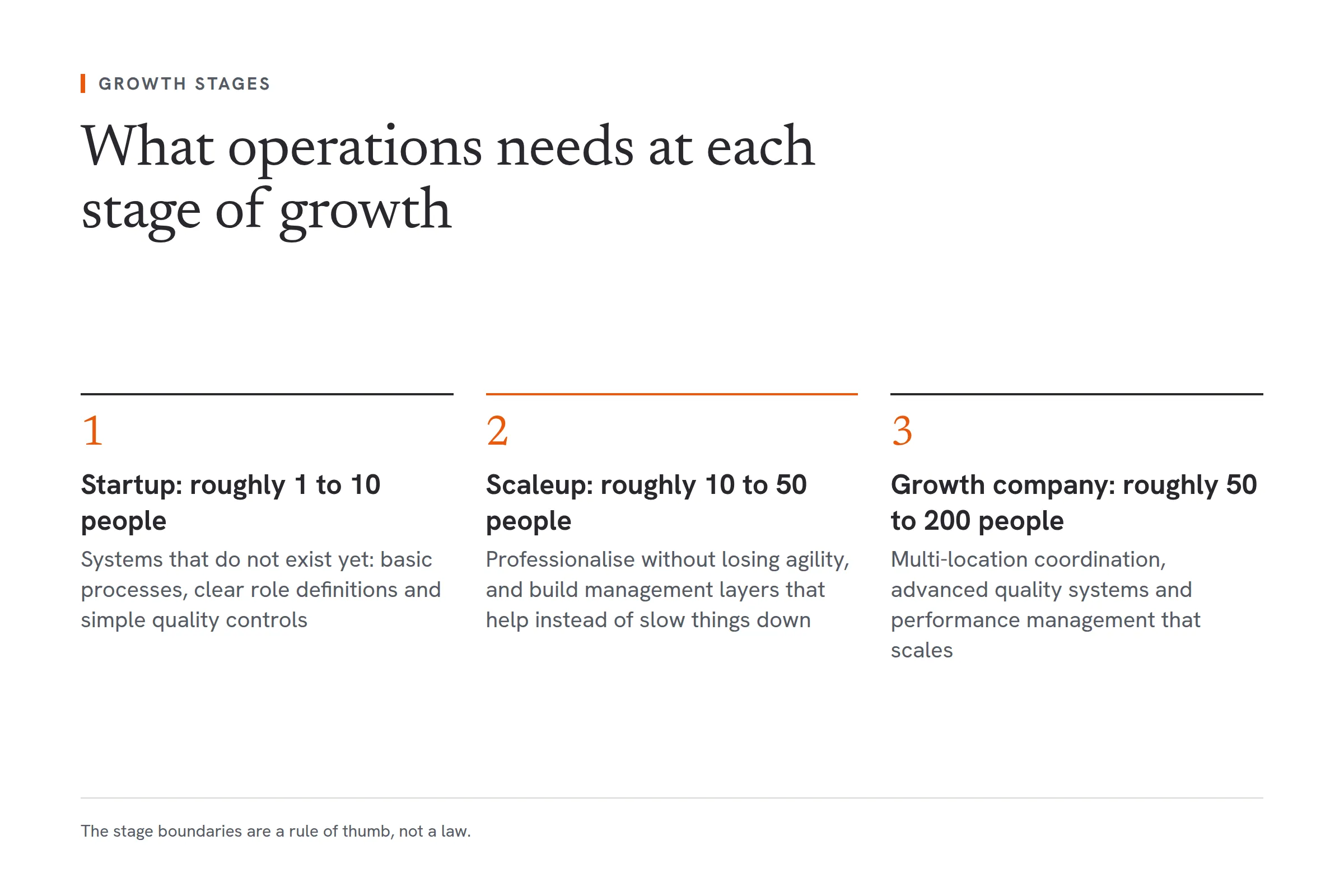
Your systems have not kept up with your growth. The processes that worked at 10 people break at 40. That is a classic SME scaling problem, and it needs a COO, not a site-level GM.
You are not ready, or cannot justify, a full-time hire. This is where most Dubai SMEs land. A fractional COO gives you the same calibre of thinking for the hours your business actually needs.
The fractional model exists precisely for this situation: senior operations leadership without the full-time overhead. Our flexible operations leadership guide goes deeper on how that works in practice.
When you need a general manager instead
A GM makes sense when your business model is inherently multi-location and each location needs its own accountable leader.
Retail chains, F&B groups, franchise operations and regional expansion across the GCC need GMs: someone who knows that site, leads that team and owns those numbers. The real numbers on COO value creation show why portfolio-level coordination becomes essential once complexity outgrows strong site leadership alone.
If you are opening your third restaurant in Dubai, you probably do not need a COO yet. You need strong GMs per site. If you are running ten restaurants and the operational complexity is spiralling, that is when a COO starts making sense.
Dubai-specific scenarios
Free zone vs mainland complexity. Many Dubai companies operate across both, with different regulators and licensing conditions. The UAE Corporate Tax regime also maintains incentives for qualifying free zone businesses that meet the regulatory requirements, so structure matters to the numbers. Coordinating this needs someone thinking company-wide. That is a COO, not individual GMs.
Multi-emirate expansion. Moving into Abu Dhabi or Ras Al Khaimah is not just logistics. It is positioning, relationships and regulatory navigation: strategic operational thinking.
F&B and retail chains. Very common in Dubai. These typically need GMs at each site, plus someone (a COO or equivalent) coordinating standards, supply chain and growth strategy across the whole portfolio. At a certain scale, one person cannot do both jobs well.
E-invoicing across entities and sites. The UAE's electronic invoicing system is being introduced in phases. A business with revenue of AED 50 million or more must appoint an Accredited Service Provider by 30 October 2026 and implement e-invoicing by 1 January 2027. Below that threshold, the original decision sets 31 March 2027 for appointing a provider and 1 July 2027 for going live. If each site raises invoices its own way, a rollout needs one owner above the GMs. That is a company-level operations job.
Can you have both?
Yes, and at a certain size you should. The classic structure is one COO overseeing multiple GMs. The COO sets standards and builds systems; the GMs execute within them.
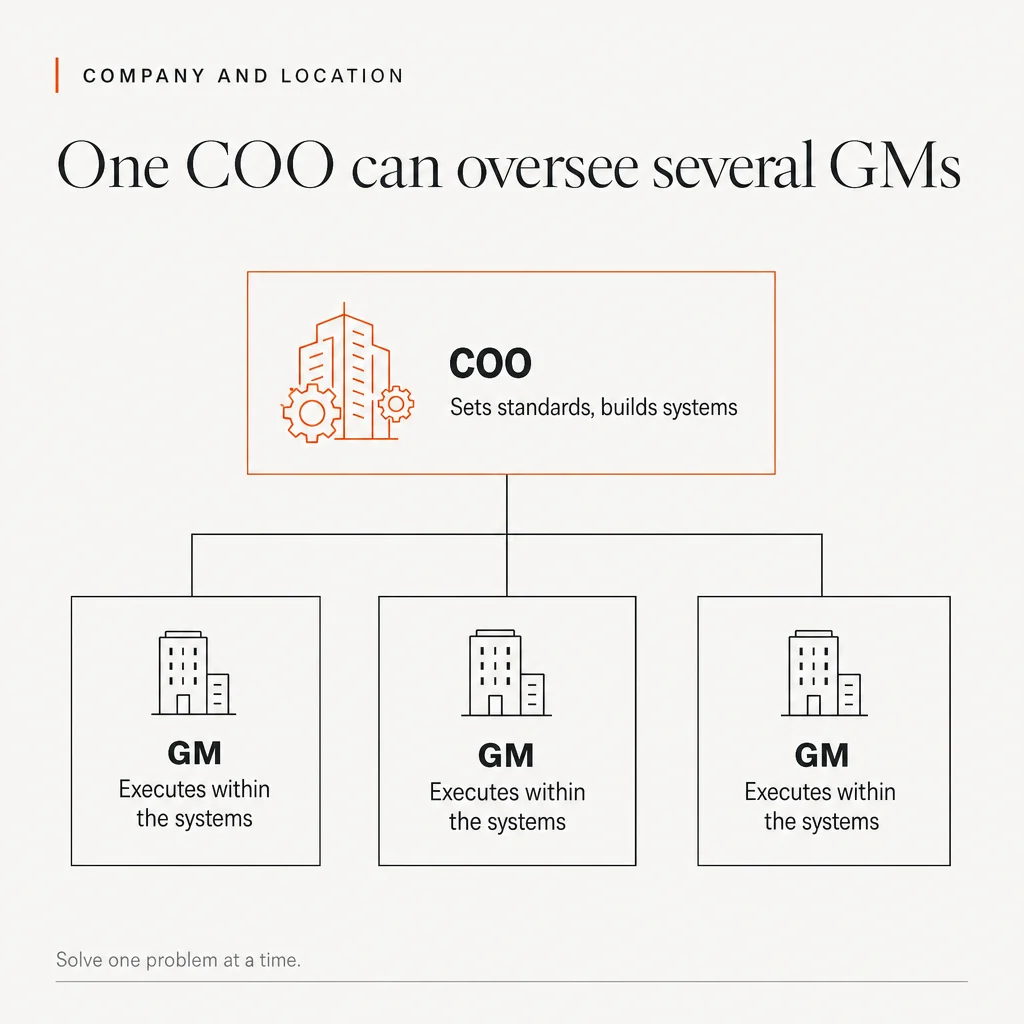
For most Dubai SMEs, though, you are not there yet. Solve one problem at a time. If individual locations run fine but the company struggles to scale, that is a COO problem. If strategy is clear but you need people to run specific locations, that is a GM problem.
Our fractional COO readiness assessment is useful here if you are unsure which problem you are solving.
The simple decision
Ask one question: is the problem I am trying to solve company-wide, or location-specific?
Company-wide (scaling systems, founder bottleneck, cross-functional mess, operational infrastructure): you need a COO. For most Dubai SMEs, a fractional engagement is the right way to access that.
Location-specific (running a site, leading a team, hitting location targets): you need a GM.
If you are not sure, it is worth a conversation before you commit to either hire. Getting this wrong is expensive. Getting it right accelerates everything.
FAQs
What is the difference between a COO and a General Manager? A COO owns company-wide operations strategy and reports to the CEO. A General Manager runs a specific business unit or location, focusing on execution within that remit. COOs build systems; GMs run their patch within those systems.
Does a Dubai SME need a COO or a General Manager? It depends on the problem. If the whole business needs structure, systems or scaling, that is a COO problem. If a specific location needs day-to-day leadership, that is a GM problem. Many Dubai SMEs benefit from a fractional COO before they are ready for, or can justify, a full-time hire.
How much does a fractional COO cost in Dubai vs a full-time hire? Cooper Fitch's 2025 guide puts senior operations and General Manager roles in the tens of thousands of dirhams a month in base salary alone (see the cost section above). Our engagements typically run 30 to 60% less than a full-time hire, structured around the hours your business actually needs.
Not sure which structure your business needs? Explore our fractional COO service or read our guide on scaling operations in Dubai.
Ready to figure out which operations structure your business needs? Talk to the Fractional Dubai team. We will help you work out whether a COO, a GM, or a combination of both is the right answer for where you are right now.