A founder we spoke with recently put it plainly: "I know I should have a board. I do not really know what a non-executive director would do all day." It is a fair question, and the usual answers do not help much. The textbook definitions are written for listed corporates, and the job titles blur together: non-executive director, independent director, board adviser, chair.
This is the plain version, written for the owner of a small or mid-sized business or a scaling company, not for a FTSE audience.
The short answer
A non-executive director is a member of your board who takes no part in running the business day to day. They govern rather than manage. In practice that means four things: bringing independent judgement to the decisions that matter most, challenging and supporting the executive team, satisfying themselves that risk and financial controls are sound, and giving investors, lenders and shareholders confidence that the company is well run.
Note what is not on that list. A non-executive director does not run a function, does not deliver projects and does not own operational outcomes. That work belongs to management. The director's job is to hold management to account for it, and to be the independent voice in the room before a big decision is taken rather than after.
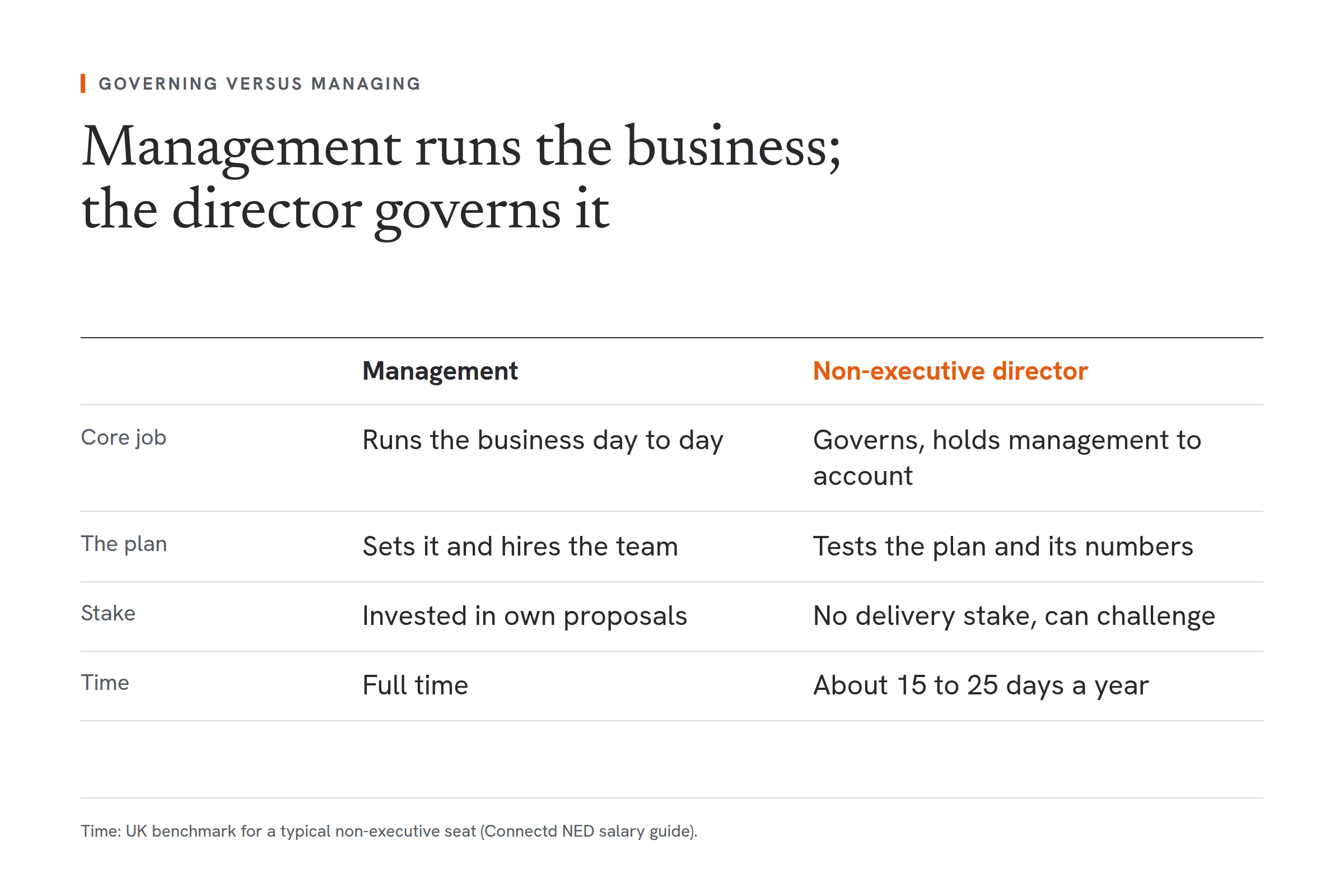
Governing is not the same as managing
The single most useful distinction to hold onto is the one between governing and managing.
Management decides how the business is run and does the running: sets the plan, hires the team, ships the product, closes the deals, watches the cash. A non-executive director sits above that. They ask whether the plan is sound, whether the numbers behind it are real, whether the risks have been thought through, and whether the executive team is the right team to deliver it. They do not take the wheel. They make sure the person at the wheel is being held to a proper standard.
This is why independence matters so much. An executive who also sits on the board is, understandably, invested in their own proposals. A non-executive director has no such stake in day-to-day delivery, which is exactly what lets them say the uncomfortable thing when it needs saying.
What the role looks like in a normal month
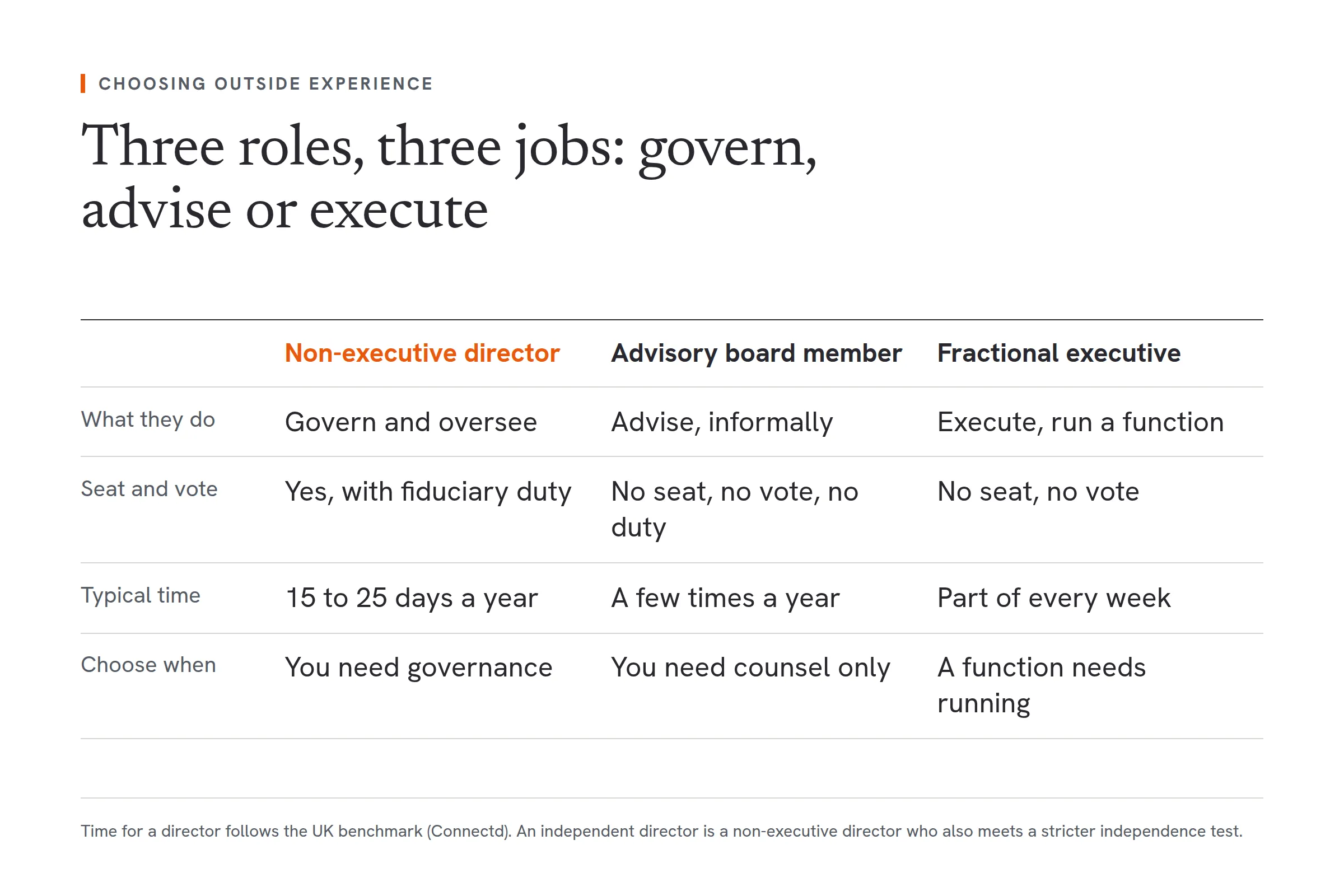
Non-executive work is light-touch by design. A typical seat is about 15 to 25 days a year, or a day or two a month: the board meeting itself, the reading that goes into it, committee work, and being reachable by the chair and chief executive between meetings when a real question comes up.
Across a year, that usually resolves into a handful of moments that matter: signing off the budget and challenging the assumptions in it, pressure-testing a fundraise or an acquisition, being the steady voice through a difficult hire or a difficult quarter, and making sure the founder is not the only person carrying the weight of the largest decisions. The hours are modest. The leverage is in the judgement applied to a small number of important things.
Non-executive director, independent director, advisory board: which is which
Three terms get used interchangeably and should not be.
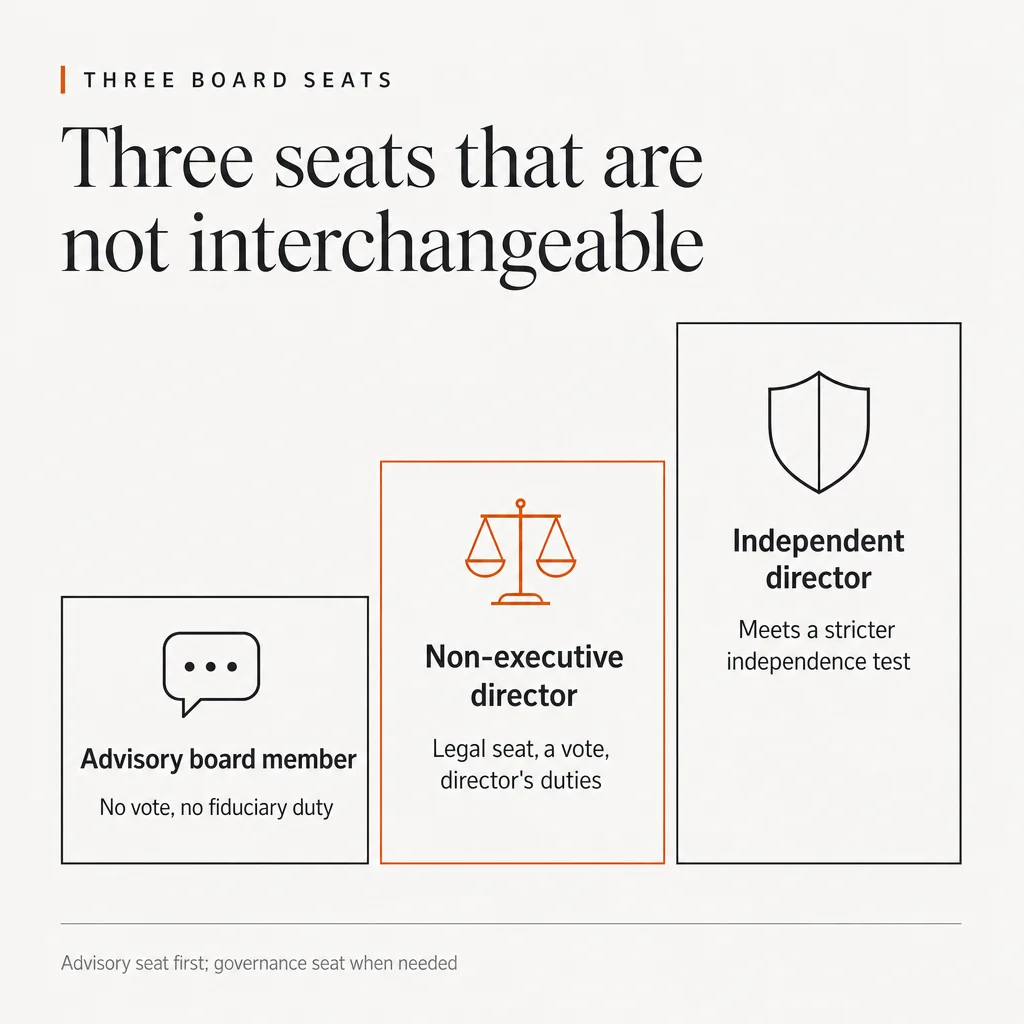
- Non-executive director. Holds a legal seat on the statutory board, carries a director's duties, and has a vote. This is governance in the full sense.
- Independent director. A non-executive director who also meets a stricter independence test: no significant financial, employment, consulting or family ties to the company, its auditor or its major shareholders. In the UAE, the Securities and Commodities Authority (SCA) Governance Guide, as issued in 2020, treats a director as not independent if they worked for the company or its senior management in the previous two years, provide it with consultancy, or hold 10% or more of its capital.
- Advisory board member. Sits on an informal panel, offers counsel, and carries no fiduciary duty and no vote.
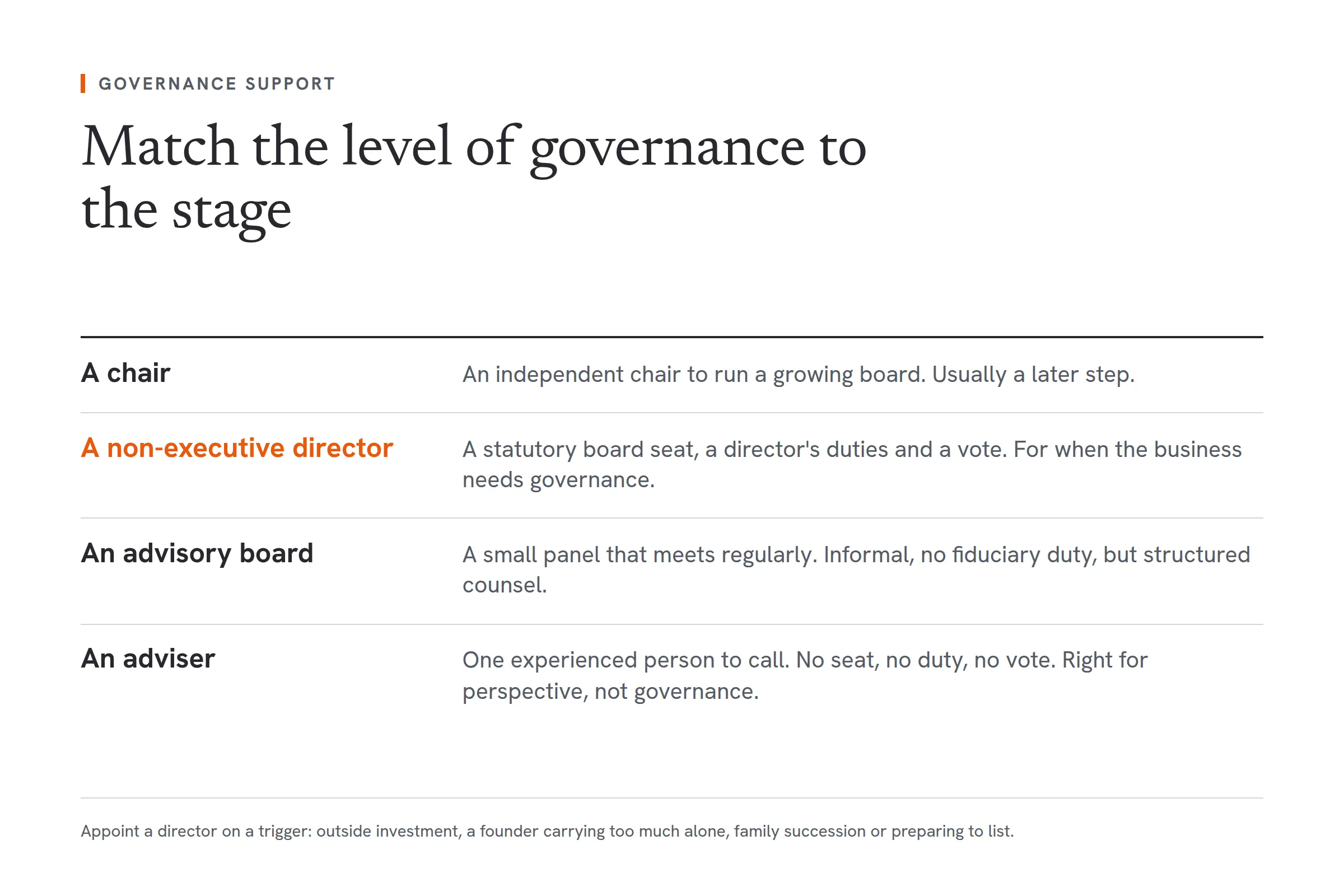
For an earlier-stage company, an advisory seat is often the sensible first step: real experience in the room without the formality of a statutory board. The move to a non-executive director is the right one when the business needs governance rather than only advice, which typically arrives with outside investment, a coming transaction, or simply a level of scale where the founder wants independent challenge as standard. We look at that progression in more detail on our non-executive director search page.
Why UAE businesses are appointing now
Two forces are pushing the question up the agenda locally.
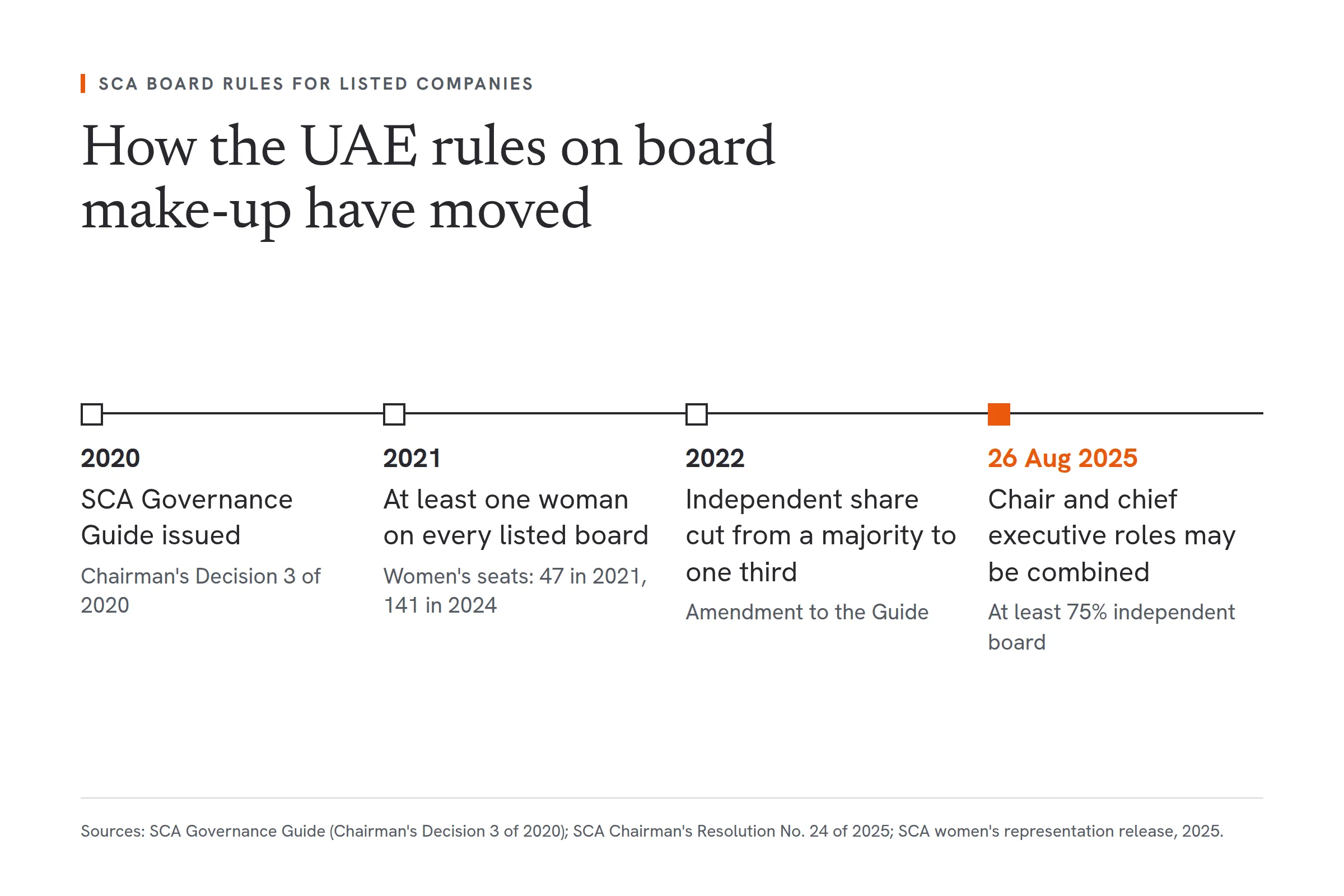
The first is regulatory. For listed public joint stock companies, the SCA requires at least one third of the board to be independent, a majority to be non-executive and at least one woman on the board. In 2025, SCA Chairman's Resolution No. 24 of 2025 (effective 26 August 2025) allowed the chair and chief executive roles to be combined, but only where at least 75% of the board is independent and every permanent committee is fully independent. The UAE's Commercial Companies Law also makes board members of joint stock companies liable for fraud, abuse of power and breaches of the law (Article 162), which is why directors take the seat seriously. Any company that is listed, planning to list, or preparing to raise institutional capital is expected to show a properly composed board. We set the rules out in full in board governance in the UAE.
The second is generational. Many UAE family enterprises are moving from founder-led control towards more formal governance as the next generation and outside capital arrive. An independent director gives those boards an objective view and a way to take the emotion out of sensitive decisions. It is a theme we return to for family businesses and for companies preparing to raise.
What good looks like
A strong non-executive director is not a career committee-sitter collecting seats. The best of them are operators: people who have actually run the functions a board oversees, who have sat where your chief executive sits, and who can therefore challenge with credibility rather than from theory. They bring the scar tissue of having done the job, the independence of no longer doing it, and the discretion a serious boardroom requires.
Matched well, one such appointment changes the quality of the decisions a company makes long before it changes anything on the org chart. That is the whole point of the role, and it is why it is worth getting the person right.
If you are weighing whether your business is at the stage for a non-executive director, or whether an advisory seat is the better first move, tell us what you are working through and we will give you a straight answer. For how the options compare, read non-executive director vs advisory board vs fractional executive.