Headhunters Dubai: fees, how they work, and the alternatives
Published fee guides put a Dubai headhunter's fee at roughly 20–35% of the hire's first-year compensation, paid in stages, and even a well-run search takes weeks, often months [1][2][3]. Search the term and you'll find plenty of firms but few straight answers on price. That's the market you're buying into. For some hires it's exactly right. For plenty of others, it isn't.
Most founders we speak to reach this moment the same way. The business needs serious senior capability. A finance leader before a funding round. An operator after a messy year. So you call a headhunter, hear the fee, see the timeline, and start wondering what else exists.
Good instinct. This guide answers it properly: what executive search costs in Dubai, how the process runs, how to judge a firm, and the alternatives worth knowing, including the fractional model we work in every day.
What is meant by executive search?
Executive search is a confidential, research-led process for filling senior roles: C-suite, board and other business-critical appointments. Rather than advertising and waiting, the firm maps the talent market. It identifies suitable people, including those not looking to move. It approaches them discreetly, assesses them and presents a shortlist [1][4].
The keyword is proactive. A recruiter advertises a role and screens whoever applies. An executive search firm starts from the market itself: who is doing this job well, at which companies, and what might make them move.
This is the formal end of C-suite recruitment. In Dubai, assignments commonly run across the UAE and the wider GCC: succession planning, founding leadership hires, confidential replacements [4]. The common thread is discretion and research, not job boards.
You pay for that depth.
How much do headhunters charge in Dubai?
Published Dubai fee guides put retained executive search at roughly 20–35% of the hire's first-year compensation [1][2]. Around 30% is a reasonable rule of thumb, but it's not a fixed UAE-wide tariff [3]. Fees move with seniority, scarcity, complexity and exclusivity.
There's no verified standard fee for Dubai. What exists is a cluster of ranges firms publish themselves. One Dubai search firm's guide puts retained search at 20–33% of first-year total compensation [1]. Another Dubai guide lists 25–35% of annual salary [2]. Treat 30% as useful shorthand, not a rate card [3].
The structure matters as much as the percentage. Retained fees are usually split into three milestone payments: at briefing, at shortlist, and when the offer is accepted [5][3]. You're financially committed long before anyone starts work.
Check the basis before you sign. Some firms quote a percentage of base salary, others of the full first-year package [1][2]. On the same percentage, that difference is real money.
Until a firm puts a written proposal against your brief, treat every percentage as indicative.
How long a retained search takes
The fee is only half the quote. The other half is time.
Published estimates for a senior Dubai search cluster around 8–16 weeks from briefing to accepted offer [6][5][3]. Regulated DIFC or ADGM appointments, board searches, relocation and long notice periods can stretch that to 16–20 weeks or longer [6][7][3]. The estimates vary between firms, so treat any timeline as a provider estimate, not a promise [2].
What's the difference between a headhunter and executive search?
A headhunter is a person or firm that proactively approaches candidates, usually people already employed and not applying anywhere. Executive search is the broader, structured assignment around that outreach: market mapping, assessment, shortlisting and offer support. In Dubai, the terms are often used interchangeably [1][8].
Headhunting describes a method: going to the people you want rather than waiting for applicants. Executive search describes the engagement around it: a defined brief, research, assessment, a shortlist and support through the offer.
Dubai firms themselves blur the line. Some treat executive search, headhunting and executive recruitment as the same service on their own websites [1]. Nothing about the labels is standardised.
So shop on scope, not vocabulary. Ask what the work covers, how candidates are assessed, what happens if the hire fails, and how the fee is structured. The label on the website tells you almost nothing.
How to choose an executive search firm in Dubai
There is no single 'executive search firm in Dubai'. The phrase describes any firm that recruits senior executives into the emirate, and plenty operate here. The useful question is not which one exists but which one fits your brief. That comes down to a short list of criteria.
Judge any firm, us included, on these:
Vetting depth. How do they assess beyond the CV? Who interviews the candidate, and how many stages happen before you see a shortlist?
Accountability. What are the replacement terms if the hire fails in the first few months? Who owns what after the offer is signed?
Time to start. Ask for a written timeline with milestones. Published estimates for a senior search run to 8–16 weeks, and longer for regulated or board-level mandates [6][3].
Notice and exit terms. What happens if the brief changes halfway through, or you want to stop?
Local knowledge. Dubai senior hiring runs on specifics: DIFC and ADGM regulation, board approvals, relocation and notice periods [6][7][3]. A firm that cannot talk through these has not hired here.
How the fee is charged. Percentage of base salary or the full package, milestone structure, expenses. Get it in writing before you sign anything [1].
Where Fractional fits
Fractional is the fractional executive search partner for SMEs, not a traditional search firm. We match curated C-suite leaders to the stage, sector and challenge of your business, and they embed to deliver outcomes.
Against the criteria above:
- Vetting depth. Every executive in our collective is curated before they join it. In the UAE, the collective numbers nearly 500 of them.
- Accountability. The executive owns the outcomes. We provide the support, structure and governance around every engagement. Embedded, not placed and left.
- Time to start. There's no market-mapping stage, because the executives are already identified, curated and available.
- Notice and exit. Engagements run business to business, on as little as one month's notice.
- Fee. A retainer agreed against the scope. Not a percentage of a full-time salary for a role that isn't one.
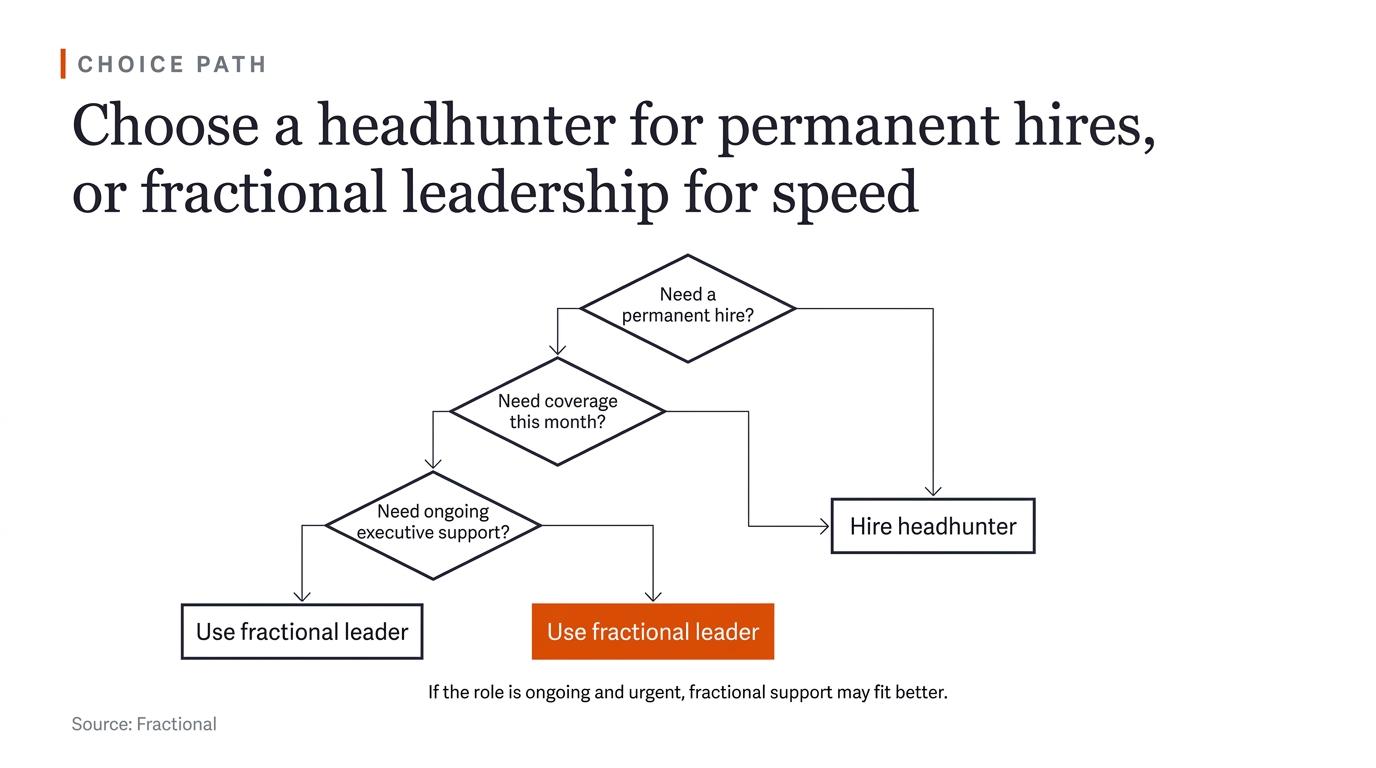
If you're unsure which kind of hire you need, our fractional executive needs assessment walks through the decision in a few minutes.
The alternatives to a traditional headhunter
A retained search is one way to solve a senior hiring problem. It's not the only way, and for most SMEs it's not the obvious one. Around 94% of businesses in the UAE are SMEs, according to the Mohammed Bin Rashid School of Government. The full-time, full-fee executive model was not designed for most of them. Not because they lack ambition, but because their problems rarely arrive five days a week.
And paying a third of a permanent package to solve a part-time problem is like buying the whole building when you need two floors.
Dubai founders have lived through enough sudden swings to know that senior capability can't always wait a full search cycle. A funding winter. A supply shock. A key resignation at the worst moment.
Here are the realistic options at a glance.
| Retained executive search | Contingency recruitment | Interim executive | Fractional executive |
|---|---|---|---|---|
How you pay | Staged retainer, usually three milestones [5][3] | One fee, only if you hire their candidate [5] | Full-time cost for a fixed term | A retainer agreed against scope |
Typical cost | 20–35% of first-year compensation [1][2] | A percentage of salary; varies by firm [5] | Full-time equivalent for the duration | Set by scope, not a percentage of salary |
Typical time | 8–16 weeks, longer if regulated or board-level [6][3] | Often quick to start; CV-led | Full-time presence for the term | No verified average; fewer stages by design |
What you get | A permanent, full-time hire | A permanent, full-time hire | Senior cover, five days a week | A curated C-suite executive, part-time or defined-term |
Who owns the outcome | You own the hire; the firm owns the process | Mostly you | The interim, for the term | The executive, with governance around the engagement |
Suits | Permanent C-suite and board hires | Mid-senior roles, active candidate market | Maternity cover, sudden departures, crises | SMEs needing senior capability without a full-time seat |
Contingency recruitment
Pay on success. The firm sends candidates, and you pay a fee only if you hire one [5]. It can start quickly because it works from active applicants rather than mapping the market. The trade-offs are depth and discretion: lighter assessment, less confidentiality, and more CVs to sift yourself.
It suits mid-senior roles where the candidate market is active and the hire is not sensitive.
Hiring through your own contacts
Referrals, investors, other founders. Free, fast, occasionally brilliant. It's also how businesses end up hiring someone's available former colleague rather than the right person. For a genuinely senior hire, the sample size is simply too small.
Interim executives
A full-time executive on a fixed term. Interim works when the seat itself is the problem: maternity cover, a sudden departure, a crisis that needs someone senior in the chair five days a week. You get full-time cover without a permanent commitment, at a full-time cost for the duration.
Fractional executives
A fractional executive is a C-suite or director-level professional who embeds directly into your business without the commitment of a full-time hire. They advise, execute and are accountable to outcomes.
Say you need senior finance through a funding round, but not five days a week. A fractional Chief Financial Officer (CFO) embeds with your team, runs the numbers and the investor conversations, and owns the result. When the round closes, the engagement flexes with it.
The model is established, not experimental. In 2022, Axios counted roughly 2,000 LinkedIn profiles worldwide with 'fractional' in the title. By early 2025, that count had risen past 142,000. A count of profiles is not a headcount of executives, but the direction is plain.
It's also built for this market. You engage the executive business to business, so there's no employment visa to sponsor, no medical insurance to arrange and no end-of-service liability accruing. Terms can run on as little as one month's notice. That's why maternity cover, a turnaround or a first serious finance hire fits the model so well. And it's why plenty of founders are navigating change, from AI to new regulation, with experienced leadership beside them.
For the detail on how this kind of search runs, contracts and all, read our guide to fractional executive search in the UAE. If you want the direct two-way comparison of fees and timelines, that's here: executive search vs fractional hiring in Dubai. This piece stays with the headhunter market itself.
Sources
[1] Executive Search Firm Dubai: C-Suite & Senior Hiring, Guildhall
[2] Executive Search in Dubai: Complete Guide, Business Umbrella
[3] Executive Search in Dubai: A Guide for Leaders & Job Seekers, Guildhall
[4] Executive Search and Recruitment in Dubai, UAE, Hanson Search
[5] Retained vs Contingency Executive Search in Dubai, Alliance Recruitment Agency
[6] Top 10 Executive Recruiting Firms in Dubai and MENA, Warner Scott
[7] BFSI Executive Search, Dubai / UAE, Gladwin International