Governance is high on the UAE boardroom agenda, and not by accident. The Securities and Commodities Authority (SCA) reworked its rules on board leadership in 2025, family businesses are professionalising as a new generation takes over, and the listing pipeline, though uneven, is still there. The question on many agendas is the same: is our board actually fit for what comes next? This is a plain guide to the answer.
It is written for founders, family principals and finance leaders who need to understand the rules without reading a regulator's rulebook cover to cover. The detail below is sourced, but the aim is clarity, not legal advice.
The short answer
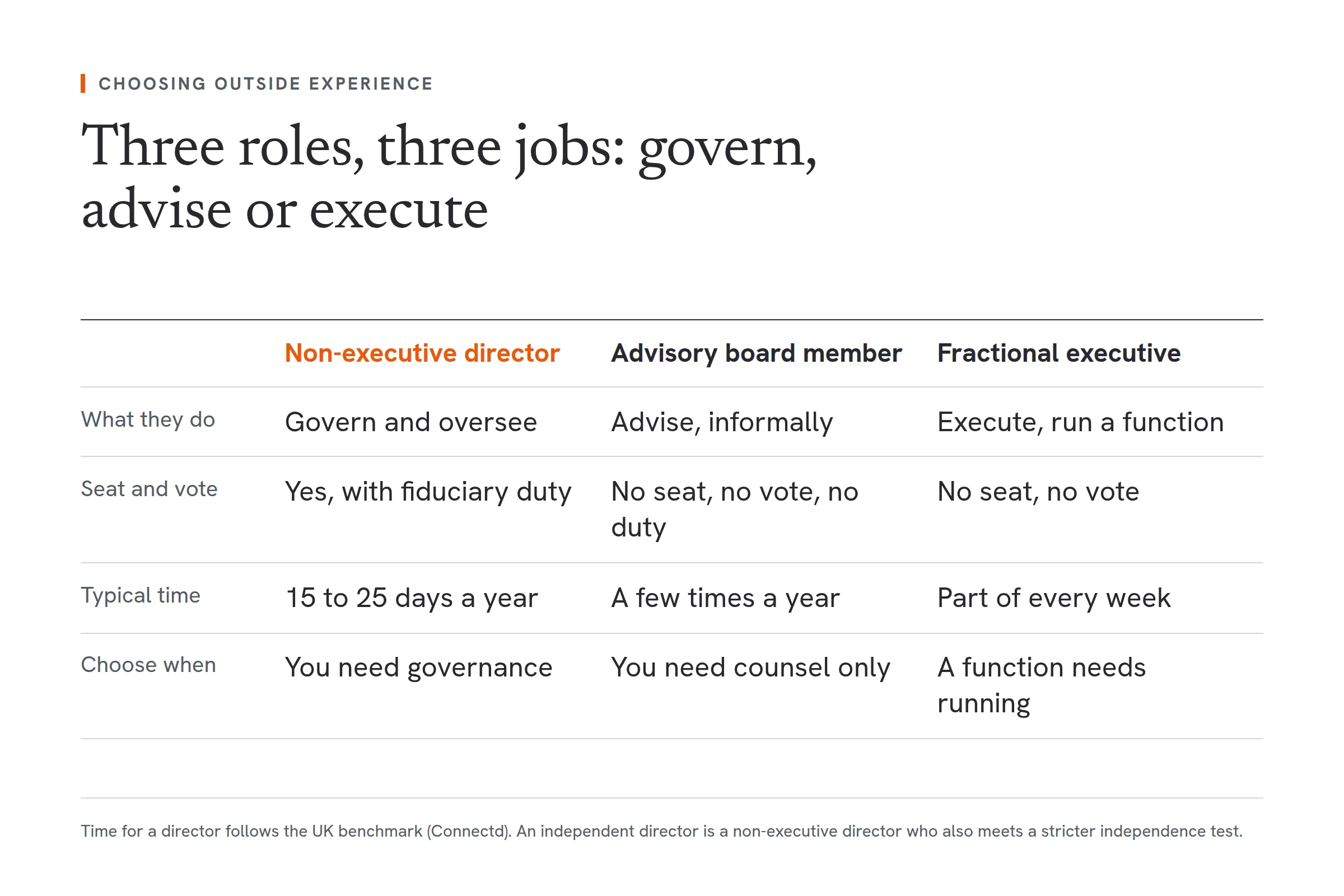
Corporate governance in the UAE runs through three main regimes. Mainland public joint stock companies follow the Securities and Commodities Authority Governance Guide and the Commercial Companies Law. Entities in the financial free zones follow the DIFC and ADGM regimes. Regulated sectors, such as banking, follow their own rules under the Central Bank. Across all of them, the common requirement is the same: independent directors holding management to account on behalf of shareholders.
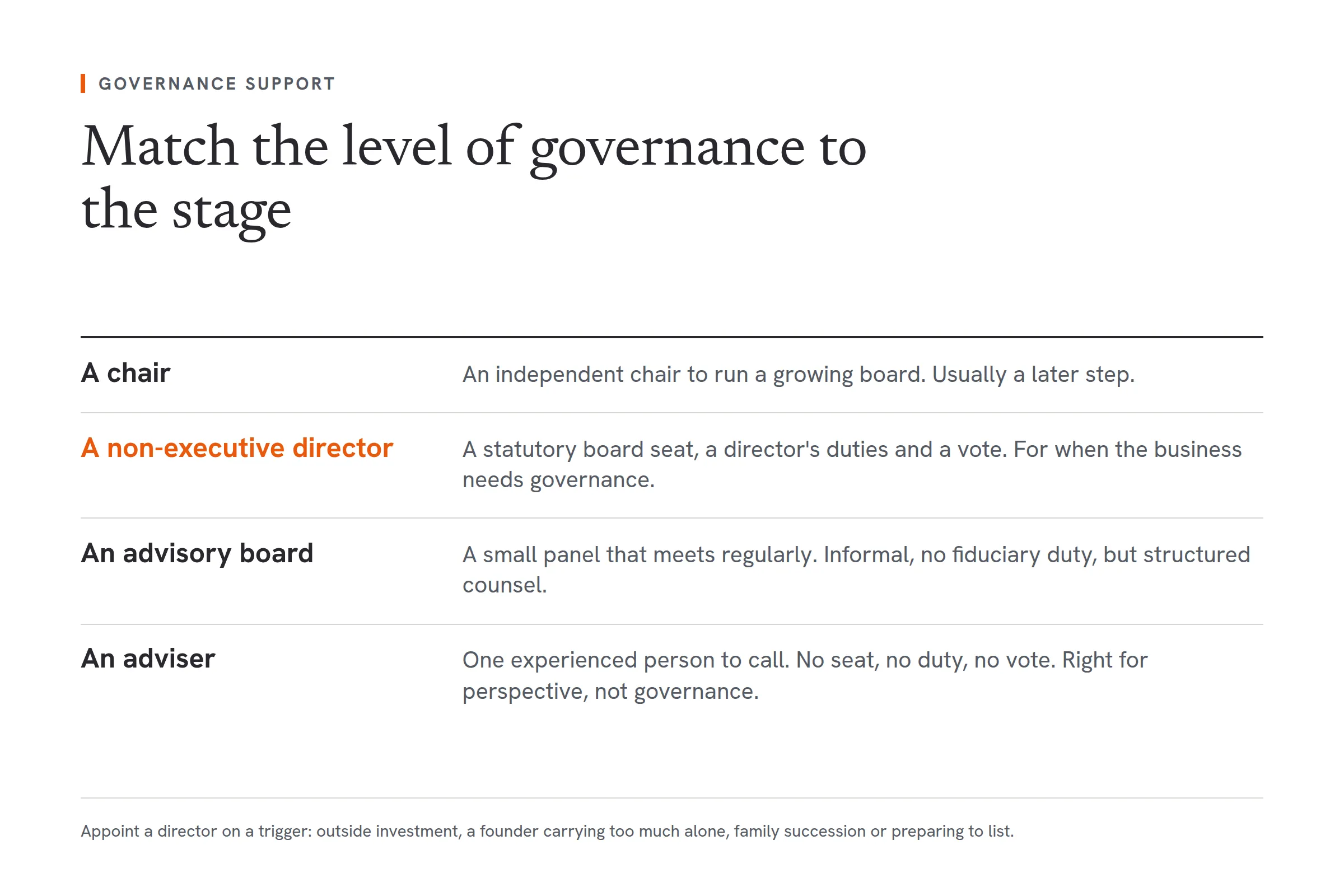
For a listed company, or one heading towards a listing, that translates into concrete obligations about who sits on the board and its committees. For a private family business, it is a direction of travel: the governance you will need before you can raise institutional capital or list.
The SCA Governance Guide: what a listed board must look like
For UAE public joint stock companies, the SCA Governance Guide (Chairman's Decision 3 of 2020, since amended) sets the shape of the board. The headline requirements are these:
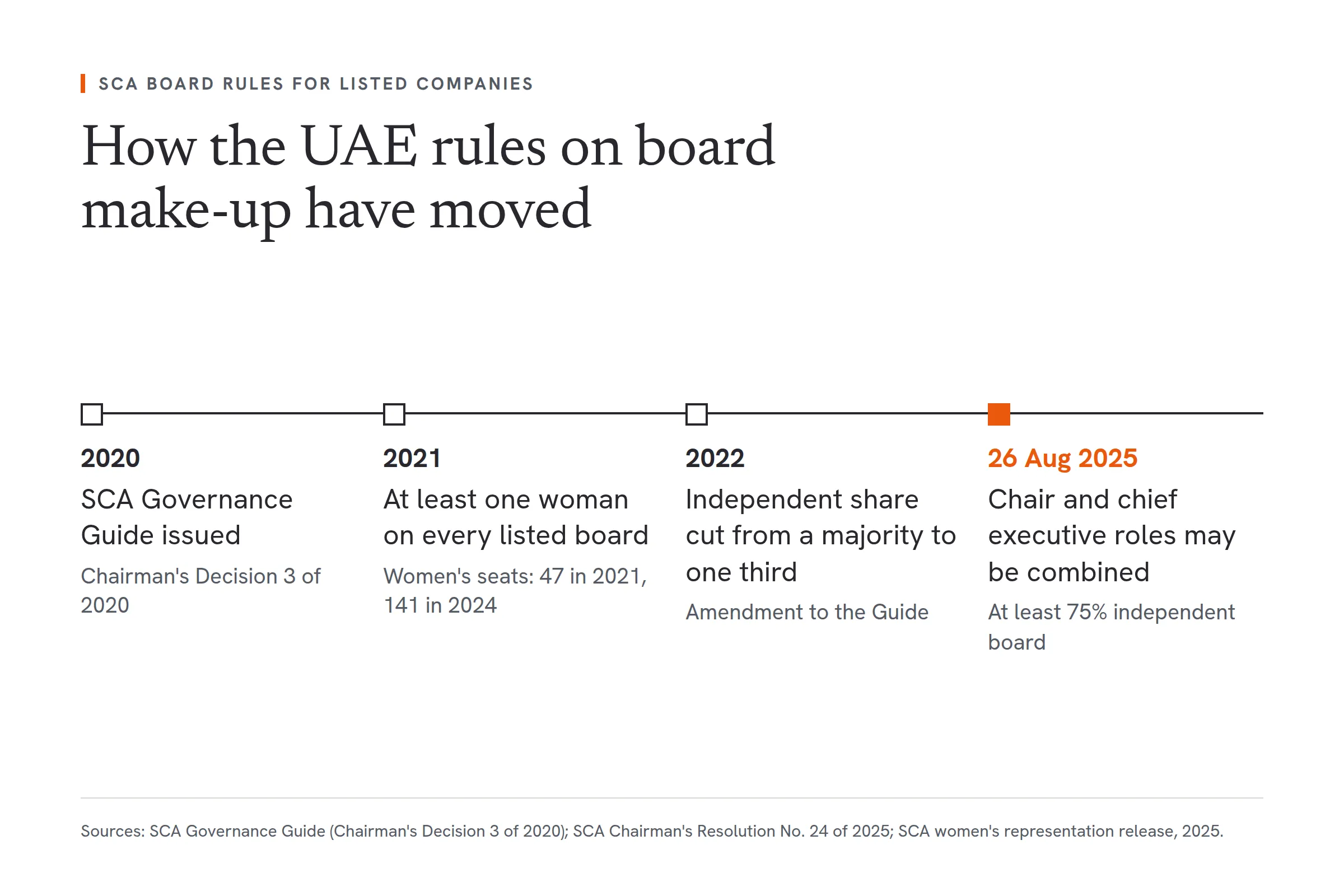
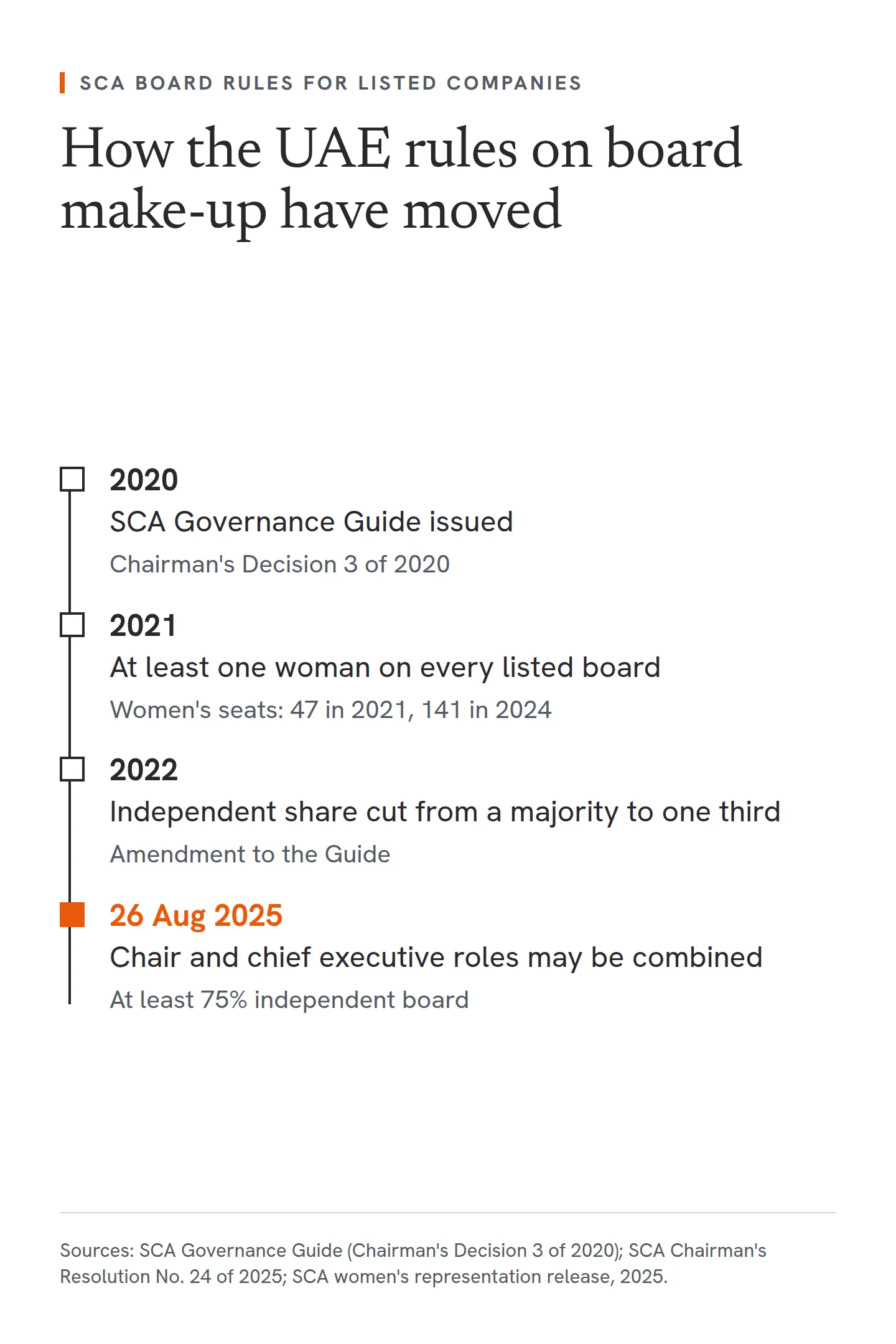
- Board independence. At least one third of the board must be independent directors. The 2022 amendment lowered this from a majority. A majority of the board must also be non-executive.
- Women on the board. Since 2021, every listed company must have at least one woman on its board. The SCA reports that women's board seats across listed public joint stock companies rose from 47 in 2021 to 141 in 2024.
- Committees. In the Guide as issued in 2020, the audit committee and the nomination and remuneration committee each need at least three non-executive directors, at least two of them independent, with an independent chair. The board chair cannot sit on either.
- What counts as independent. In the same version, a director loses independence if they, or a close relative, worked in the company's senior management or for the company in the previous two years, provide consultancy to it, are linked to its auditor, hold 10% or more of its capital, or are selected for a fourth consecutive term.
- The chair. The chair must not hold the company manager, managing director or any other executive position. Since Chairman's Board Resolution No. 24 of 2025, effective 26 August 2025, the chair and company manager roles can be combined, but only if the articles of association allow it and shareholders approve it by special resolution. In that case at least 75% of the board must be independent and all permanent committees must be fully independent, and a governance committee must review each year whether the combined role is still justified.
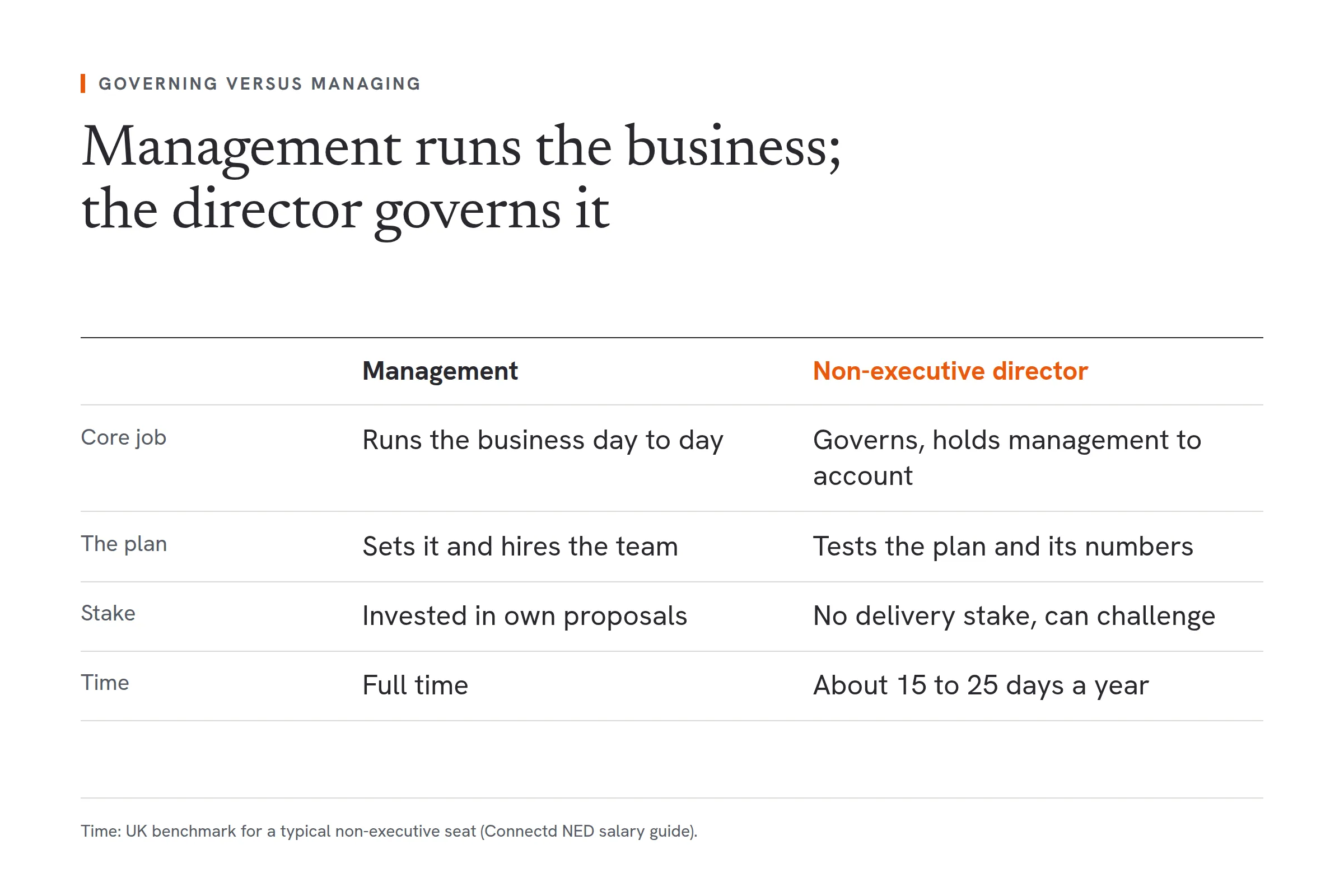
The thread running through all of this is independence. The purpose of the rules is to make sure the people overseeing the executive team are genuinely at arm's length from it, because a board that is led by management cannot hold management to account. Because the Guide has been amended several times, check the current text before you design a board around it.
What the Commercial Companies Law adds
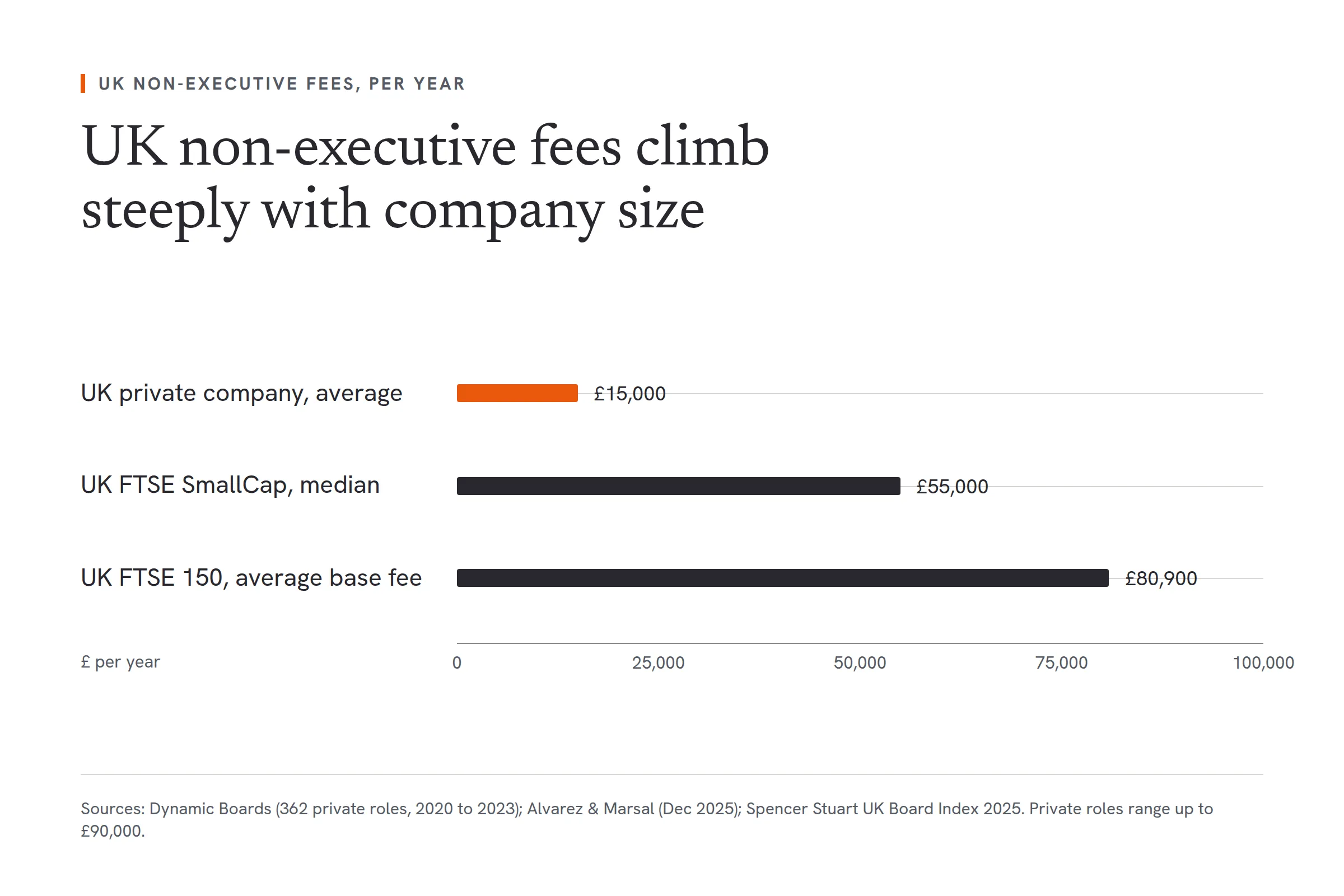
The Commercial Companies Law (Federal Decree-Law 32 of 2021) sets the statutory frame for joint stock companies. A board has between three and eleven members, each serving no more than three years per term. No one may sit on more than five joint stock company boards in the UAE, or chair or vice-chair more than two. Directors are liable to the company, shareholders and third parties for fraud, abuse of power and breaches of the law or the company's statute, and total board remuneration is capped (we cover the numbers in what a non-executive director costs).
The seat limits matter in practice: they cap how many boards any one experienced independent director can serve, which is one reason good independent directors are hard to find quickly.
DIFC, ADGM and the sector regimes
Not every UAE company sits under the SCA. The two financial free zones, the DIFC in Dubai and the ADGM in Abu Dhabi, are common-law jurisdictions with their own companies laws and regulators. Companies in regulated sectors have their own rules on top: the Central Bank, for instance, sets a corporate governance framework for banks.
The principles align across these regimes, but the specific rules and the regulator differ. The practical point for a founder is to be certain which regime applies to your company before you design your board, because the composition it demands is not identical everywhere. The ECGI's UAE overview is a useful map of how the frameworks fit together.
Family businesses: the governance shift
Many UAE family enterprises are going through the same transition at once: from founder or family control towards more formal governance, driven by generational succession and the arrival of outside capital.
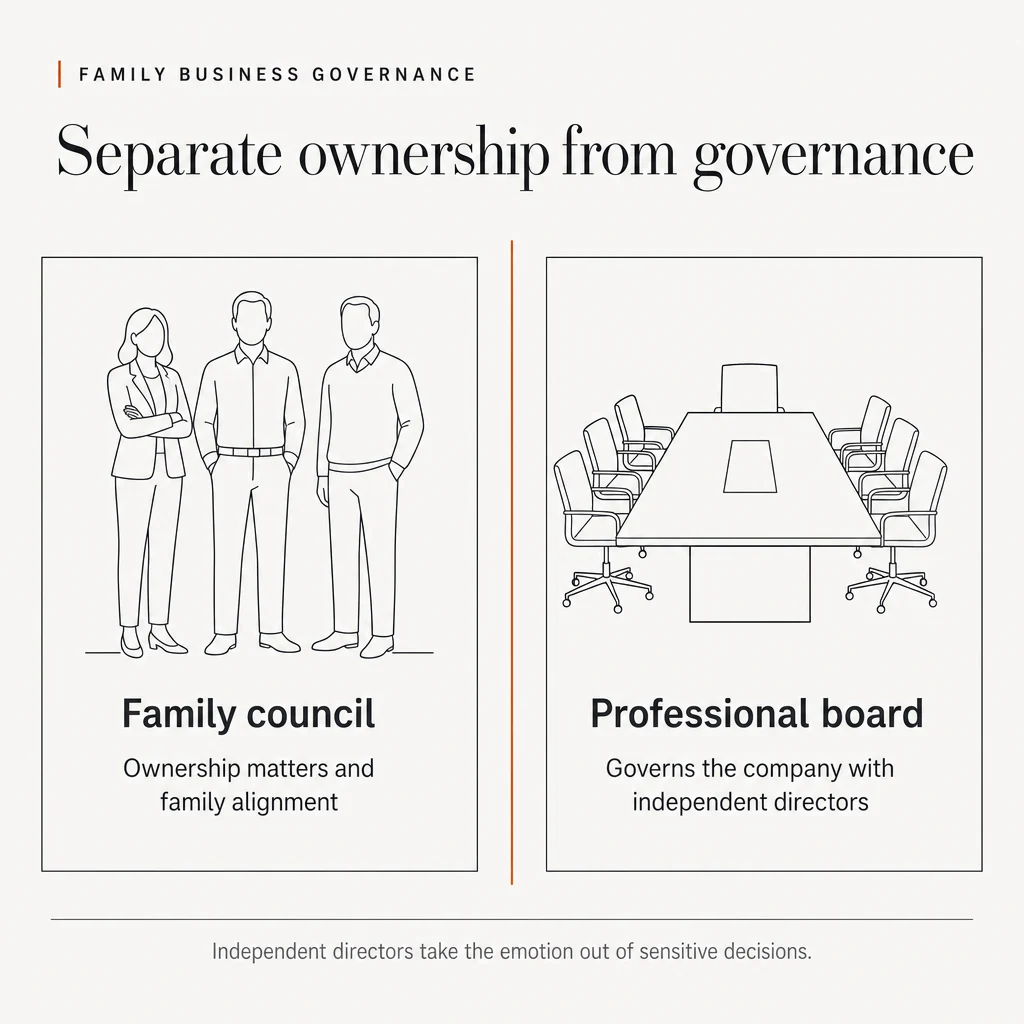
The governance answer is not to hand the family business to outsiders. It is to separate two things that are often tangled together: ownership and governance. Many UAE families run a family council, which handles ownership matters and keeps the family aligned, alongside a professional board, which governs the company and includes independent directors. The independent directors bring an objective view and help take the emotion out of sensitive decisions. We look at that decision in more depth for family businesses.
The law has also moved to help. Federal Decree-Law 20 of 2025 amended the Commercial Companies Law so that mainland limited liability companies can issue different classes of shares and build drag-along, tag-along and succession arrangements into their constitutional documents, and so that private joint stock companies can access private placements. For a family planning succession or an outside investor, those tools sit naturally alongside a stronger board.
IPO-readiness is a governance project
For a company heading towards a listing, board composition is not a detail to sort out at the end. It is scrutinised, and it takes time to get right.
"IPO-readiness" in governance terms means having the right board in place before the listing, not during it: independent directors who meet the SCA independence tests, audit and nomination and remuneration committees that meet the composition rules above, a non-executive chair, at least one woman on the board, and a clear separation between family or founder ownership and board decision-making. A company that arrives at its listing with that structure already working is in a stronger position than one assembling it under deadline pressure.
Dubai Financial Market (DFM) has built support around exactly this. Its IPO Accelerator Programme, developed with the Dubai Chamber of Commerce, is aimed at large enterprises and family-owned businesses and offers IPO-readiness assessments, sector benchmarking and equity-narrative development. DFM also lists a Growth Market route for SMEs, so listing is not only a large-company question.
The listing window in 2025 and 2026
The window has been uneven. The UAE raised about US$1.1 billion from three IPOs in 2025, according to Dealogic data reported by The National, in a year when the wider Middle East raised its least since 2020. In the first half of 2026, EY recorded MENA IPO numbers down nearly 80% and proceeds down over 90% year on year amid the conflict in the region. The pipeline of planned listings has not disappeared, so the sensible reading is that governance work done now is not wasted if the window is shut: it is what lets a company move when it opens. If a raise or a listing is on your horizon, our note on fundraising covers the wider readiness picture.
Where a non-executive director fits
All of this comes back to people. A governance code can require a certain number of independent directors, but it cannot supply directors who actually understand your sector, your regulator and your stage. That is the gap.
The strongest independent directors for a UAE board are operators who understand the local regime, who have sat where your executives sit, and who bring the independence of no longer doing the job. Matched well, they let a board meet the standard with people who add judgement, not just compliance. That is exactly what our non-executive director search is built to do.
If governance is now on your agenda, whether for a family transition, a raise or a listing, tell us what you are working through and we will help you think through the board you will need. For the role itself, start with what a non-executive director actually does. Companies approaching a turnaround or private equity transaction often appoint independent directors at the same time.