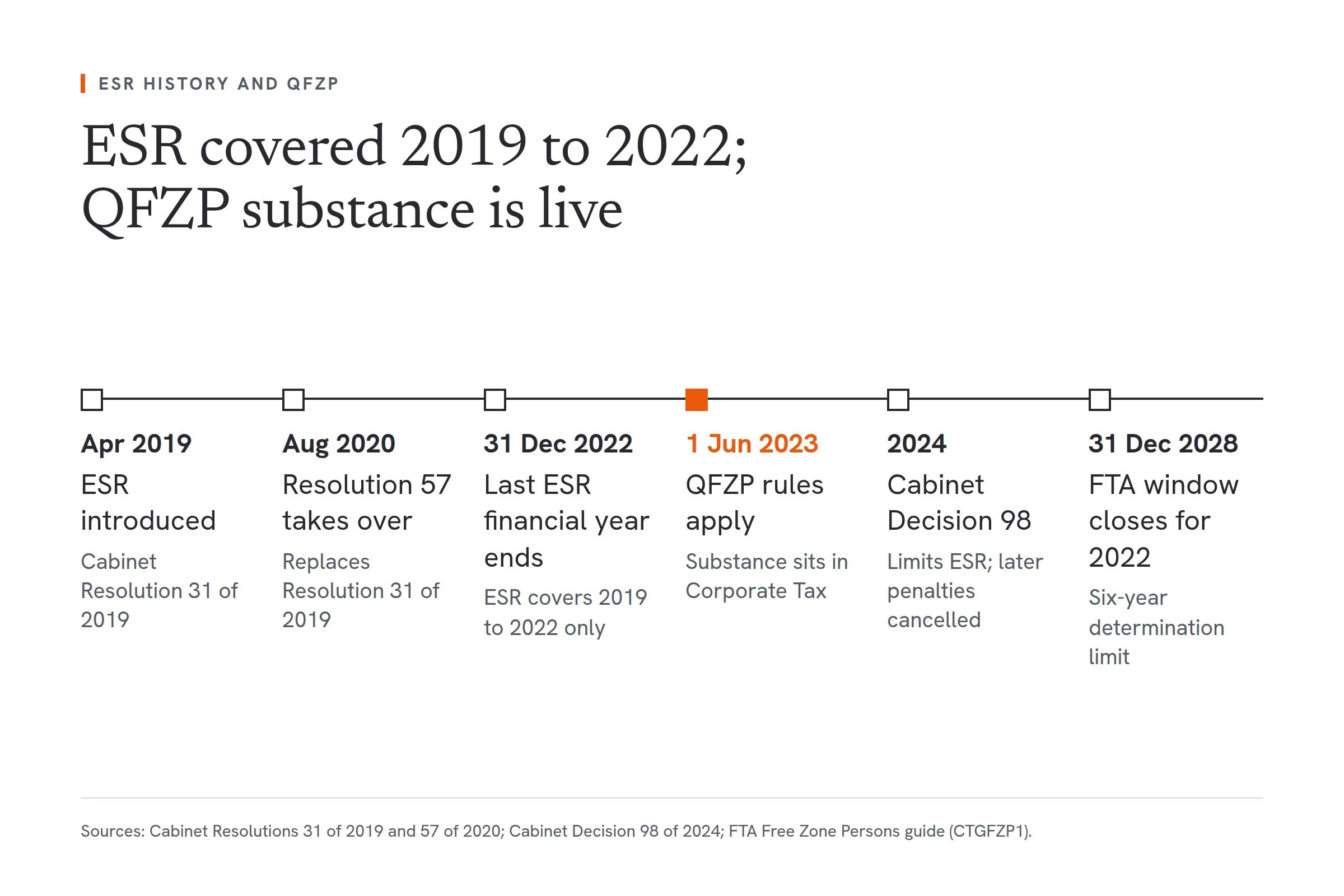
Update, September 2026. The UAE Economic Substance Regulations have been retired. Cabinet Decision 98 of 2024 amended Cabinet Decision 57 of 2020 so that ESR applies only to financial years from 1 January 2019 to 31 December 2022. For any financial year ending after 31 December 2022 there is no ESR notification, no ESR report and no penalty exposure. Penalties already levied for those later periods were cancelled, and amounts already paid are refunded by the Federal Tax Authority. This article is kept as a historical explainer of the regime as it applied to 2019 to 2022. If you run a free zone business today, the live question is the adequate-substance condition attached to Qualifying Free Zone Person status under UAE Corporate Tax.
Most SME founders in the UAE could not answer this cleanly: does your business pass the economic substance test?
Not "have you filed the forms" or "have you ticked the box." Genuinely pass. If the Federal Tax Authority knocked on your door and asked you to prove real presence and real activity in the UAE, could you show them?
In short: the Economic Substance Regulations (ESR) tested nine relevant activities for financial years 2019 to 2022 and were retired by Cabinet Decision No. 98 of 2024. The substance question itself moved into Corporate Tax, where it decides whether a free zone business keeps the 0% rate as a Qualifying Free Zone Person (QFZP).
What the economic substance test was and why it still matters
The UAE introduced its Economic Substance Regulations in April 2019 through Cabinet Resolution 31 of 2019, replaced in August 2020 by Resolution 57 of 2020. The Ministry of Finance explains that the regime was introduced as part of the UAE's commitment as a member of the OECD Inclusive Framework, and in response to an assessment of the UAE's tax framework by the EU Code of Conduct Group. Both were asking whether companies claiming UAE residence did any real business there. Or whether they simply used the UAE as a low-tax address while operations sat elsewhere.
The answer was a test. Companies conducting certain activities had to prove they genuinely operated in the UAE, with real staff, real premises and real decisions made on the ground.
In 2024, Cabinet Decision No. 98 limited the ESR to financial years from 1 January 2019 to 31 December 2022. For later periods there is no notification, no report and no penalty. That is the good news. The caveat is that substance has not disappeared. It now sits inside the Corporate Tax framework, which applies from 1 June 2023 for the QFZP rules.
So yes, this still matters, in a different form.
Who was subject: the nine relevant activities
Under the original ESR framework (which still governs financial years 2019 to 2022), a business was subject to the test if it conducted one or more "relevant activities" and earned income from them. The nine relevant activities were:
- Banking
- Insurance
- Investment fund management
- Shipping
- Lease-finance
- Headquarters
- Distribution and service centre
- Intellectual property
- Holding company
These categories were broader than they sound. A holding company that only received dividends and capital gains from subsidiaries was in scope, though it faced a reduced test. So was a regional headquarters coordinating group functions. So was a business licensing intellectual property to related parties. Certain licensees, such as investment funds and entities tax resident elsewhere, could claim an exemption through the notification.
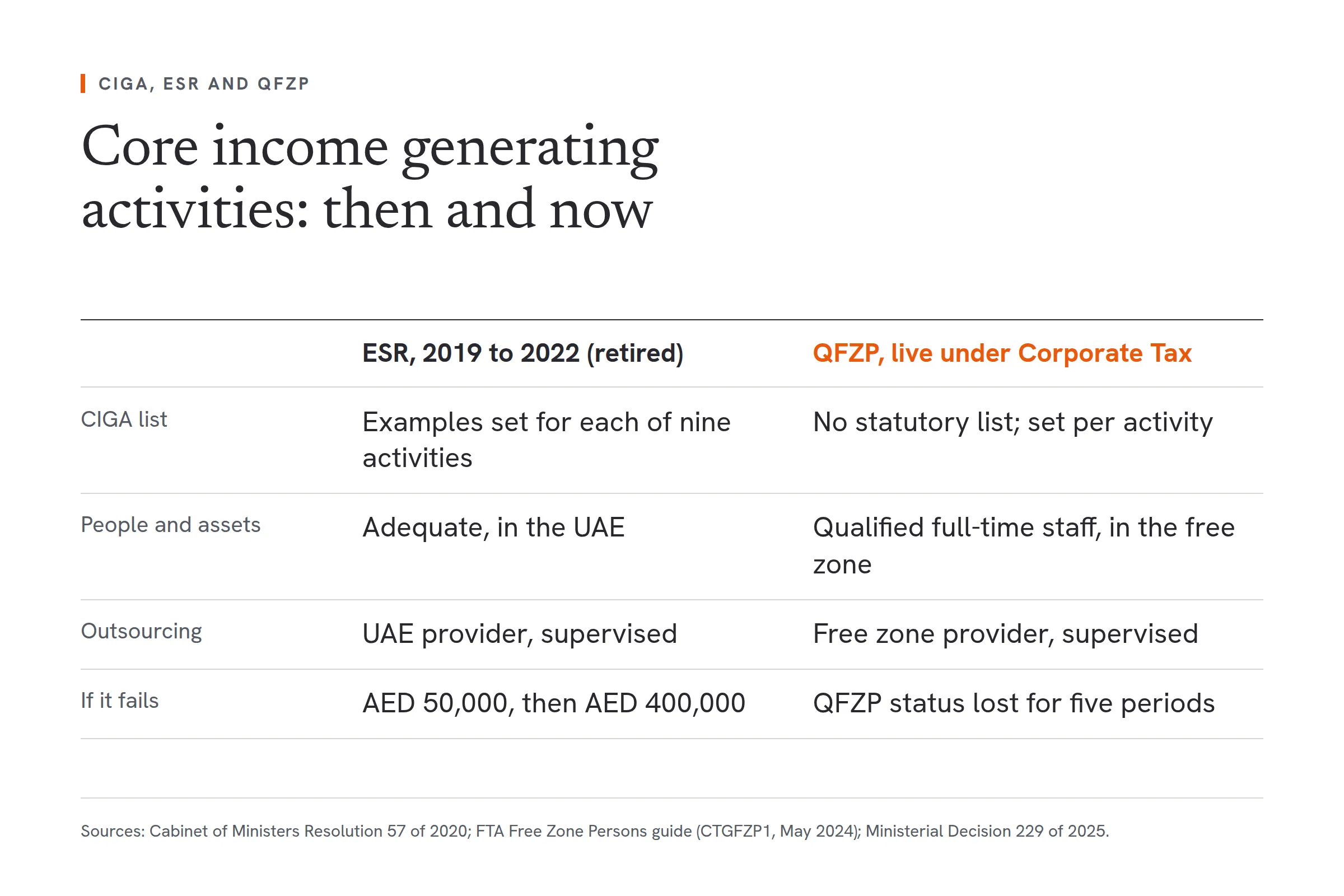
From 2023 onwards, free zone businesses seeking the 0% QFZP rate face a substance requirement under the Corporate Tax law. The comparison below shows how the two regimes line up.
The three-part test
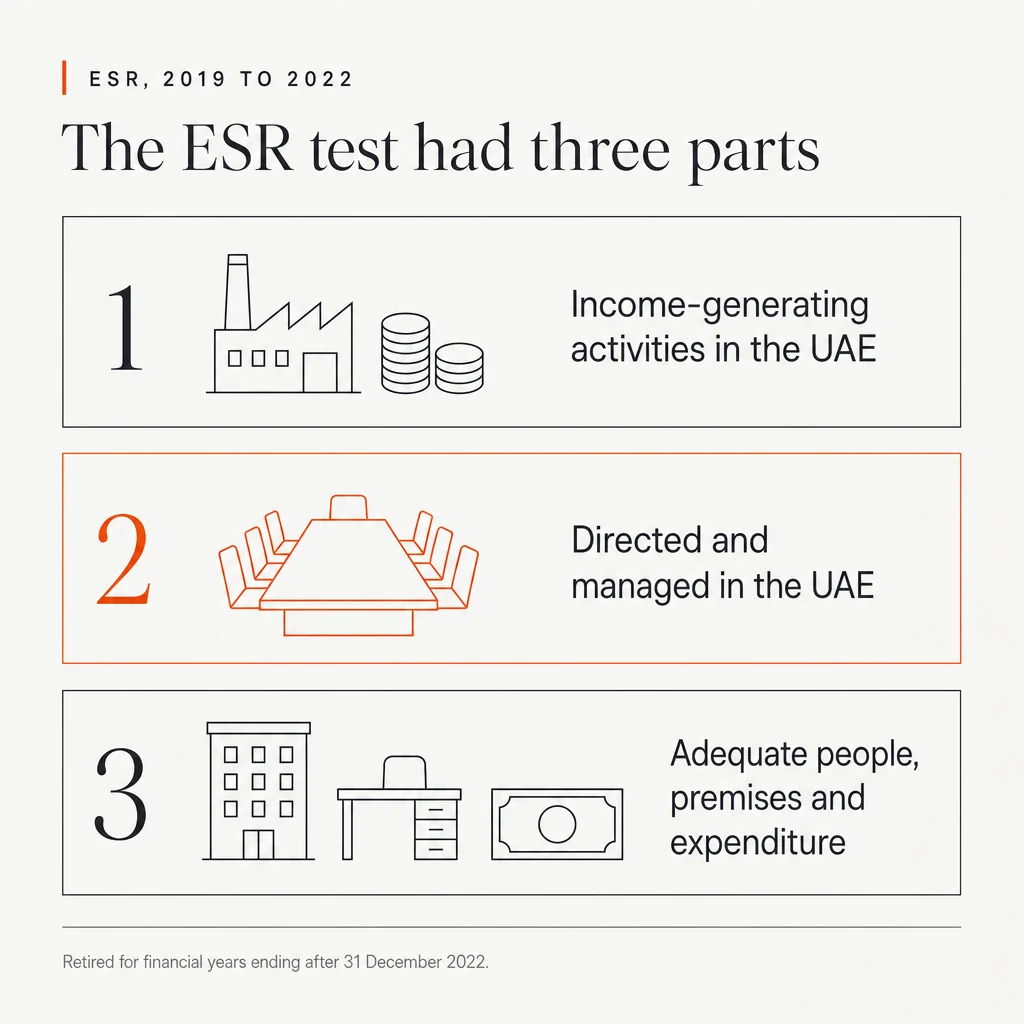
For the 2019 to 2022 period, a business conducting a relevant activity had to satisfy three distinct elements to pass the economic substance test. The same ideas, in a different legal wrapper, are what a free zone business is now judged on for QFZP purposes.
1. Core Income-Generating Activities (CIGAs) in the UAE
The business had to perform the activities that generate its income here in the UAE. Not offshore. Not delegated to a parent company abroad. The CIGAs differed by activity type. For a headquarters business, that meant taking relevant management decisions locally. For an IP business, it meant conducting research and development in the UAE, or branding and marketing for a marketing intangible.
The regulations permitted outsourcing, with conditions. The licensee had to be able to monitor and control whoever performed the CIGAs. The provider had to perform them in the UAE with adequate resources. You could not outsource your way out of substance.
Before you self-assessed, it was critical to understand core income-generating activities for your relevant activity in detail.
2. Directed and Managed in the UAE
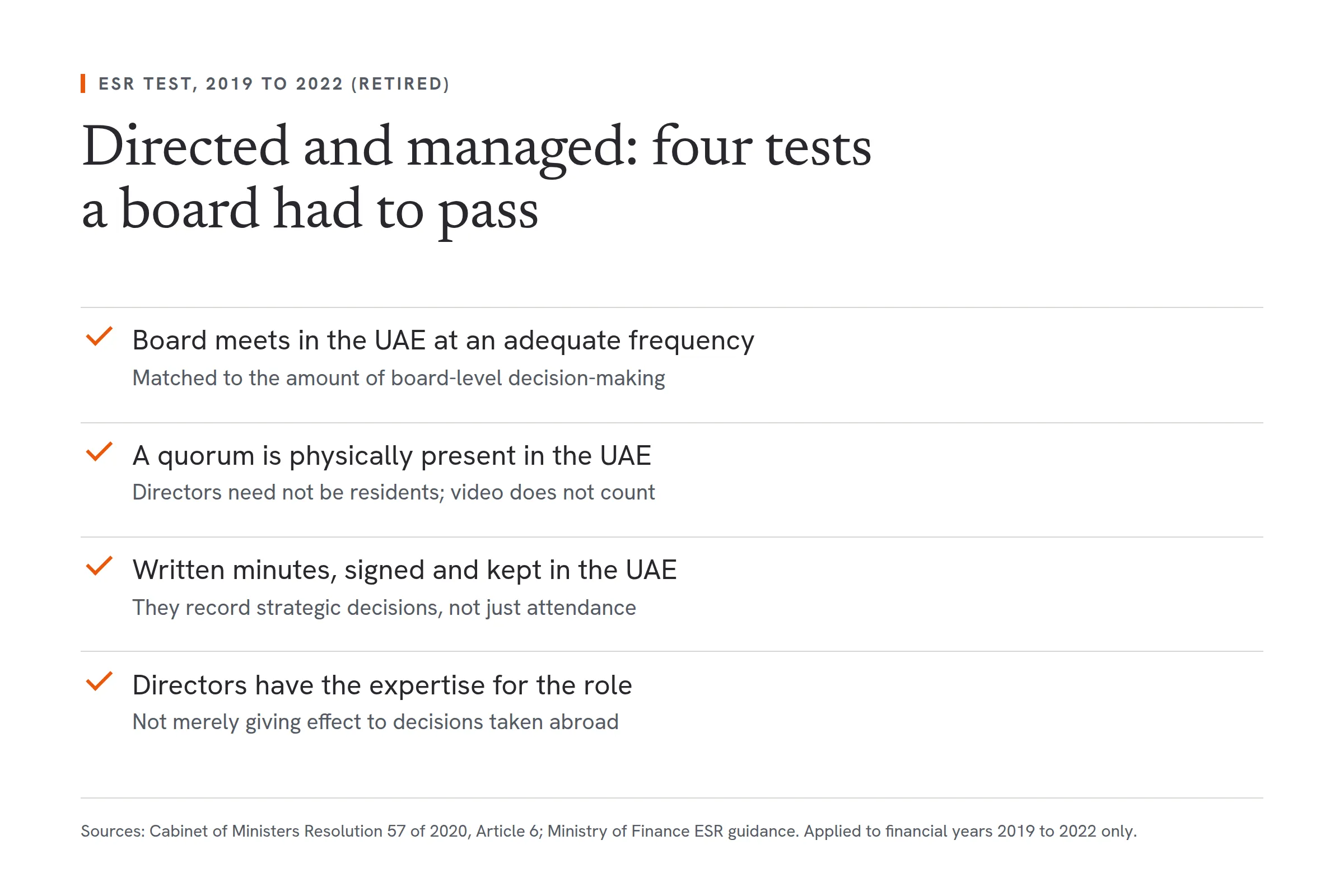
This is where many companies stumbled. The relevant activity had to be directed and managed in the UAE. Strategic decisions had to be made by a board (or equivalent) that met in the UAE at an adequate frequency. Minutes had to be kept in the UAE. A quorum had to be physically present. The directors needed the knowledge and expertise to discharge their duties.
If your board meetings happened on video calls from London, or board resolutions were rubber-stamped by directors who had never been to Dubai, you had a problem. What directed and managed actually required was more specific than most founders realised.
3. Adequate People, Premises and Expenditure
The business needed an adequate number of qualified full-time employees physically present in the UAE. It needed adequate physical assets (premises) here, and adequate operating expenditure, all judged against the level of relevant activity. There was no fixed headcount threshold. That is both flexible and frustrating.
ESR versus QFZP substance at a glance
| ESR test (2019 to 2022) | QFZP substance condition (from 2023) |
|---|---|---|
Who | Licensees carrying on one of nine relevant activities | Free zone persons claiming the 0% rate on qualifying income |
Filing | Annual notification and report | None separate; evidenced through Corporate Tax registration and return |
Core test | CIGAs in the UAE; directed and managed in the UAE; adequate people, premises, expenditure | CIGAs in the free zone; adequate assets, qualified full-time employees and operating expenditure in the free zone |
Outsourcing | To a UAE provider with adequate supervision | To a free zone provider (Designated Zone for distribution) with adequate supervision; R&D on qualifying IP is the exception |
Consequence of failing | AED 50,000, then AED 400,000 for a repeat failure, plus information exchange | Loss of QFZP status for the tax period and the following four |
Status | Retired for financial years ending after 31 December 2022 | Live |
The 2024 shift: Cabinet Decision 98 and what moved into corporate tax
Cabinet Decision No. 98 of 2024 drew a bright line: ESR obligations apply only to the period from 1 January 2019 to 31 December 2022. For financial years ending after 31 December 2022, businesses are not required to file ESR notifications or reports. Administrative penalties for those later periods were cancelled, and any already paid were to be refunded.
But substance requirements have not been abolished. They sit within the Corporate Tax framework. To be a QFZP, a free zone person must perform its core income-generating activities in a free zone, and have adequate assets, qualified full-time employees and operating expenditure there, as set out in the FTA's Free Zone Persons guide (CTGFZP1, May 2024).
The FTA keeps its powers over the 2019 to 2022 ESR period. Article 7 of Resolution 57 allows a determination up to six years after the end of the financial year. The window for the 2019 year therefore closed on 31 December 2025, and an assessment for the period ending December 2022 can technically be made until 31 December 2028. Keep your records. Before you close the file on historic periods, read how ESR obligations shifted into the corporate tax framework.
The QFZP connection for free zone businesses
If your business is registered in a free zone and you want the 0% corporate tax rate as a QFZP, you are not exempt from substance requirements. You simply operate under a different rulebook. To qualify, a free zone person must, in each tax period:
- Maintain adequate substance in the free zone, performing its core income-generating activities there
- Derive qualifying income, with non-qualifying revenue within the de minimis limit (the lower of 5% of total revenue or AED 5 million)
- Comply with transfer pricing documentation requirements
- Prepare audited financial statements, regardless of revenue
If any condition fails, status is lost from the beginning of that tax period and for the following four. Substance here is not a box-ticking exercise. It is a genuine operational requirement. How a fractional executive supports the QFZP substance position covers this in detail.
Self-assessment checklist
Before seeking professional advice, run through this quick review:
For the 2019-2022 ESR period:
- Did your business conduct any of the nine relevant activities?
- Did you earn income from those activities during those years?
- For financial years 2019 to 2022, were ESR notifications and reports filed on time?
- Can you evidence board meetings held in the UAE with proper minutes?
- Do you have records of UAE-based staff, premises and expenditure?
- Have you retained your ESR supporting records (required for six years from submission)?
For 2023 onwards (corporate tax framework):
- If you are a free zone entity, have you assessed your QFZP eligibility?
- Does your business have genuine operational presence in the free zone, with the staff, assets and expenditure to match?
- Are the decisions that generate your income genuinely being taken in the free zone?
- Are your transfer pricing arrangements documented?
- Are your audited financial statements in order?
If you cannot answer these questions confidently, that is useful information in itself.
What happened if you failed: penalties and information exchange
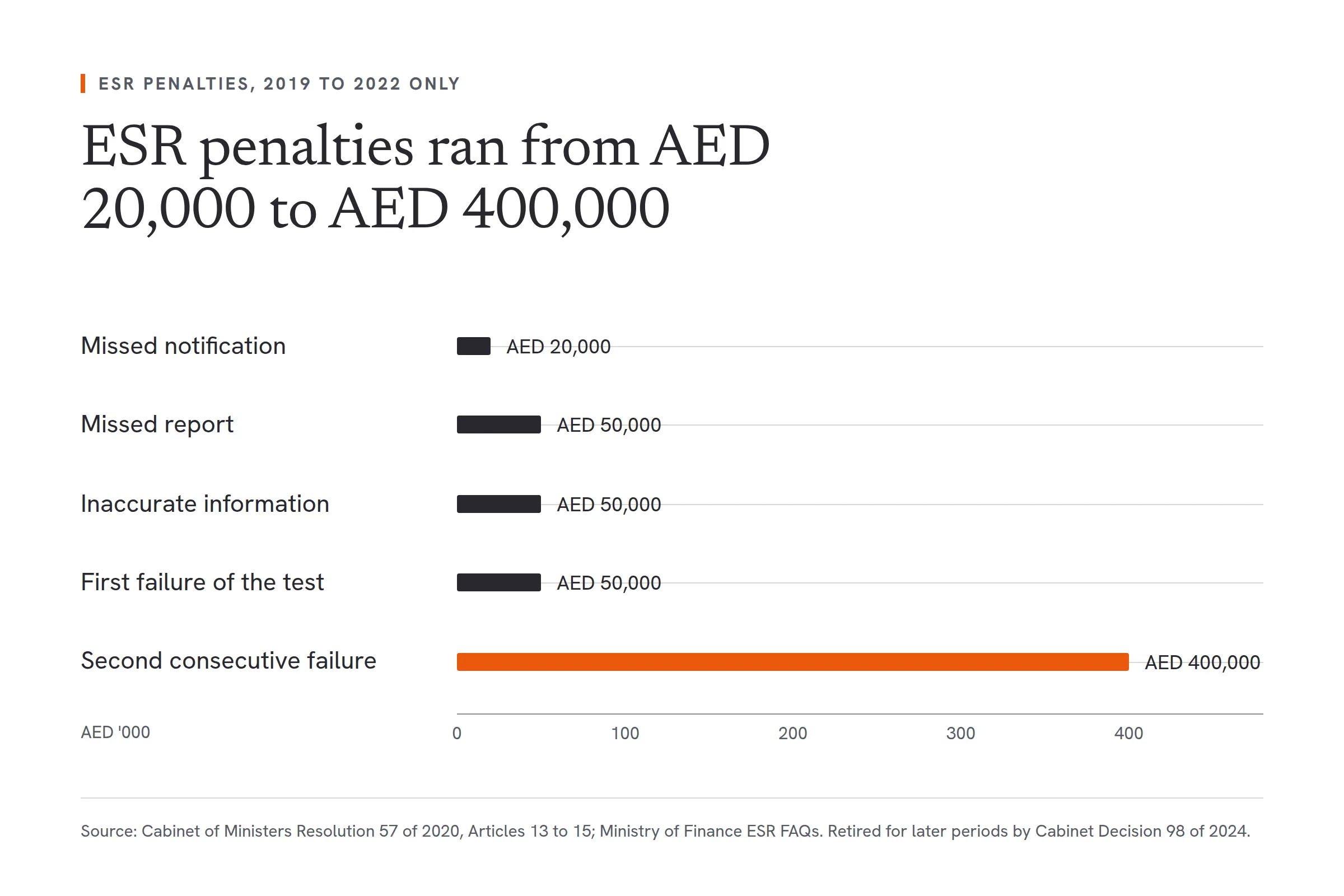
For the 2019-2022 ESR period, the consequences of failing the economic substance test remain live. The penalty was AED 50,000 for failing the test in a given year, rising to AED 400,000 for a second consecutive failure. Failing to file a notification carried AED 20,000 and failing to file the report AED 50,000.
Beyond fines, the consequences ran deeper. After a second consecutive failure the licence could be suspended, withdrawn or not renewed.
Then there was information exchange. Under Article 11 of the Resolution, where a licensee failed the test, the Ministry of Finance gave the information to the foreign tax authorities of the countries where its parent company, ultimate parent company and ultimate beneficial owner reside. That concentrated minds.
For more on enforcement, see what the FTA could do if you failed.
How a fractional executive builds genuine substance
The founders we speak to often confuse compliance theatre with real substance. Renting a desk in a co-working space and appointing a nominee director is not economic substance. A qualified executive making real decisions about your business in the UAE, regularly, is.
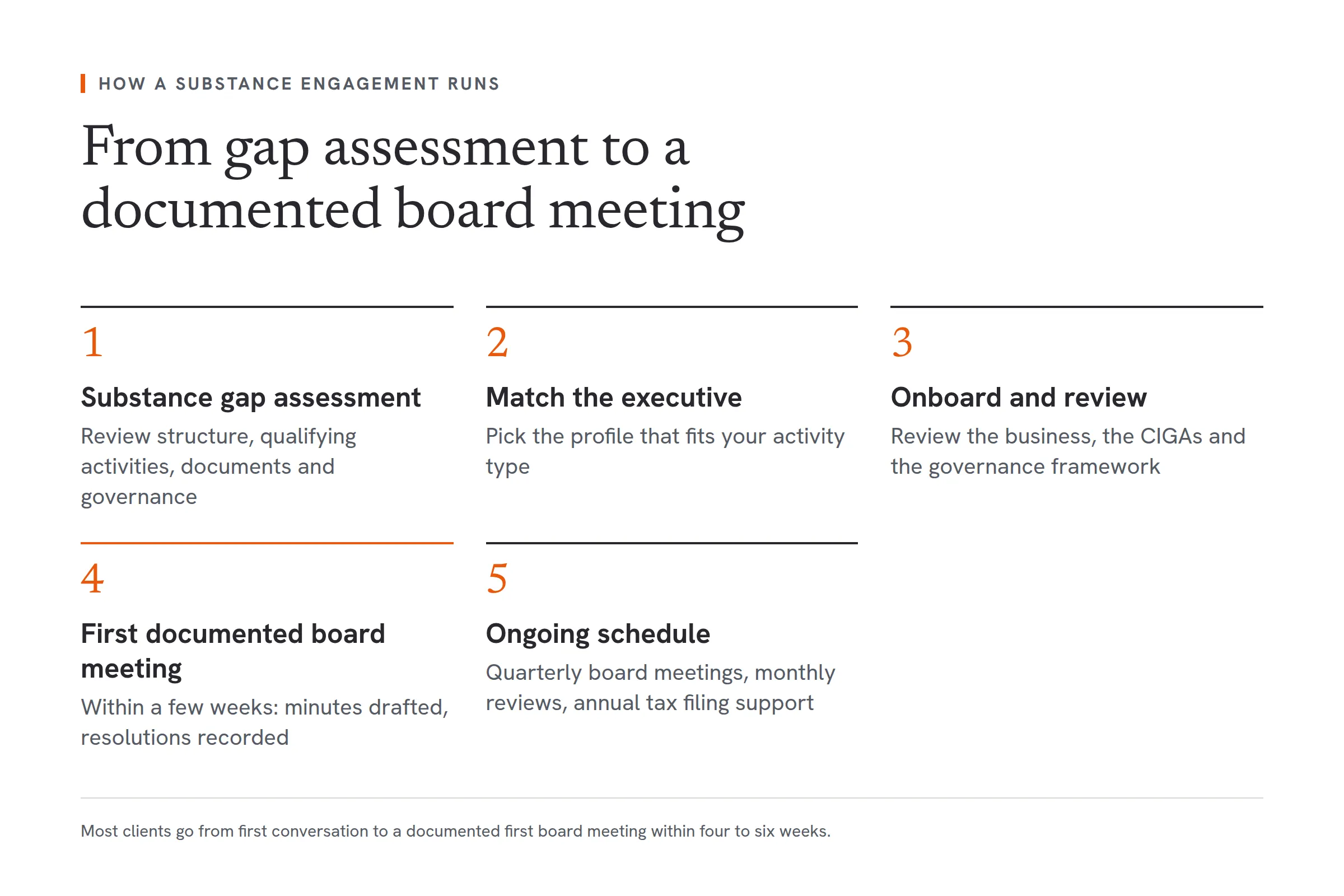
A fractional Chief Financial Officer (CFO), Chief Operating Officer (COO) or Chief Technology Officer (CTO) who spends meaningful time in the UAE working on your business contributes to your substance position. They attend and take part in board meetings as required. They generate records of decisions made, strategies approved and operations directed. All of this evidences genuine management activity. For SMEs in free zones, that model is often a practical way to strengthen governance without a full-time executive salary. It does not replace the full-time employees that the QFZP test looks for in the free zone. Take tax advice on how your structure will be assessed.
This is not a workaround. It is how businesses with legitimate UAE operations naturally function. The substance test was designed to tell real businesses from brass-plate arrangements. If your business genuinely operates here, the evidence should already exist.
How a fractional executive can help establish genuine substance explores this in depth, including what documentation a fractional arrangement should generate to be credible with the FTA.
You can also explore our fractional CFO service, our free zone substance and tax service, and take our fractional executive readiness assessment if you are still weighing up whether this model fits your business.
Frequently asked questions
Does the UAE economic substance test still apply in 2026? The standalone ESR regime ended for financial years ending after 31 December 2022, following Cabinet Decision No. 98 of 2024. However, an equivalent substance condition now exists within the UAE corporate tax framework. Free zone businesses claiming the 0% QFZP rate must still demonstrate adequate substance in the free zone. Historic ESR obligations (2019-2022) remain subject to FTA assessment until their six-year time limits expire.
What are the nine relevant activities under the UAE ESR? Banking, insurance, investment fund management, shipping, lease-finance, headquarters activities, distribution and service centre activities, intellectual property activities, and holding company activities. If your business earned income from any of these between 2019 and 2022, you were required to comply with the ESR unless exempt.
What does "directed and managed in the UAE" actually mean? It meant your board or equivalent had to hold meetings in the UAE at an adequate frequency, with a quorum physically present, signed minutes kept in the UAE, and directors with the knowledge to take the decisions. Remote board meetings or rubber-stamp resolutions did not satisfy the requirement.
Can a fractional executive count towards my economic substance? A fractional executive who physically works on your business in the UAE, attends board meetings and creates documented decision trails contributes real governance and decision-making evidence. Under the QFZP rules, however, the substance condition looks for adequate full-time employees in the free zone, so a fractional executive supports rather than replaces that team.
How long must ESR documents be retained? Supporting information had to be kept for six years from the date of submission. Separately, the FTA's time limit for determining a failure runs for six years from the end of each financial year, so for the period ending December 2022 it runs to 31 December 2028. Keep board minutes, employment contracts, office lease agreements and financial records for the full duration.
Ready to assess your substance position?
If you are not confident your business would pass an FTA review today, get ahead of it. Substance that holds up under scrutiny is built, not declared. We work with SMEs across the UAE to build genuine operational substance, not just paper.
Speak to the Fractional Dubai team to explore how fractional executive support can strengthen your business's real presence in the UAE. Get in touch here.
Note: This article provides general information only and does not constitute legal or tax advice. Regulatory details should be verified with a qualified UAE tax adviser.