In short: To keep the 0% corporate tax rate on qualifying income, a Qualifying Free Zone Person must perform its core income generating activities in the free zone. That takes adequate assets, qualified full-time employees and operating expenditure there. A fractional executive is often the most practical way to close the governance and evidence gap.
Most UAE businesses have a trade licence. Fewer have genuine substance. For a free zone company, that gap now has a price.
A Qualifying Free Zone Person (QFZP) must perform its core income generating activities in the free zone to keep the 0% rate. It needs adequate assets, qualified full-time employees and operating expenditure there too.
What the QFZP substance test requires from a human perspective
The substance test is not a documentation exercise. It is a people question.
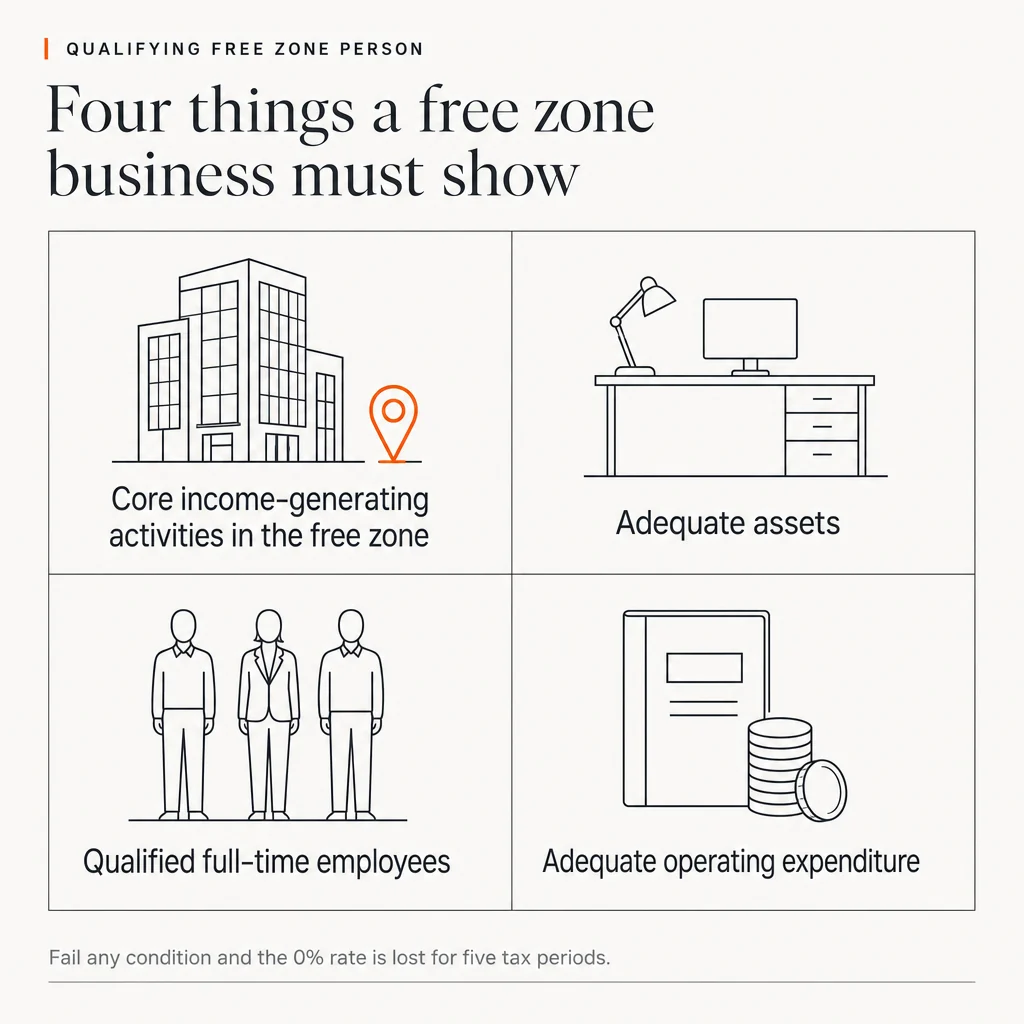
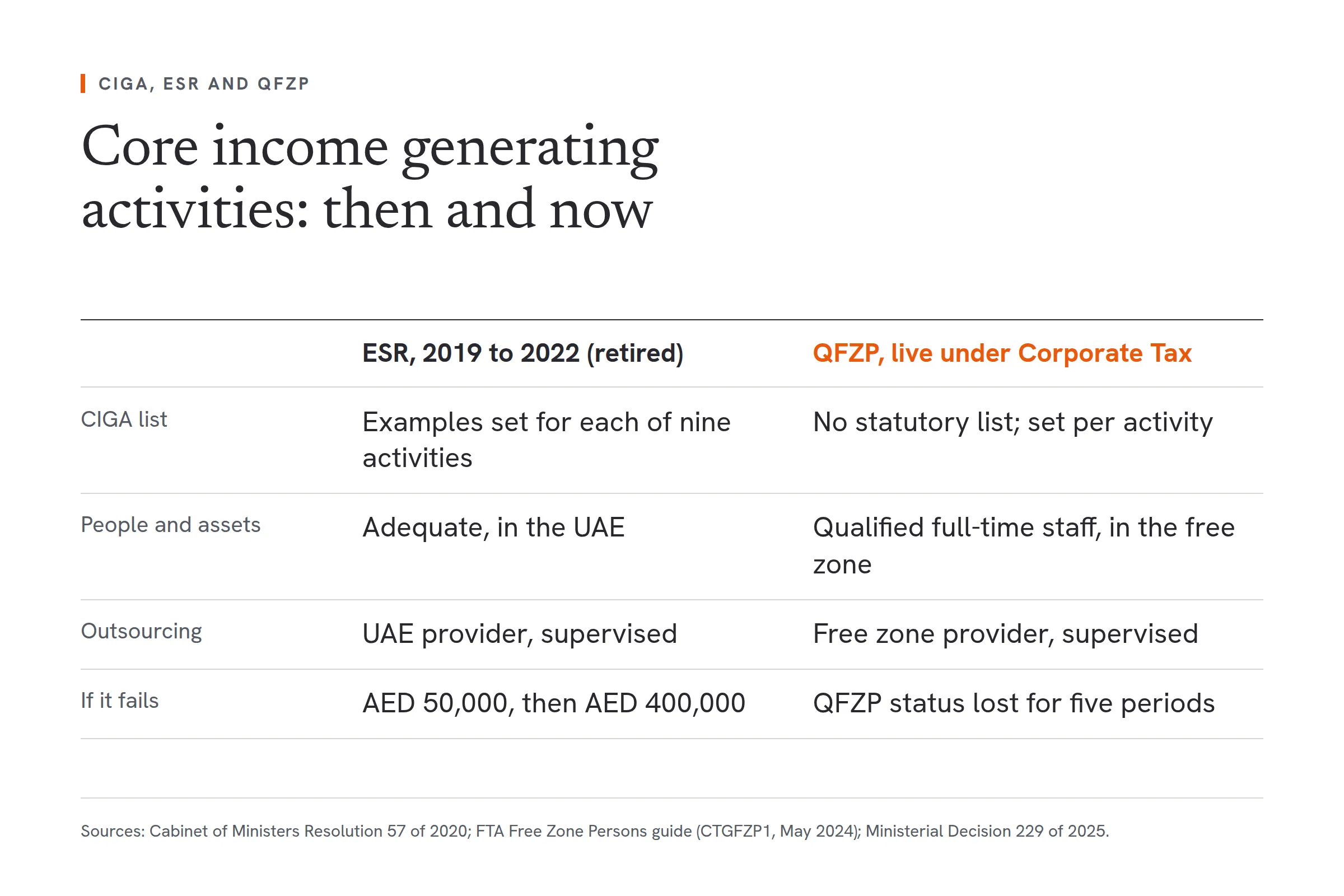
Under the FTA's Free Zone Persons guide (CTGFZP1), a free zone person must maintain adequate substance in a free zone throughout the tax period. That means it must undertake its core income-generating activities (CIGAs) in the free zone. It must also have adequate assets, qualified full-time employees and operating expenditure there to perform them. The same employee cannot be counted for more than one core activity. Outsourcing counts only if the provider performs the work in a free zone and the free zone person supervises it adequately.
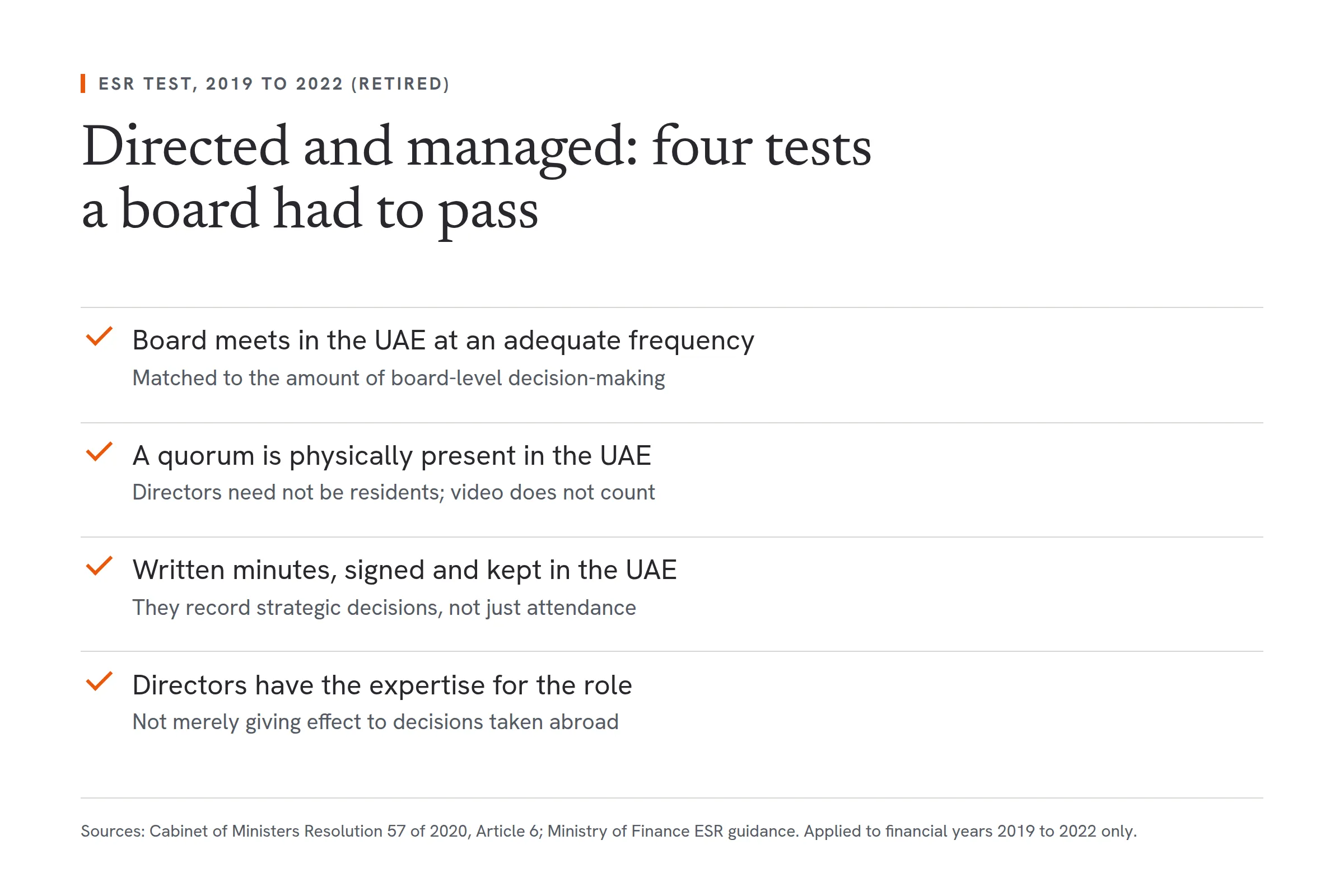
Where income comes from decisions rather than operations, the board is the activity. The guide treats a free zone holding company with no employees as having adequate substance where its board takes the investment decisions in the free zone. The evidence is minutes of meetings at its free zone office. A fund manager that merely executes decisions taken by a foreign parent is not performing CIGAs in the free zone.
Boards that meet once a year are exposed. So are boards that approve decisions already made by a founder in London or Singapore. The old directed and managed requirement was an ESR test, but the same logic now shapes how the FTA reads the evidence.
From ESR to QFZP: what changed
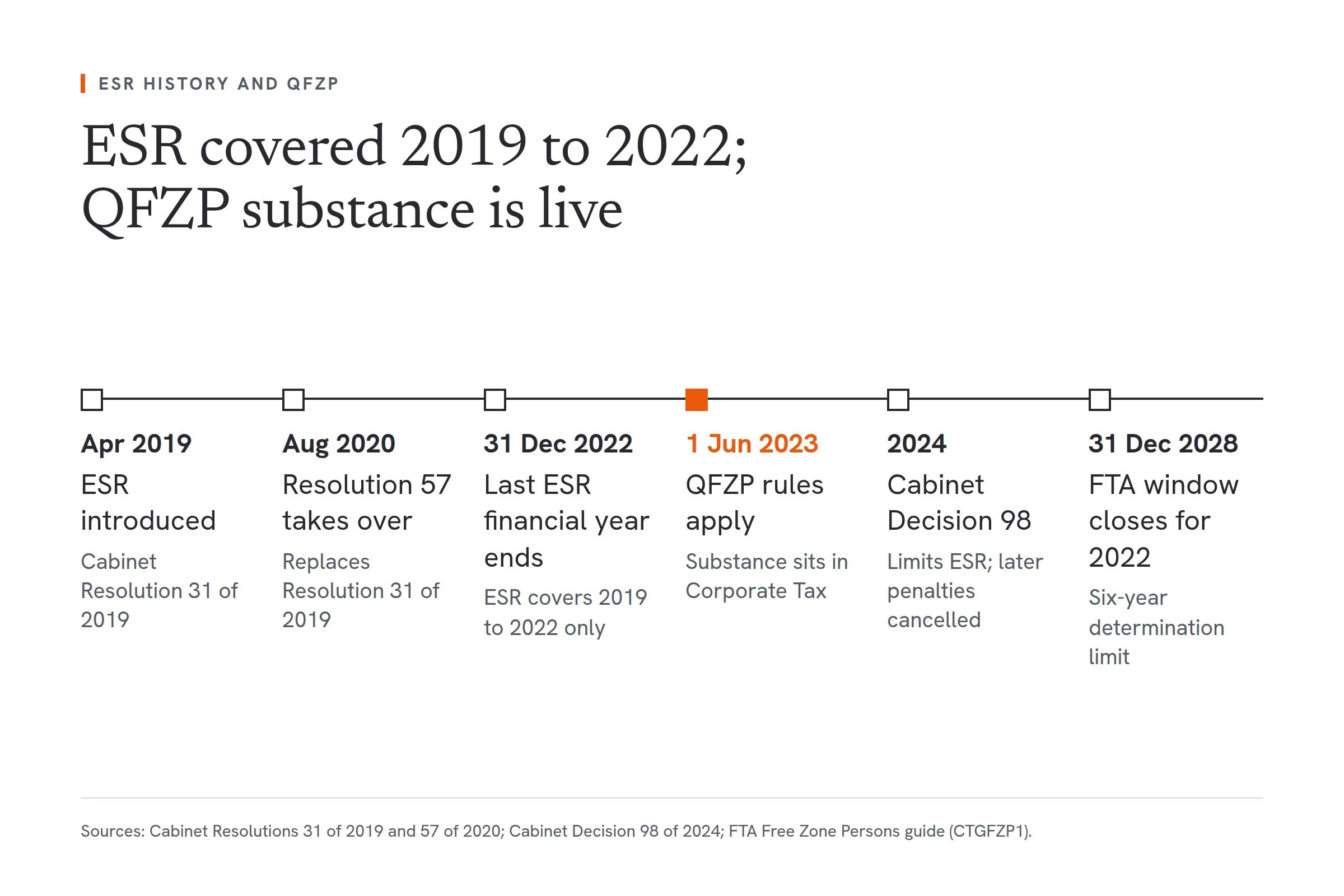
Cabinet Decision 98 of 2024 limited the old ESR regime to financial years from 1 January 2019 to 31 December 2022. There is no ESR notification or report for later periods, and penalties levied for them were cancelled. Substance did not disappear. It moved into the Corporate Tax framework, namely Federal Decree-Law 47 of 2022, Cabinet Decision 100 of 2023 and the Ministry of Finance's decisions on qualifying activities.
Two developments in 2025 and 2026 matter here:
- Updated qualifying activities. Ministerial Decision 229 of 2025 replaced Ministerial Decision 265 of 2023, with effect from 1 June 2023. It lists manufacturing, processing, trading of qualifying commodities, holding shares for investment, ships, reinsurance, fund and wealth management, headquarter services, treasury and financing, aircraft financing and leasing, distribution from a Designated Zone and logistics services, plus ancillary activities. It also sets the de minimis limit: non-qualifying revenue must not exceed the lower of 5% of total revenue or AED 5 million. And it requires audited financial statements under Ministerial Decision 84 of 2025.
- Extra evidence for free zone distributors. FTA Decision No. 6 of 2026 requires QFZPs distributing goods in or from a Designated Zone to obtain an independent agreed-upon procedures report on customer status and Designated Zone imports, for tax periods beginning on or after 1 January 2026.
The FTA's own guide pre-dates both changes (it was published in May 2024), so read it alongside the current decisions.
Why most businesses have a substance gap
There is a real difference between having a licence and having genuine presence. Most founders know this. Many have simply not acted on it.
The typical situation looks like this. A business sets up in a free zone. There is an office, some staff and a trade licence. The founder is in and out of the country. Strategic decisions get made on calls and in messages. The company earns qualifying income from overseas clients. On the surface, everything looks fine.
Look closer. Who is attending board meetings? Where are those meetings held? Who is actively overseeing the core income-generating activities that generate your qualifying income? Can you document all of this clearly enough to survive an FTA review?
Founders often find that at least one answer is uncomfortable. Not because anyone did anything wrong, but because many businesses were structured before corporate tax, when substance requirements were lighter. The stakes are now clear. Under Article 5(2) of Ministerial Decision 229, a person that fails any QFZP condition ceases to be a QFZP from the beginning of the tax period and for the following four tax periods. That is up to five tax periods without the 0% rate on qualifying income.
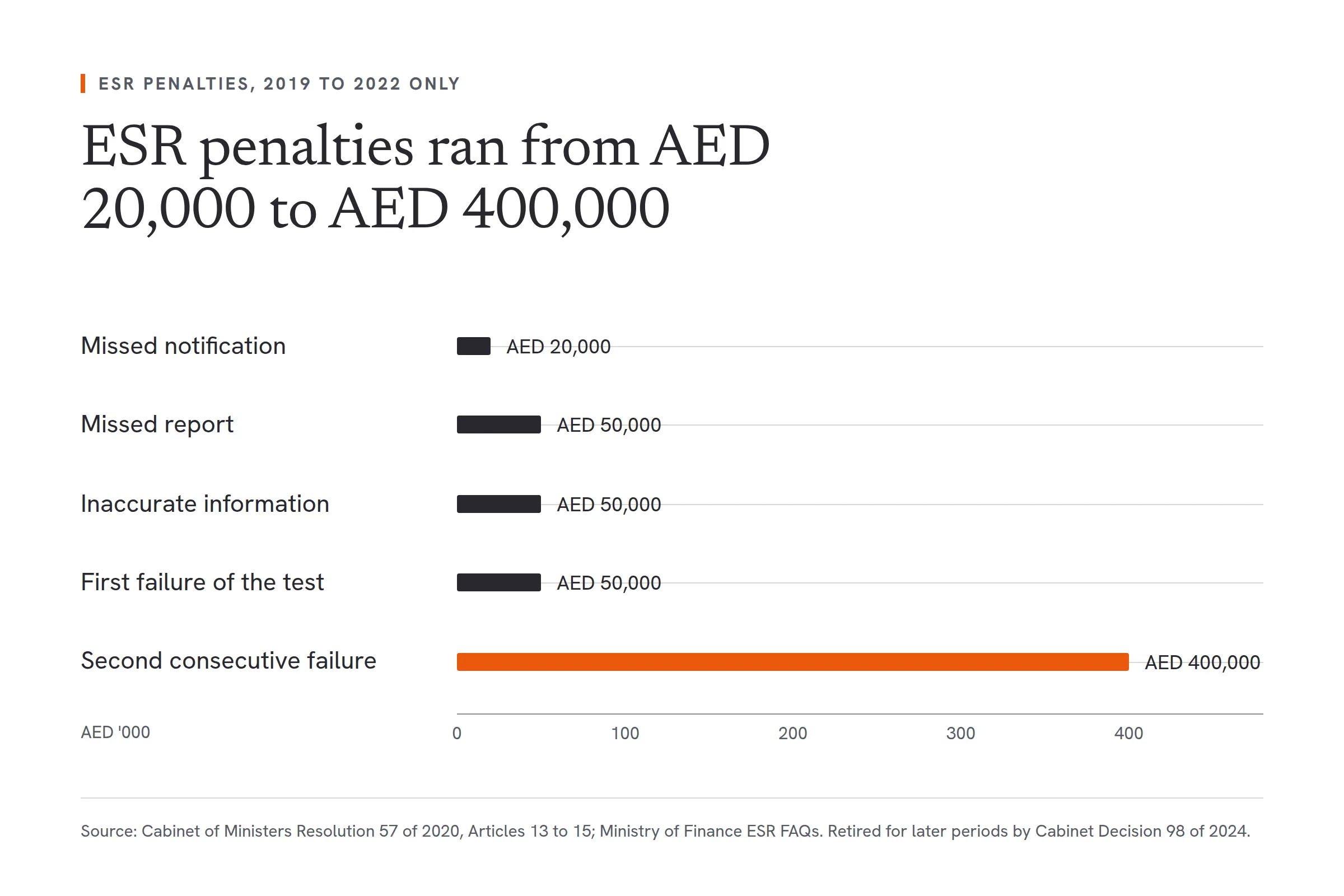
It helps to know what substance failures cost under the old regime. For the full framework, see our guide to the UAE economic substance test.
What a fractional executive does in a substance role
A fractional executive in a substance role is not a consultant who writes a report and disappears. They are a named, qualified officer of the business. They attend board meetings in person. They sign off on strategic decisions. They oversee the core income-generating activities and create the paper trail the FTA expects to see.
In practice, this breaks down into four areas.
Board attendance and governance. The fractional executive attends board and committee meetings as a principal, not an observer. That creates verifiable evidence of free zone decision-making. Minutes, signed resolutions and attendance records all join the substance file.
CIGA oversight. Depending on the qualifying activity, the executive manages or supervises the relevant function. They are not rubber-stamping. They are responsible for the activity the substance test examines.
Documentation and record-keeping. Substance is only as defensible as the evidence behind it. A fractional executive keeps board minutes, resolutions, management accounts and operational records in order and audit-ready. A QFZP must also prepare audited financial statements regardless of revenue and keep its records for seven years after the end of the tax period. That demands someone who knows what auditors look for.
Corporate tax filing support. QFZP returns require clear segregation of qualifying and non-qualifying income and transfer pricing documentation. A fractional Chief Financial Officer (CFO) or Chief Operating Officer (COO) who knows this from the inside is worth far more than an accountant who sees the business once a year.
One honest limit. The QFZP test looks for adequate qualified full-time employees in the free zone. A fractional executive strengthens governance, supervision and evidence. They do not on their own replace the team that performs the core activities. We recommend taking tax advice on how your structure is likely to be assessed.
This differs from what a business adviser or compliance firm does. We covered the distinction in our piece on fractional executive vs business adviser in Dubai.
Why fractional is the right model
The businesses we work with in this space are typically SMEs. They do not need a full-time CFO on a full senior salary. They need the expertise of one, at the frequency the substance obligation requires.
For context, a full-time SME Chief Financial Officer in the UAE commands a base salary of AED 61,000 to 92,000 per month, roughly AED 730,000 to 1.1 million a year, before bonus, benefits, visa and end-of-service. Our engagements typically run 30 to 60% less than a full-time hire.
A full-time senior hire to cover substance obligations is expensive, slow to onboard and often more than the role needs. A compliance firm will cover the documentation but will not attend your board meetings or take responsibility for CIGAs. A fractional executive sits in the gap: qualified, available and engaged at the right level.
Speed matters too. If your next corporate tax filing period is approaching and your substance position is uncertain, you cannot afford a three-month recruitment process. We explain how a fractional engagement is structured and delivered. For most substance-focused engagements, clients can be onboarded and hold a first documented board meeting within a few weeks of starting.
Matching the CXO profile to your qualifying activity
Not every executive profile fits every substance requirement. The person responsible for CIGAs should have genuine expertise in the relevant activity. Matching matters. Here is how we think about it:
Finance, treasury, holding and fund activities call for a Fractional CFO. If your qualifying income comes from financing, holding or treasury functions, the executive overseeing those CIGAs should have a credible financial background.
Distribution, logistics and manufacturing activities call for a Fractional COO. If you are distributing goods from a Designated Zone or operating logistics services, operational oversight is what the substance test is measuring.
Intellectual property, technology and R&D activities call for a Fractional CTO. If your qualifying income is IP-derived, the executive managing research, development and exploitation of that IP should have a technology leadership background.
Headquarters activities with people and workforce functions call for a Fractional CHRO. If your business operates as a regional headquarters with workforce coordination as a core activity, HR leadership is what the substance test will examine.
The FTA guide is explicit that substance must be adequate relative to the nature and size of the business. A holding company with a well-functioning board may meet the test through board decision-making alone. A logistics business with active CIGA employees needs demonstrably more. We can help you assess where you sit before an engagement, not after.
How the engagement works: from onboarding to first board meeting
For most SMEs, the process is straightforward.
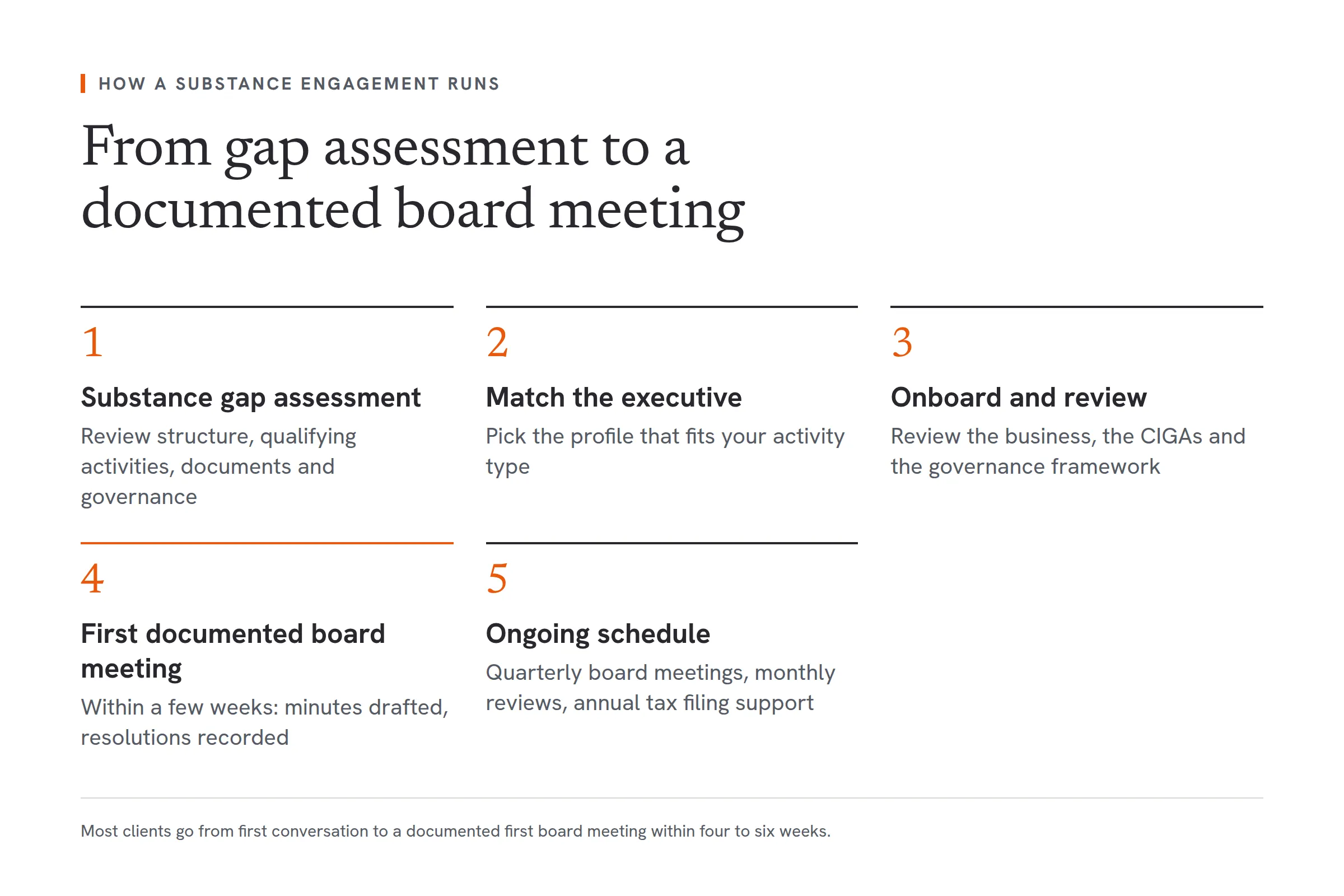
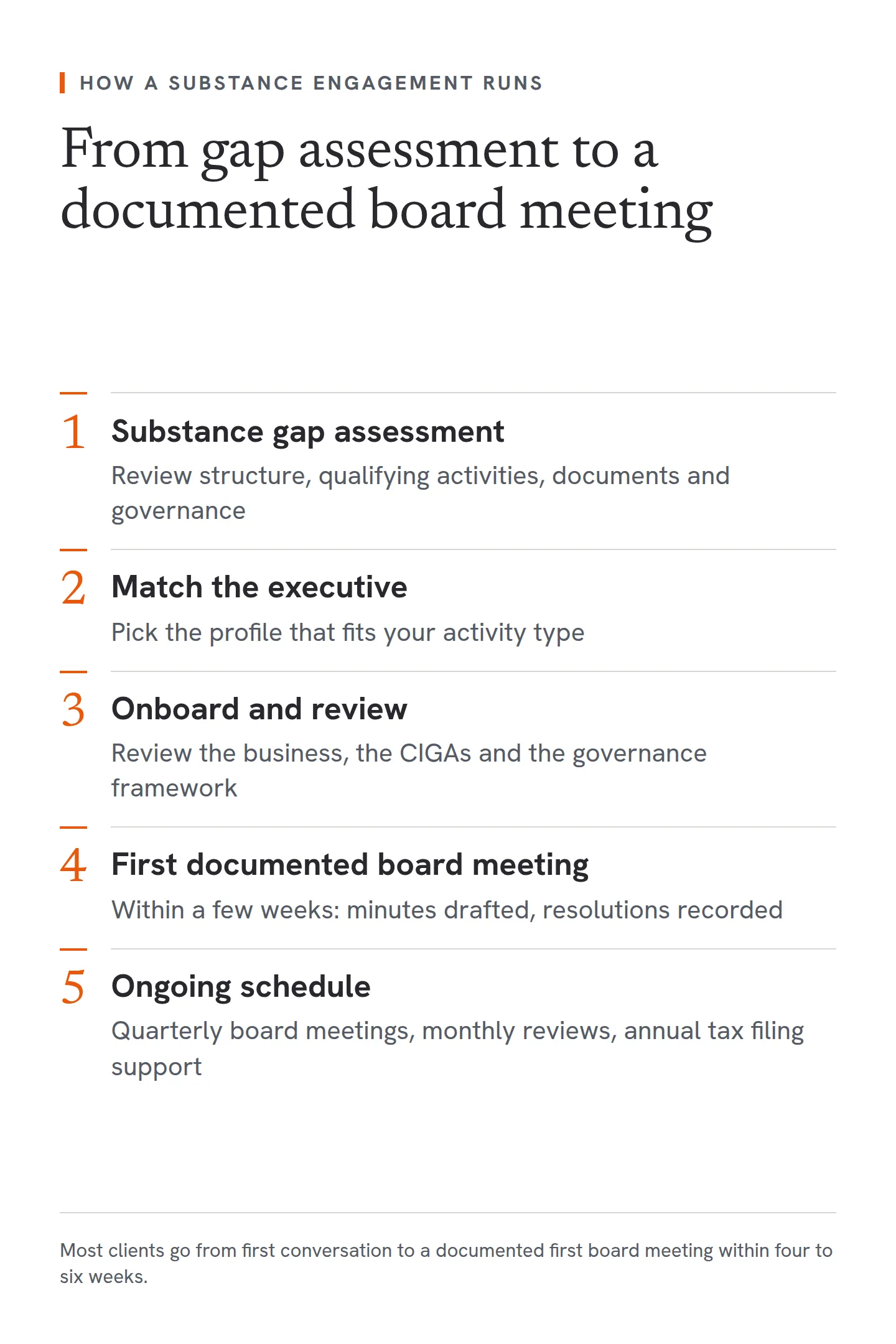
We start with a substance gap assessment. We look at your corporate structure, qualifying activities, existing documentation and governance arrangements. We identify what is missing and what the risk is. Most founders find this clarifying, even when some of it is uncomfortable.
From there, we match you with the right fractional executive for your activity type. They onboard quickly. They review the business, the relevant CIGAs and the governance framework. If board structure needs formalising, we help with that too.
Within a few weeks, the first properly documented board meeting takes place. Minutes are drafted, resolutions recorded and the paper trail begins. From that point, the engagement runs on a schedule that suits both the substance requirement and the business: quarterly board meetings, monthly management reviews, annual corporate tax filing support.
Take the readiness assessment
If you are not certain your substance position would survive an FTA review, find out before the FTA does.
Our Economic Substance Readiness Assessment takes around ten minutes and gives you a clear picture of where your gaps are, which executive profile fits your qualifying activity and what you need to do next.
If you would rather talk it through directly, contact the Fractional Dubai team. We work with free zone businesses across Dubai and the UAE to close substance gaps before they become corporate tax problems through our free zone substance and tax service.
Frequently asked questions
Has the old ESR regime been abolished? Do I still need to worry about substance?
The separate ESR filing requirement for financial years ending after 31 December 2022 was ended by Cabinet Decision 98 of 2024. The substance question did not disappear. Free zone businesses that want to keep the 0% rate as a QFZP must maintain adequate substance in the free zone under the Corporate Tax Law. Failing means losing QFZP status for the tax period and the following four.
What happens if my business fails the QFZP substance test?
If you fail any QFZP condition, including adequate substance, you cease to be a QFZP from the beginning of that tax period and for the following four tax periods. Your income is taxed under the standard Corporate Tax regime rather than the 0% rate on qualifying income. Your status is tested again from the sixth tax period. For a business with meaningful revenue, this is a serious financial consequence.
Can a fractional executive genuinely satisfy the substance requirement, or does it need to be a full-time hire?
A fractional executive can provide the board-level decision-making, CIGA supervision and documentation that evidence substance. The FTA's guide, however, looks for adequate qualified full-time employees in the free zone to perform the core income generating activities, so a fractional executive supports rather than replaces that team. We recommend taking legal or tax advice specific to your structure.
How quickly can a fractional executive engagement be set up?
Most clients go from initial conversation to documented first board meeting within four to six weeks. The process covers a substance gap assessment, executive matching, governance review and first meeting preparation. For businesses with an imminent filing deadline, this timeline can be accelerated.
Which fractional executive role is right for my qualifying activity?
The match depends on your qualifying activity. Finance, treasury and holding activities typically suit a CFO profile. Distribution, logistics and manufacturing suit a COO. IP and technology activities call for a CTO. Headquarters activities with people functions suit a CHRO. Our Economic Substance Readiness Assessment is a practical starting point.