In short: The Chief Marketing Officer (CMO) decides where marketing should take the business; the VP of Marketing gets it there. Hire for whichever half is missing.
A Chief Marketing Officer (CMO) sets marketing strategy and owns market positioning at board level. A VP of Marketing runs the department and delivers the plan.
Strategy unclear? You need a CMO. Strategy clear, delivery the problem? You need a VP.
Most founders we speak to use "CMO" and "VP Marketing" interchangeably. They're not the same thing. And that confusion leads to a very specific problem: you hire the wrong person, wonder why marketing isn't working, and assume marketing itself is broken.
It isn't. You just hired the wrong kind of leader.
Here's the plain version of how these two roles differ, and how to figure out which one your business actually needs right now.
What a CMO actually does
A CMO operates at company level, not department level. They sit at the board table, influence revenue strategy, and shape how the business positions itself in the market.
Day-to-day, a CMO is thinking about questions like: What markets should we be in? What does our brand stand for in Dubai versus the wider GCC? How does marketing tie directly to business growth? They own the marketing budget as an investment with a return, not just a spend line. They work alongside the CEO, CFO, and COO to make sure marketing decisions are grounded in commercial reality.
They're externally oriented. Competitors, market shifts, customer perception, brand equity. If your company is going through a repositioning, entering a new market, or trying to change how customers think about you, that's CMO territory.
The strategic CMO role we describe in our guide to fractional CMO leadership in Dubai is exactly this: executive-level marketing thinking that shapes commercial direction.
What a VP Marketing actually does
A VP of Marketing runs the marketing department. They're operationally focused. Campaigns, teams, tools, performance metrics, channel management. If your business needs someone to own the marketing calendar, manage a team of marketers, and make sure campaigns actually get executed properly, that's a VP.
They typically report either to a CMO or directly to the CEO in smaller companies. Their orientation is internal: managing people, hitting KPIs, overseeing agency relationships, keeping the machine running.
They're excellent at execution. Not necessarily at setting the direction in the first place.
The core difference
Strategic versus operational. External versus internal. Board-level versus department-level.
A CMO defines where marketing needs to go and why. A VP Marketing figures out how to get there and manages the people doing the work.
You can have both. In fact, in a well-structured marketing function, you'd have a CMO setting strategy and a VP Marketing executing it. But most Dubai SMEs can't afford both full-time. And honestly, most don't need both full-time.
| CMO | VP Marketing |
|---|---|---|
Focus | Strategy and brand direction | Campaigns and team management |
Reports to | CEO / Board | CMO or CEO |
Orientation | External (market, brand, growth) | Internal (team, execution, operations) |
Key output | Market positioning, revenue growth | Campaign delivery, marketing operations |
Stage fit | Repositioning, expansion, growth | Scaling execution, building marketing teams |
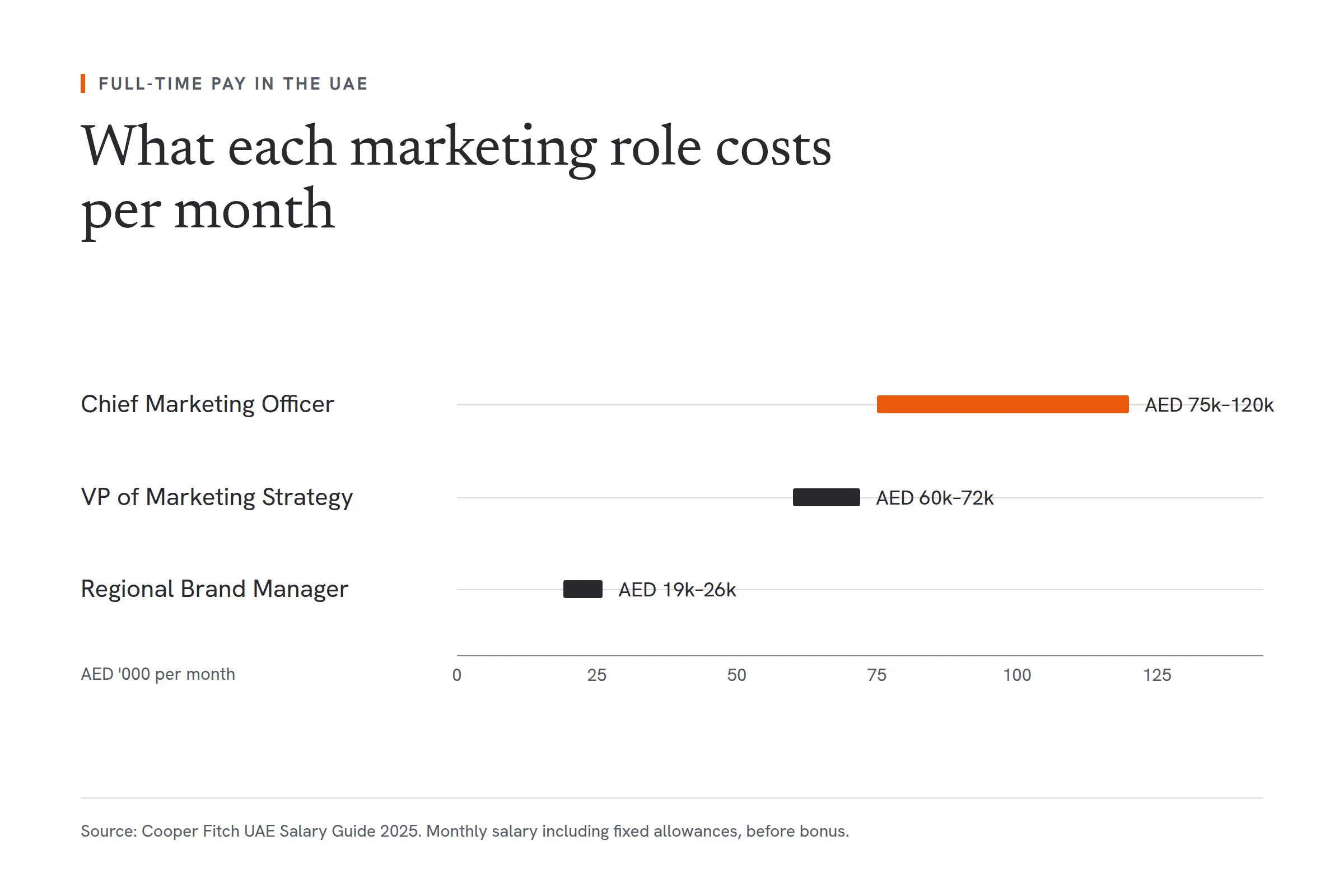
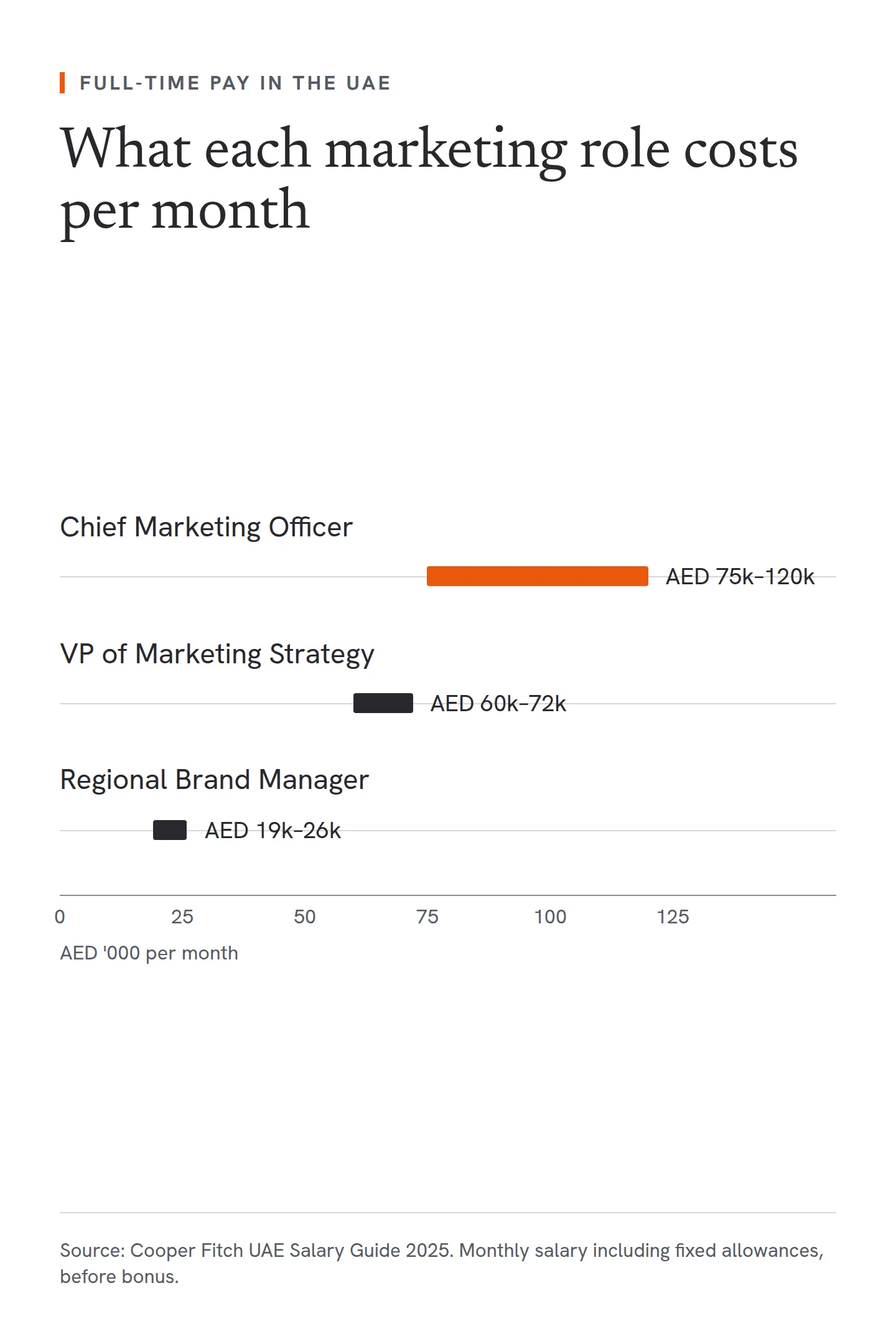
Typical full-time pay in the UAE (Cooper Fitch 2025, per month) | AED 75,000 to 120,000 | AED 60,000 to 72,000 (VP of Marketing Strategy) |
The pay row comes from Cooper Fitch's UAE Salary Guide 2025, which quotes monthly salary including fixed allowances and excluding bonus. It lists CMOs at AED 75,000 to 120,000 a month for B2B businesses and AED 85,000 to 120,000 for B2C, and VPs of Marketing Strategy at AED 60,000 to 72,000 in both. The guide doesn't break marketing roles out by company size, so SMEs may land lower. The gap between the two titles is narrower than many founders expect. That's one reason a full-time CMO plus a full-time VP rarely makes sense below enterprise scale.
When you need a CMO
You need CMO-level thinking when marketing has a strategic problem, not an execution problem.
Signs you need a CMO: your brand feels unclear or inconsistent, you're not sure how to position against competitors, you're expanding into new markets in the UAE or region, or leadership decisions lack any marketing voice. Revenue is stalling and you suspect it's a positioning issue rather than a campaign issue.
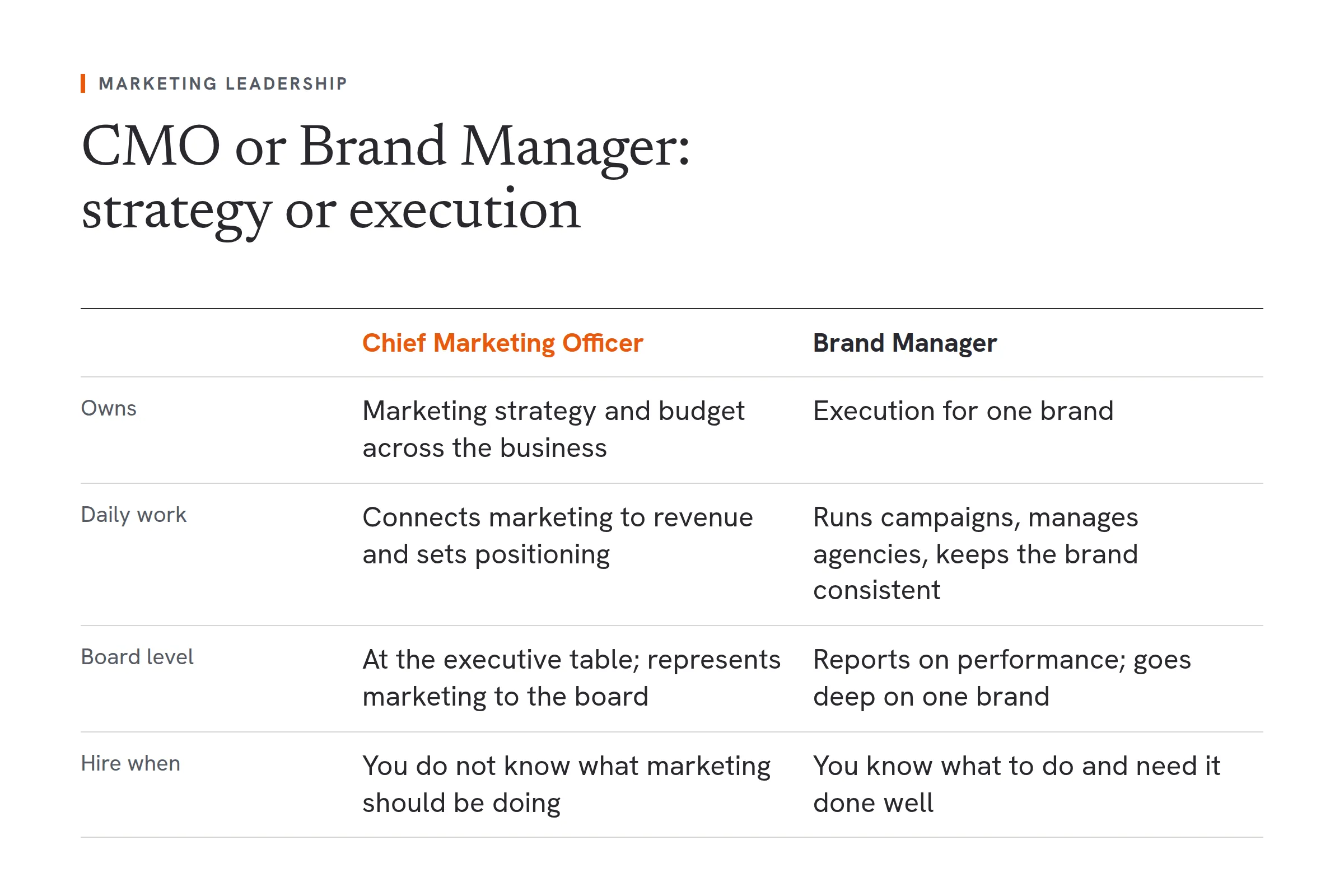
Dubai's market is particularly demanding here. You're marketing to a genuinely multicultural audience: Emirati, South Asian, Western expat, Arab regional. Getting positioning right in that context requires someone who's done it before at a strategic level, not someone who's good at running Google Ads. If the gap is brand execution rather than department leadership, see CMO vs Brand Manager.
You can explore fractional CMO services as a practical entry point. Seasoned CMO-level thinking without a full-time hire.
When you need a VP Marketing
You need VP-level leadership when execution is the problem.
Signs you need a VP Marketing: you have a clear strategy but campaigns are inconsistent or poorly managed, your marketing team is growing and needs proper leadership, you're spending on agencies without coherent oversight, or marketing operations feel chaotic.
This is common in businesses that have been founder-led on marketing. The strategy is in the founder's head. It just needs someone to systematise and execute it. A VP Marketing can do that.
If you're not sure which gap you actually have, the fractional CMO readiness assessment will help you work it out.
What has changed in 2026
Three developments sharpen the line between the two roles.
AI makes the budget decision strategic. Gartner's 2026 CMO Spend Survey found CMOs allocating an average of 15.3% of marketing budgets to AI, while only 30% report mature AI readiness. Its 401 respondents are mostly at companies above USD 1 billion in revenue in North America, the UK and Europe, so read it as direction, not a Dubai SME benchmark. The split of roles is the useful part. The CMO decides where AI belongs in the strategy and the budget. The VP makes it work in the team's daily routine.
Social advertising needs a permit. Since 1 February 2026 the UAE Media Council requires an Advertiser Permit for anyone advertising on social media from within the UAE, paid or unpaid, and organisations must verify that the advertisers they work with hold one. Setting the creator and influencer policy is a CMO call. Running the checks, contracts and approvals is VP-level operations.
Independent leadership is now mainstream. Heidrick & Struggles' 2026 Talent Lens Survey found small and medium companies account for more than four-fifths of client demand for interim talent, and that 42% of projects now last longer than six months, up from 27% in 2021. The respondents are 3,810 independent professionals, mostly in North America, so it describes the global model, not the UAE specifically. It does show that part-time senior leadership is a normal choice for companies of your size.
What most Dubai SMEs actually do
Most SMEs we speak to are in one of two situations.
The first: they've been running without any senior marketing leadership at all. In that case, you almost always need CMO thinking first. Before you build a team and execute campaigns, you need to know what you're actually saying and to whom. We see this repeatedly with SMEs that have outgrown founder-led marketing but can't yet justify a full-time CMO salary.
The second: they have a decent marketing team but it's running without clear strategic direction. Again, CMO-level work first.
The fractional model is well-suited to both. Rather than committing to a full-time CMO at the salaries above, a fractional CMO gives you genuine senior marketing leadership a few days a week, and our engagements typically run 30 to 60% less than a full-time hire. When the strategy is clear and execution becomes the priority, you can add a VP-level operator.
Our guide to fractional CMO leadership in Dubai goes deeper on how this model typically runs in practice.
The honest answer
For most Dubai SMEs reading this, the real question isn't CMO versus VP Marketing. It's whether you need strategic marketing leadership at all right now, or whether you need someone to manage campaigns you already know how to run.
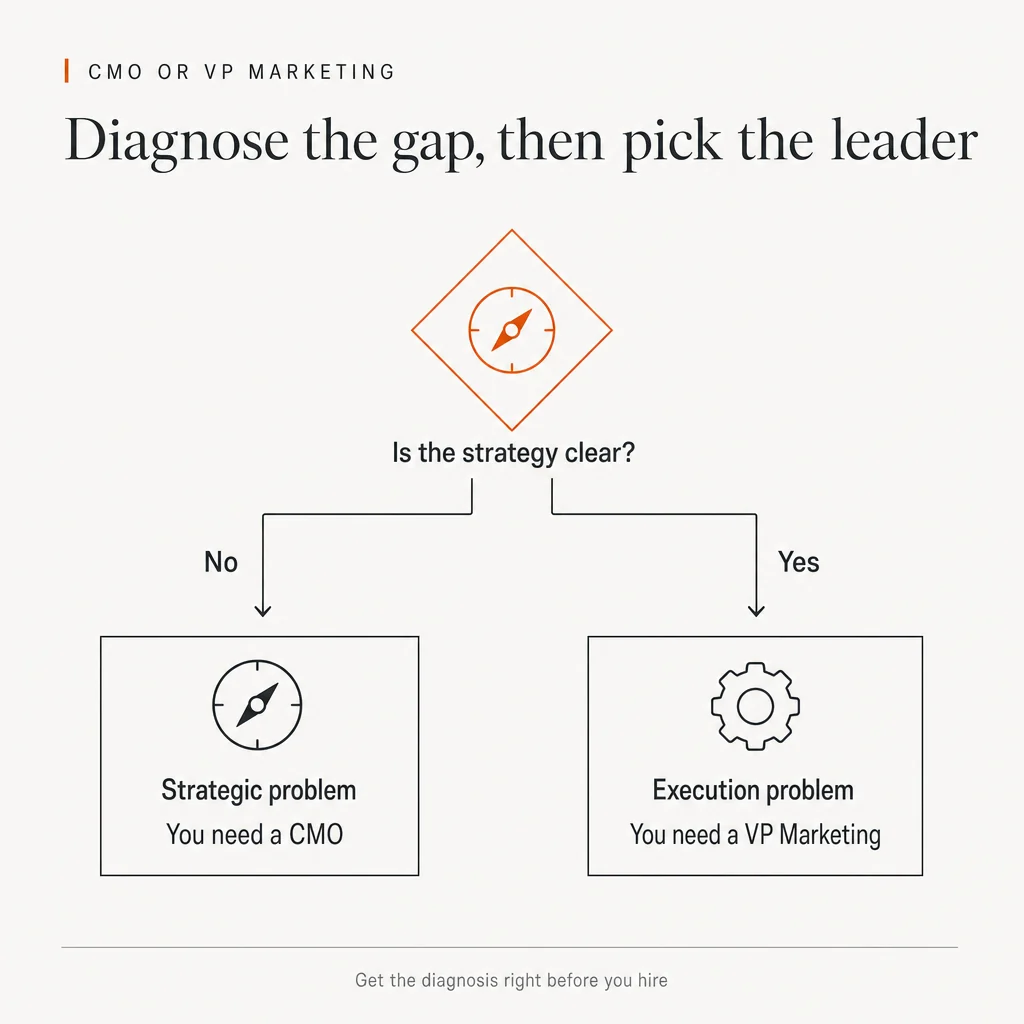
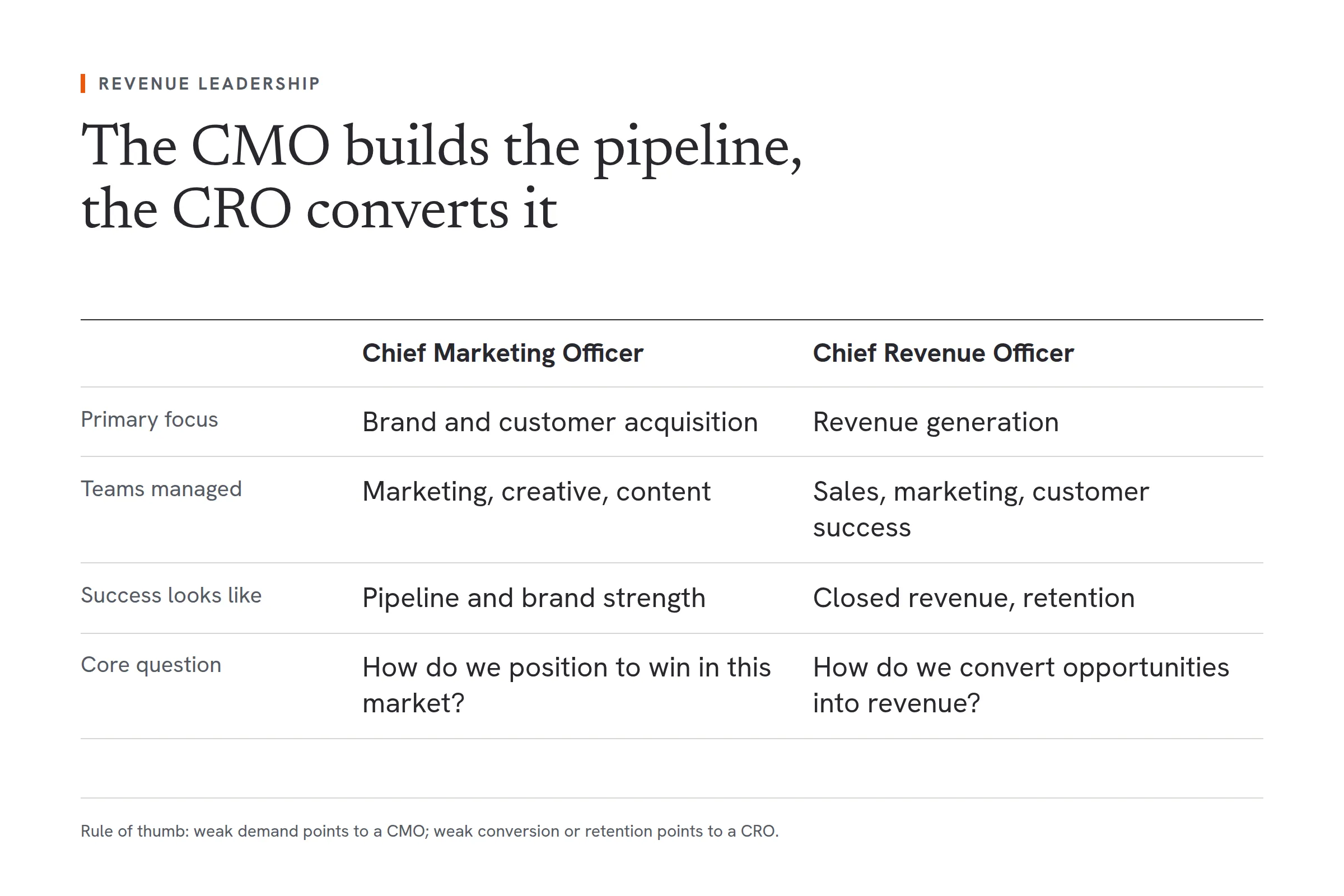
If you're unsure what marketing should be doing for your business, that's a CMO problem. If you know exactly what needs doing but no one's doing it well, that's a VP problem. When the constraint is revenue conversion rather than positioning, read CMO vs CRO before you commit to a hire.
Get the diagnosis right before you hire. It'll save you a lot of expensive mistakes. New to fractional leadership? Start with what fractional leadership means for UAE businesses.
Ready to work out which type of marketing leadership your business actually needs? Talk to the Fractional Dubai team and we'll help you figure it out quickly.
FAQs
Can a VP Marketing do a CMO's job in a small business? Sometimes, in early-stage companies where strategy is relatively simple. But as soon as you face a real positioning decision, brand challenge, or market expansion, you'll feel the gap. VP Marketing and CMO are genuinely different skill sets; one doesn't automatically contain the other.
Do I need both a CMO and a VP Marketing? Most Dubai SMEs don't need both full-time. A fractional CMO setting strategy combined with a strong VP or Head of Marketing handling execution is a very cost-effective structure for growing businesses.
What's the difference between a Head of Marketing and a VP Marketing? Largely seniority and scope. In practice, Head of Marketing and VP Marketing often describe the same operational role, particularly in companies without a CMO layer. The title matters less than whether the person has strategic authority or is primarily an operator.
How do I know if my marketing problem is strategic or operational? If you could give your marketing team a clear brief tomorrow and they'd know exactly what to do, it's an operational problem. If you don't know what the brief should say, that's a strategic problem and you need CMO-level help first.